-
E-mail
1485311053@qq.com
-
Phone
13806142315
-
Address
27 Hongshan Road, Jintan District
Changzhou Jintan Taina Instrument Factory
Calibration and Calibration of Infrared CO/CO ₂ Analyzer: Key Steps to Ensure Accuracy of Detection Data
Date: 2025-11-20Read: 96
Infrared CO/CO ₂ analyzer is a core equipment for monitoring the concentration of carbon monoxide (CO) and carbon dioxide (CO ₂), widely used in indoor air quality detection, industrial combustion optimization, and environmental emission monitoring. Its detection accuracy directly affects human health assessment (such as CO poisoning risk) and energy efficiency management (such as boiler combustion efficiency), and calibration and calibration are the core links to ensure data accuracy.
1、 The necessity of calibration and calibration:
Infrared CO/CO ₂ analyzerBased on the principle of gas absorption at specific infrared wavelengths (CO corresponds to 4.65 μ m, CO ₂ corresponds to 4.26 μ m), the sensitivity of the sensor will gradually decrease due to environmental temperature fluctuations, light source aging, or filter contamination during long-term use, resulting in measurement deviation. For example, in low temperature environments during winter, the detector response speed slows down, which may result in lower CO readings; The high dust environment in industrial sites can accelerate filter pollution, resulting in higher CO ₂ measurement values. In addition, the internal circuit parameters of the instrument may drift (such as amplifier gain changes) after transportation, storage, or prolonged idle time, further affecting data reliability. Therefore, regular calibration is the key to correcting these deviations.
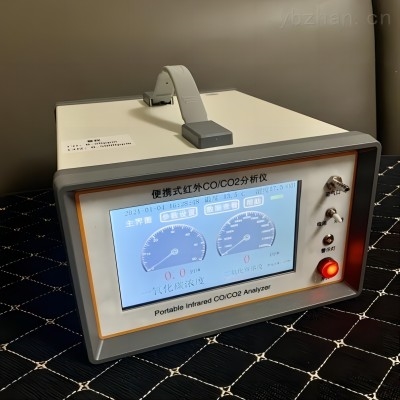
2、 Core steps of calibration and calibration:
Preparation work: Select calibration gases that meet national standards (such as CO standard gases: 0ppm, 50ppm, 100ppm; CO ₂ standard gas: 0ppm, 400ppm, 1000ppm), ensuring gas purity>99.99% and stable pressure (usually 0.1-0.3MPa). Before calibration, place the instrument in a standard environment (temperature 20-25 ℃, humidity 40% -60%) and let it stand for 2 hours to achieve thermal equilibrium of the internal components.
Zero point calibration: Introduce zero point gas (such as pure nitrogen or catalytically treated air, ensuring CO/CO ₂ concentration<1ppm), adjust the instrument display value to 0 (or the allowable error range close to 0, such as ± 1ppm). This step is used to eliminate background interference (such as sensor zero drift or environmental gas residue).
Range calibration: sequentially introduce standard gases of different concentrations (such as CO 50ppm, 100ppm); CO ₂ 400ppm, 1000ppm), after the reading stabilizes (usually takes 30-60 seconds), compare the instrument display value with the nominal value of the standard gas. If the deviation exceeds the allowable range (usually CO ± 2% FS, CO ₂ ± 1% FS), adjust the gain coefficient through the internal calibration menu of the instrument (such as inputting the standard value and letting the instrument automatically calculate the correction parameter) until the displayed value is consistent with the standard value.
3、 Calibration cycle and maintenance:
General adviceInfrared CO/CO ₂ analyzerPerform routine calibration every 3 months (for low precision scenarios of indoor air quality monitoring) or high-precision calibration every 1-2 months (such as industrial combustion control or environmental law enforcement). For instruments that operate continuously for a long time (such as power plant flue gas online monitoring systems), it is necessary to increase the calibration frequency (weekly fast zero calibration+monthly full-scale calibration). In addition, data (such as calibration time, standard gas concentration, instrument display value, and correction factor) should be recorded after each calibration, and a "calibration file" should be established to predict the degree of sensor aging through trend analysis (if the deviation increases after multiple consecutive calibrations, it indicates the need to replace the sensor).
Through strict calibration and calibration processes, the infrared CO/CO ₂ analyzer can control measurement errors within ± 1% (high-precision scenarios), providing solid data support for human health protection, industrial energy efficiency improvement, and environmental compliance.