-
E-mail
2850687958@qq.com
-
Phone
13538469076
-
Address
Dongcheng Lixin Jinhui Industrial Park, Dongguan City, Guangdong Province
Guangdong Aisili Testing Instrument Co., Ltd
Working principle and usage method of high and low temperature testing machine
Date: 2025-10-13Read: 9
High and low temperature testing machine is a widely used testing equipment in scientific research, industrial production and other fields. It can simulate different high and low temperature environments and provide strong support for product performance testing. Below is a detailed introduction to its working principle and usage method.
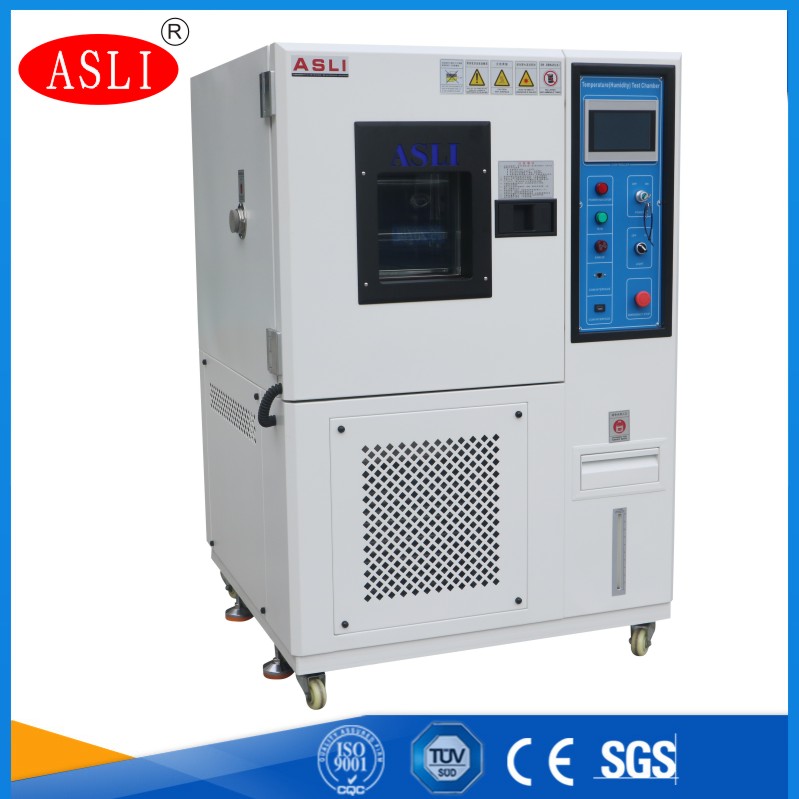
working principle
The high and low temperature testing machine is mainly based on the basic principles of heat exchange and temperature control to achieve accurate simulation of the test environment temperature.
1. Refrigeration system: The refrigeration system is a key component for achieving a low-temperature environment. It usually adopts a vapor compression refrigeration cycle, mainly composed of components such as compressor, condenser, throttling device, and evaporator. The compressor compresses low-temperature and low-pressure refrigerant gas into high-temperature and high-pressure gas, and then discharges it into the condenser. In the condenser, refrigerant gas dissipates heat to the surrounding environment, gradually cooling and condensing into high-pressure liquid. Next, the high-pressure liquid passes through the throttling device, and after throttling and pressure reduction, it becomes a low-temperature and low-pressure liquid that enters the evaporator. In the evaporator, the low-temperature and low-pressure refrigerant liquid absorbs heat from the surrounding air and evaporates, thereby reducing the temperature inside the test chamber. By controlling the flow rate and evaporation rate of the refrigerant, the low-temperature environment inside the test chamber can be precisely adjusted.
2. Heating system: The heating system is used to achieve a high-temperature environment. Generally, electric heating elements such as resistance wires are used. When it is necessary to increase the temperature inside the test chamber, the electric heating element is energized through the control system, and the current generates heat through the resistance wire. The heat is transferred to the test chamber through air convection and thermal radiation, causing the temperature inside the chamber to rise. The control system can accurately control the heating power of the heating element according to the set temperature value to achieve and maintain the required high temperature environment.
3. Temperature control system: The temperature control system is the core control part of the high and low temperature testing machine, which can accurately adjust and control the temperature inside the testing chamber. The system mainly consists of temperature sensors, controllers, and actuators. The temperature sensor monitors the temperature inside the test chamber in real time and converts the temperature signal into an electrical signal to transmit to the controller. The controller compares the received temperature signal with a pre-set temperature value and outputs a control signal to the actuator based on the comparison result. The actuator adjusts the working state of the refrigeration system or heating system according to the control signal, so as to stabilize the temperature inside the test chamber near the set value.
Instructions for use
1. Preparation before the experiment
-Location selection: The high and low temperature testing machine should be placed on a dry, well ventilated, and level ground to ensure sufficient space around the equipment for heat dissipation and operation. At the same time, it is necessary to avoid direct sunlight and strong electromagnetic field interference on the equipment.
-Equipment inspection: Before use, a comprehensive inspection of the equipment is required. Check if the power supply circuit is connected properly and if any components are damaged or loose. Check if there are any leaks in the pipelines of the refrigeration and heating systems, and if the water level in the water tank is within the normal range. Also, check if the temperature sensor and other control components are functioning properly.
-Set test parameters: According to the test requirements, set the temperature range, heating rate, cooling rate, insulation time and other parameters for the test on the controller. For example, if you want to test the performance of a product in an environment of -20 to 80 degrees Celsius, you need to accurately set these two temperature values on the controller, as well as the speed of heating and cooling, and the holding time at each temperature point.
2. Sample placement and test initiation
-Sample placement: Place the samples to be tested in a reasonable manner on the sample rack inside the testing chamber. Pay attention to maintaining a certain distance between samples to avoid obstructing each other and affecting air circulation and temperature uniformity. For some special samples, special fixing methods may be required to ensure the stability of the samples during the testing process.
-Start test: After confirming that the sample is placed correctly and the parameter settings are correct, close the test chamber door, press the start button, and the equipment will start running according to the set parameters. At this point, the refrigeration or heating system begins to operate, and the temperature inside the test chamber gradually changes towards the set value.
3. Monitoring of the experimental process
-Temperature monitoring: During the experiment, closely monitor the temperature data displayed on the controller to ensure that the temperature inside the test chamber changes according to the set parameters. If abnormal temperature fluctuations or deviations from the set value are found, the operation of the equipment should be checked in a timely manner, which may be due to malfunctions in the refrigeration system, heating system, or temperature control system.
-Observing the state of the sample: Regularly observe the changes in the state of the sample under different temperature environments through the observation window of the test chamber. For example, whether there is any deformation, cracking, discoloration, etc., and keep records. This is crucial for evaluating the performance changes of products in high and low temperature environments.
4. End of experiment and equipment maintenance
-Test completion operation: When the test reaches the set time or all test steps are completed, press the stop button to stop the equipment from running. After the temperature inside the test chamber returns to near room temperature, open the test chamber door and take out the sample.
-Equipment maintenance: After the experiment is completed, the equipment should be cleaned and maintained. Clean the debris and dust inside the test chamber, and wipe the inner wall of the test chamber with a clean damp cloth. Regularly check the operation of the refrigeration system and heating system, such as the pressure of the refrigerant and the performance of the heating elements. At the same time, regular maintenance should be carried out according to the equipment's user manual, such as replacing filters, adding lubricating oil, etc., to ensure the normal operation of the equipment and extend its service life.