-
E-mail
51037070@qq.com
-
Phone
18028963555
-
Address
Room 113, Building 1, No. 3 Shugang Avenue, Hongmei Town, Dongguan City, Guangdong Province
Guangdong Derui Testing Equipment Co., Ltd
GB/T 2423 Thermal Shock Test Standard
Date: 2025-12-03Read: 9
In the field of environmental reliability testing, temperature change testing is a fundamental and important evaluation method. Among them, the thermal shock test, as the main method for simulating harsh temperature conversion conditions, is widely used in industrial product development and quality control. The relevant parts of the GB/T2423 series of standards provide systematic specifications for the conditions, equipment, procedures, and judgment requirements of thermal shock testing.
Compared with other temperature testing methods, the core feature of the cold and hot shock test is its rapid temperature change ability. Ordinary high and low temperature tests are usually conducted at a relatively slow rate of temperature rise and fall, such as 1-3 degrees Celsius per minute, mainly used to examine the adaptability and material stability of products in temperature gradient environments. The cold and hot shock test emphasizes the strict temperature conversion speed, requiring the sample to be exposed to vastly different high and low temperature environments in a short period of time, with the conversion time generally controlled within a few minutes or even shorter. This method focuses more on testing whether the internal structure, welding points, components, and material interfaces of the product will crack, detach, or fail in performance when subjected to drastic temperature changes.
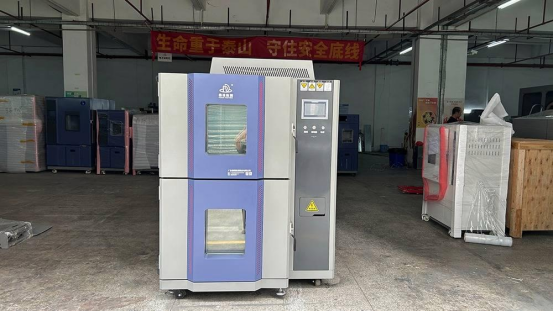
The thermal shock test specified in GB/T2423 standard is usually conducted using the two box method or the three box method. The two box method includes a high temperature box and a low temperature box, and the test sample is quickly moved between the two boxes through a transfer device; The three box rule has a high temperature zone, a low temperature zone, and a normal temperature zone, which can reduce the impact of temperature fluctuations on the sample to a certain extent. This design approach differs significantly from experimental methods such as constant humidity and heat, temperature and humidity cycling. For example, the wet heat test mainly examines whether products undergo corrosion, insulation degradation, and other issues in high temperature and high humidity environments. Its focus is on the dual effects of humidity and temperature, rather than the physical impact caused by temperature fluctuations.
From the perspective of applicable objects, this standard covers a wide range of products, including electronic components, circuit boards, metal materials, plastic products, and various industrial products. Compared with other industry standards or enterprise customized testing methods, the advantage of GB/T2423 lies in its universality and processability. It not only specifies the specific parameters of the experiment, such as temperature range, residence time, cycle times, etc., but also puts forward unified requirements for the calibration of the testing equipment, the installation method of the samples, and the evaluation of the results, thus making the test results comparable between different laboratories. This is particularly important for some large manufacturing enterprises or multinational supply chains, as it helps all parties establish a commonly recognized quality verification language.

It is worth noting that although the cold and hot shock test is rigorous, the experimental conditions still need to be scientifically and reasonably set. The standard recommends that users determine testing parameters based on the actual usage environment of the product to avoid over testing or under testing. For example, thermal shock testing for automotive electronic components may require a wide temperature range (such as -40 ° C to+125 ° C), while general consumer products may only need to be tested between 0 ° C and 70 ° C. This flexibility enables standards to meet the needs of fields such as aerospace and engineering, as well as for quality verification of ordinary civilian products.
In terms of cost, implementing the GB/T2423 cold and hot shock test requires the investment of corresponding equipment resources. The price of a standard cold and hot shock test chamber usually ranges from tens of thousands to hundreds of thousands of RMB, depending on the temperature range, conversion time, and box capacity. Compared to ordinary high and low temperature chambers, the technical complexity of cold and hot shock equipment is higher, especially with more stringent requirements for temperature recovery time and stability. Enterprises need to comprehensively consider their own product requirements and resource conditions when selecting testing plans. For some small and medium-sized enterprises, it is common practice to entrust qualified third-party testing agencies to conduct experiments.

From the perspective of technological development trends, the standards for thermal shock testing are constantly being revised and improved. Compared with earlier versions, the current standard further refines the criteria for judging temperature stability, guiding principles for sample installation, and requirements for environmental testing equipment. These revisions reflect the more complex scenarios that industrial products face in practical applications, as well as the ongoing pursuit of testing repeatability and reliability by standard setting organizations.
Overall, the GB/T2423 thermal shock test standard provides a scientific and unified performance verification method for various products under rapidly changing temperature environments. It complements other environmental testing methods and together forms an important foundation for the reliability evaluation of industrial products. By applying this standard reasonably, enterprises can timely detect design defects during the research and development stage, improve the overall quality level of products, and provide the market with more durable and reliable products.