-
E-mail
19175269088@163.com
-
Phone
15876446198
-
Address
Room 102, Building 1, No. 101 Zhongxin Road, Changping Town, Dongguan City, Guangdong Province
About Us
Guangdong Haotian Testing Instrument Co., Ltd
Date: 2025-09-02Read: 5
In the industrialization process of solid-state batteries, reliability verification at temperature is the core bottleneck that restricts mass production. The 480Wh/kg high-energy density solid-state battery developed by a domestic new energy enterprise has a reliability verification cycle of up to 120 hours due to the inability of traditional testing equipment to match the wide temperature range requirements of -40 ℃ to 150 ℃, which seriously hinders the progress of mass production. Introducing Guanghao TianThermal Shock ChamberLater, by accurately simulating the high and low temperature cycling environment, not only did we overcome the difficulty of testing the electrolyte interface stability of solid-state batteries, but we also increased the efficiency of single batch testing by 50%, becoming a key driver for accelerating the commercialization of solid-state batteries.

The ordinary high and low temperature box previously used by the enterprise had defects such as a temperature change rate of less than 10 ℃/min and a conversion time of more than 30 seconds, which made it impossible to reproduce the sudden temperature changes of solid-state batteries in scenarios such as start stop and fast charging of new energy vehicles, resulting in abnormal increase in interface impedance and rapid capacity decay after battery installation. In response to this pain point, Guanghaotian has customizedThermal Shock ChamberIt has a wide temperature range of -60 ℃ to 180 ℃, with a temperature rate of 40 ℃/min and a high and low temperature conversion time of ≤ 3 seconds. It covers the full scenario testing requirements of solid-state batteries from starting in extremely cold areas to high temperature fast charging, and meets the supporting requirements of 120 ℃ vacuum drying weight loss rate detection in the "Determination Method for All Solid State Batteries".

In terms of optimizing the testing process, GuanghaotianThermal Shock ChamberInnovation adopts the "three-stage cyclic testing method": first, accelerate aging for 8 hours in a high temperature zone of 150 ℃, simulating the accumulation of thermal stress after long-term fast charging of the battery; Reduce the temperature to -40 ℃ at a rate of 40 ℃/min and monitor the low-temperature discharge performance for 2 hours; Finally, the evolution of microcracks at the interface between the solid electrolyte and the electrode was captured through 500 cycles of impact. The device is equipped with a 24 channel synchronous testing module, which can simultaneously collect voltage, capacity, and impedance parameters of 32 soft pack batteries. The data sampling frequency reaches 200 sets per second, which is 300% higher than the testing capacity of traditional equipment with a single batch of 8 batteries.
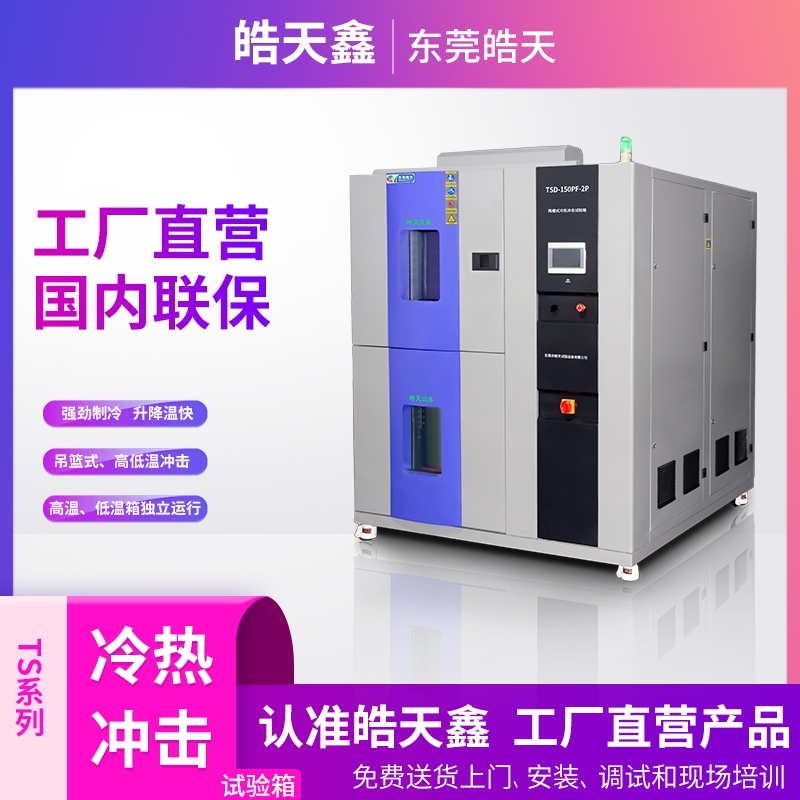
Relying on the temperature control accuracy of ± 0.3 ℃ and temperature uniformity of ± 0.8 ℃ in the Guanghao Tian cold and hot shock box, the enterprise has successfully identified the problem of a sudden drop in ion conductivity of sulfide electrolytes below -20 ℃. By adjusting the ratio of Li7La3Zr2O12 ceramic powder, the low-temperature capacity retention rate of the battery was increased from 65% to 88%, and the interface impedance was reduced by 42%. More importantly, the testing cycle has been compressed from 120 hours to 60 hours, resulting in a 50% increase in single batch testing efficiency. An additional 48 batches of validation can be completed annually, reducing research and development costs by 22%.
The Guanghao Tian cold and hot shock box not only provides accurate testing tools for the reliability verification of solid-state batteries, but also helps enterprises build a verification system that meets international standards through customized temperature curve programming, full cycle data tracing and other functions, laying a solid foundation for the large-scale application of solid-state batteries in new energy vehicles and energy storage fields.