-
E-mail
ztwang@max-ray.net
-
Phone
13033093091
-
Address
Room 713 and 711, Building A3, Zhong'an Chuanggu, No. 900 Wangjiang West Road, High tech Zone, Hefei City
Hefei Mairui Optoelectronic Technology Co., Ltd
The working principle and application fields of fiber lasers
Date: 2025-09-19Read: 9
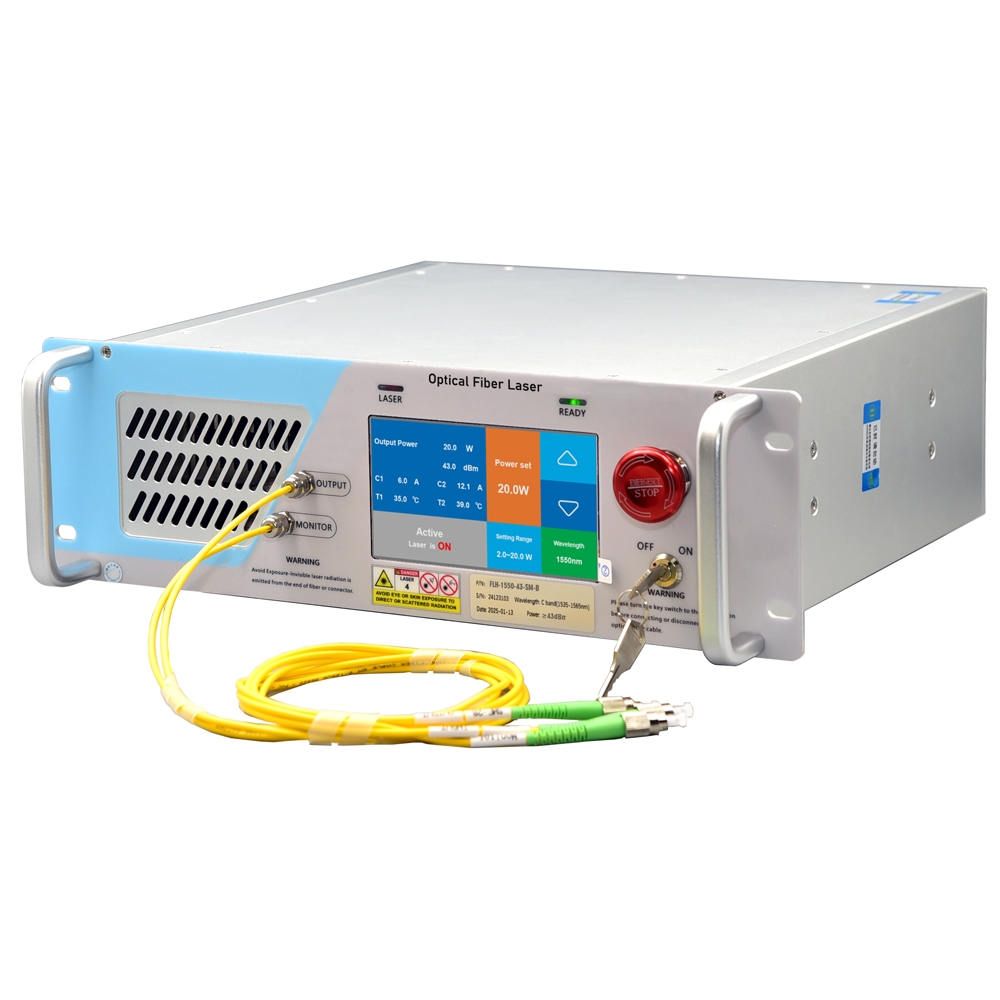
Fiber laser is a type of fiber based laser that utilizes rare earth metal ions (such as erbium, thulium, ytterbium, etc.) in the fiber as gain media to achieve laser output through fiber excitation. Compared with traditional solid-state lasers and gas lasers, it has the characteristics of small size, high efficiency, and excellent beam quality, and has been widely used in industrial, medical, communication, and other fields.
1、 Working principle
fiber laserThe core part is the fiber optic gain medium. The gain medium is usually an optical fiber doped with rare earth metal ions, such as erbium-doped fiber. The working principle can be divided into the following steps:
1. Pump light source: An external pump light source is required, usually using a diode laser as the pump source, to couple the light emitted into the gain fiber. The wavelength of the pump light source usually matches the absorption peak of the gain medium.
2. Fiber gain medium: Photons pumped by the light source are absorbed by rare earth metal ions (such as erbium ions) in the fiber, causing them to transition from the ground state to the excited state. Excited ions have high energy and can generate spontaneous and stimulated radiation.
3. Stimulated radiation and laser amplification: High energy ions in the gain medium undergo stimulated radiation phenomena after colliding with other photons, where one photon causes the emission of a photon of the same frequency, phase, and direction, forming a laser. When this stimulated radiation wave interacts with the internal reflection surface of the fiber in the gain medium, the laser is amplified.
4. Laser output: After multiple interactions with light in the reflection and gain medium, the energy of the light wave gradually increases, and finally forms a high-energy laser beam through the output port of the optical fiber.
2、 Application Fields
1. Industrial processing: Fiber lasers are widely used in industrial fields such as metal cutting, welding, engraving, and surface treatment. Due to its high power, high efficiency, and precise beam quality, it has become an important tool in modern manufacturing. For example, it can be used for precision cutting of thin plates, sheet metal, and thick metal parts, and can also achieve laser marking and laser drilling.
2. In the field of communication, it has important applications in fiber optic communication. Due to its high output power, low noise, and good modulation characteristics, it can improve the signal transmission quality and bandwidth of communication systems. Especially erbium-doped fiber amplifiers (EDFAs) can achieve signal amplification and lossless transmission in long-distance fiber optic communication, and are key components in modern fiber optic communication systems.
3. Medical field: Used for laser therapy and diagnosis in healthcare. For example, laser surgery can use high-precision lasers to cut or burn tissues, treating diseases such as ophthalmology and dermatology. In addition, it is also applied in laser vascular therapy, tumor treatment, endoscopic examination, etc.
4. Scientific research: It is also used in various scientific experiments, such as laser spectroscopy, quantum experiments, nonlinear optics research, etc. Due to its stability and adjustability, it has been widely used in high-precision experiments.
Overall, fiber lasers have become important equipment in modern technology due to their high efficiency, high beam quality, and broad application prospects. With the development of technology, its performance continues to improve. In the future, it will develop towards higher power, smaller size, better stability, and higher efficiency.