-
E-mail
qingqingshi@email.acrel.cn
-
Phone
18706162823
-
Address
No. 5 ASEAN Road, ASEAN Industrial Park, Nanzha Town, Jiangyin City, Jiangsu Province
About Us
Jiangsu Ankerui Electric Appliance Manufacturing Co., Ltd
Date: 2020-08-20Read: 22
Summary:Cement enterprises are one of the high energy consuming industries in China and have always been the target of government control in promoting energy conservation and emission reduction. Establish an enterprise energy management system to achieve automated and scientific management of the entire process from energy factor collection, process monitoring, and energy consumption management control. Increasing the rational use of energy and reducing energy consumption play a crucial role in the development of cement enterprises.
key word:Energy Management Energy Factor System Design System Architecture
1 Overview
Cement enterprises are one of the high energy consuming industries and have always been the target of government control in promoting energy conservation and emission reduction. Cement production has a high dependence on energy consumption, accounting for 40% -60% of the production cost and 7% -8% of the total energy consumption. Building a centralized and unified energy management system can enable online collection, calculation, analysis, and processing of energy data, thereby optimizing and integrating aspects such as energy material balance, scheduling and optimization, and energy equipment operation and management. Increasing the rational use of energy, reducing energy consumption, and improving energy efficiency play an important role in achieving energy conservation and emission reduction in cement enterprises.
For the development of cement enterprises, transforming and upgrading existing technological levels, energy conservation and emission reduction, reducing energy consumption, increasing rational use of energy, and building a better management system have become common problems faced by the vast majority of cement enterprises.
In recent years, China has issued GB/T22336 2008 "General Principles for the Compilation of Enterprise Energy Conservation Standard Systems" and GB/T23331-2009 "Requirements for Energy Management Systems", which have pointed out the direction for the cement industry to establish an energy management system, develop low-carbon economy, and achieve green production. Its main function is to establish an energy management system within the enterprise, promote the comprehensive utilization of enterprise resources, develop circular economy, achieve clean production, and maintain continuous improvement through technological development and innovation, ultimately achieving the goal of reducing costs, energy conservation and emission reduction, and creating a green production enterprise.
Energy consumption in cement production process
Cement production is a large-scale and complex production process, which includes numerous production links. In the main production links of cement production, comprehensive energy consumption consists of two parts. One is the comprehensive coal consumption of cement, and the other is the comprehensive electricity consumption of cement. The starting point of energy consumption is the entry of raw materials into the factory, and the process is the entire cement production process. The composition of comprehensive energy consumption in cement production includes the energy consumption of raw material crushing and homogenization, preparation of raw materials, homogenization of raw materials, preheating and decomposition, clinker burning, cement grinding, cement packaging, and other energy consumption. The composition of comprehensive energy consumption of cement is shown in Figure 1.

3. Identification of Energy Factors
The application of energy management system aims to reduce energy consumption, improve energy utilization efficiency, and the identification, analysis, and control of energy factors are the fundamental core of energy management system. The main line of energy management system operation is energy control (operation process control), and the foundation is the identification and analysis of energy factors. Energy factors are closely related to enterprise production processes. Based on the characteristics of production processes, identify energy factors that affect energy consumption in each production process, analyze the degree of impact of energy factors, identify controllable factors, and implement operational control over controllable energy factors. The energy factors that affect the energy consumption of cement production mainly exist in the following production processes:
(1) The energy factors in the raw material preparation process of the raw material mill include the grindability of the raw material, the particle size of the raw material entering the mill, the moisture content of the raw material entering the mill, and the fineness of the raw material/fuel;
(2) The energy factors in the coal powder preparation process of coal mill include the grindability of coal, the particle size of the ground fuel, and the moisture content of the fuel entering the mill;
(3) The energy factors in the rotary kiln clinker burning process include the burnability of the raw material, the raw material rate value, the composition of the kiln raw material, the moisture content of the raw material entering the kiln, the type of fuel, the calorific value of the fuel, and the scale of the production line;
(4) Energy factors in cement grinding process: clinker performance, variety and dosage of mixed materials, moisture content of raw materials, mill type (ball mill system, roller press pre grinding system, roller mill final grinding system), fineness of cement products, etc;
(5) Energy factors related to process equipment and operation: kiln head and kiln tail burners, kiln tail preheater decomposition furnace system, kiln head cooling machine operation level, waste heat recovery, system air leakage, equipment level and equipment obstacles, etc.
In addition, reactive power loss, energy types, quality and proportion, and the rationality of energy scheduling are also the main energy factors affecting the energy consumption of cement production.
4 Energy Management System Functions
The Energy Management System (EMS) is an important component of enterprise information systems. Enterprises hope to establish an energy management system using automation and information technology to analyze, collect, process, and handle controllable energy factors, achieving automated and scientific management of the entire process from energy factor collection, process monitoring, energy consumption analysis, and energy consumption management control. Thus, energy equipment, energy planning, energy balance, energy performance, and energy forecasting can be organically combined, enabling the use of data processing and analysis techniques for offline production analysis and management. Effectively utilizing energy, reducing energy consumption, improving environmental quality, achieving energy conservation and consumption reduction, and enhancing the overall energy management level of enterprises. Implement functions such as energy coordination and control management, energy and performance analysis management, energy index planning management, and energy balance operation management. The main functions of the energy management system are shown in Figure 2.

Design of 5 Energy Management System Solutions
At present, the design and application research and development of energy management systems have shifted from expert systems to the development of model-based control. Optimize operations while achieving automation. By improving the connection between the application program and database of the energy management system, the system can analyze, manage, and control energy information data.
5.1 Design Principles
(1) Standardize the automation system design of energy management systems:
(2) Implement decentralized control and centralized management of the energy system;
(3) Improve the collection, storage, management, and utilization of energy information;
(4) Optimize energy management processes and establish an energy management evaluation system;
(5) Establish an energy, scheduling, and balancing command system to save energy and reduce production consumption;
(6) Accelerate the handling of faults and anomalies in the energy system, and improve the ability to respond to plant wide energy accidents.
5.2 Design Content
The basic function of an energy management system is to collect, classify, and summarize data, process a large amount of energy information data, and plan, predict, and analyze it through the energy management system. Energy data (including statistical and predictive data) is centralized and reported in real time, providing statistical and predictive results of energy consumption, as well as the development trend of energy consumption.
Quickly display on the screen in intuitive ways such as data query tables, data scale charts, historical curve charts, and predicted trend charts. Display the distribution of energy consumption at various workstations, and provide it to enterprise leaders or management departments for coordinated planning, management and control. Promote energy conservation and consumption reduction in enterprises, and promote scientific energy and management. Implement energy coordination and control management, energy and performance analysis management, energy index planning management, energy balance operation management, etc. The design of the energy management system includes the following subsystems:
(1) Energy management network system and software and hardware platform system;
(2) Data collection system for each station in the energy system;
(3) Equipment redundancy and safety detection system;
(4) Data storage and analysis system;
(5) Human computer interface and large screen display system.
6 Implementation of Energy Management System
6.1 System Architecture
A typical energy management system architecture consists of six physical layers: user layer, presentation layer, application layer, data layer, network communication layer, and remote data collection layer (as shown in Figure 3).
Based on the principle of developing from basic automation to information construction, combined with network communication, real-time database, Client/Server technology, and SCADA comprehensive management platform software, establish an energy management system with SCADA system as the core that meets the management application functions of cement enterprises. It realizes online data monitoring, process operation, and real-time energy management functions and provides interfaces to the outside world. Using SCADA software to establish real-time data server functions for I/O servers, and establishing communication with relational databases, monitoring functions such as dynamic flowcharts, parameter tables, trend curves, etc. are achieved through online data collection.
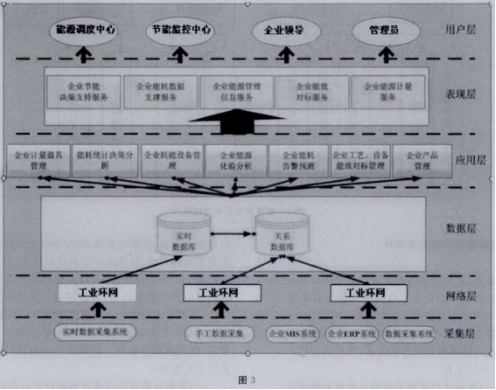
As an architecture, it is characterized by the ability to leverage the strengths of a bilateral non software environment and arrange work in an orderly manner to be completed on both the client and server sides, reducing the burden of information transmission throughout the entire system.
On the client side, users use the client application to complete their operations based on their own definitions and needs. Then the client application sends a request to the server. Respond to requests submitted from different clients through server-side applications. At this point, different processing modes can be implemented based on the different server configurations and server-side application designs. Allow simultaneous processing of requests sent from multiple client directions. Greatly improve the response speed between the client and server, making data and command transmission faster and more timely.
6.2 Data Collection
To build an enterprise energy management system, the first thing to consider is the collection of energy information, which involves summarizing and classifying the large amount of complex energy information data in the cement production process. Corresponding it to different production stages facilitates our collection. Then, based on the energy consumption points planned in the energy consumption grouping table, the on-site data distributed in various workshops and important links will be collected and processed in real time. These data will be saved to the DCS control system through relevant interfaces for use in the energy management system.
Information collection is the process of integrating data from heterogeneous databases. The implementation of heterogeneous data integration is divided into two steps: first, real-time energy data collection of production energy consumption devices is carried out, that is, designing interface programs from automation systems such as distributed control systems (DCS), FCS, programmable controllers (PLC) to the real-time database, and integrating the real-time collected energy data into the real-time database. These data mainly include information on energy consumption, energy exchange, and energy loss reflected on the production line, as well as the electricity consumption of major equipment. Most of this information is directly obtained from automation systems such as DCS, FCS, and PLC through interfaces such as OPC (OLE for Process Control) and DDE (Dynamic Data Exchange). It is heterogeneous data integration that enables automatic data connection and sharing, while maintaining real-time data.
Afterwards, the collected energy and consumption data will be transmitted to the energy management system for processing, allowing users to directly perform corresponding operations on the database through the interface. The energy management system has functions such as displaying production process energy consumption data, trend prediction, and energy information analysis. Energy data in the database can be queried and accessed at any time by category and time.
6.3 Communication Network
Adopt industrial grade Ethernet switches and establish redundant ring networks in different regions. The proprietary Real time RingTM technology for real-time industrial Ethernet switches enables fast fault-tolerant ring network redundancy, with high-level network management functions such as port configuration, port mirroring, and priority division, ensuring real-time and accurate information exchange. The coupling topology structure is used to connect the rings, thereby establishing a highly reliable and proprietary energy data acquisition communication network.
6.4 Energy Control
Nengfu Control is a computer information management system that integrates data induction and analysis, process monitoring, energy management, scheduling balance, and analysis optimization. The system will summarize, analyze, and organize the collected data, and combine it with production planning data to carry out energy management work. Including energy integration analysis management, energy quality management, energy balance, and management of energy system operation support (including task order management and power flow analysis).
The system consists of an I/O data server, Oracle relational database server, web server, and workstation. The I/O data server is responsible for real-time collection, historical compression storage, secondary calculation, and providing real-time data for monitoring of measurement data; The Oracle database server is responsible for collecting and storing measurement and statistical data, serving as the energy measurement and statistical management database; The web server will publish real-time data detection screens and dynamic curves in the form of web pages on the enterprise website for relevant departments to access online, and provide various human-machine interfaces between the system and users. Run the measurement data monitoring and management system software on the workstation to analyze and process measurement data, manage equipment, and allocate permissions.
Introduction to Ankerui Enterprise Energy Management System
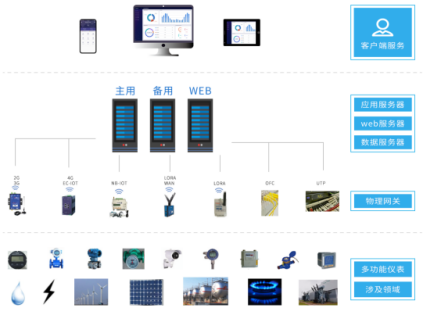
Ankerui Enterprise Energy Management System adopts automation, information technology, and centralized management mode to implement centralized and flat dynamic monitoring and data management of the production, transmission, distribution, and consumption links of the enterprise. It monitors the consumption of various energy sources such as electricity, water, gas, steam, and compressed air in the enterprise. Through data analysis, mining, and trend analysis, it helps the enterprise to conduct energy consumption statistics, month on month analysis, energy cost analysis, energy consumption prediction, and carbon emission analysis for various energy demands and consumption situations, energy quality, product energy consumption per unit, energy consumption of each process, and energy utilization of major energy consuming equipment. It provides basic data and support for strengthening energy management, improving energy utilization efficiency, exploring energy-saving potential, and energy-saving evaluation.
7.1 System Architecture
7.2 Application Place
Steel, petrochemicals, metallurgy, non-ferrous metals, mining, pharmaceuticals, cement, coal, logistics, railway, aviation industry, wood, chemical raw materials, as well as manufacturing of mechanical and electrical equipment, electrical products, and tools.
7.3 System Functions
7.3.1 Visual Display
Display the total energy consumption, conversion value, energy cost, energy consumption trend, proportion of sub item energy consumption, regional energy consumption comparison, as well as the current weather and pollution situation of the enterprise, and 3D display the energy consumption dynamics of important processes or sections of the enterprise.
7.3.2 Real time monitoring
Real time monitoring of energy usage, alarms, and other situations at various points of the enterprise. So that enterprise users can monitor the operation status of each point in real time, and at the same time, be able to quickly and effectively grasp the alarm of each point.
7.3.3 Transformer Monitoring
Display the load situation of each voltage transformer, so as to make scientific and reasonable planning for the transformer situation. By comparing and analyzing the electrical efficiency under various operating parameter states, identify the optimal operating mode. Adjust the load according to the optimal operating mode to reduce electricity consumption and minimize energy loss.
7.3.4 Energy consumption statistics
From the dimensions of energy usage types, monitoring areas, production process/section time, sub items, etc., curve, pie chart, histogram, cumulative chart, numerical table and other methods are used to analyze enterprise energy consumption statistics, year-on-year, month on month analysis, actual performance analysis, benchmark comparison, unit product energy consumption, unit output value energy consumption statistics, identify loopholes and unreasonable areas in the energy use process, and adjust energy allocation strategies to reduce waste in the energy use process.
7.3.5 Product/Output Unit Consumption
Integrate with the enterprise MES system, generate product consumption trend charts in product consumption based on product output and energy consumption data collected by the system, and conduct year-on-year and month on month analysis. So that enterprises can adjust their production processes based on the unit consumption of products, thereby reducing energy consumption.
7.3.6 Performance Analysis
Conduct daily, weekly, monthly, annual, and * time period performance statistics for various energy usage, consumption, and conversion according to teams, regions, production lines, and sections. Compare and evaluate KPI performance indicators based on energy plans or quotas to help enterprises understand internal energy efficiency levels and energy-saving potential.
7.3.7 Energy consumption prediction
By analyzing the energy consumption of production processes and equipment in enterprises, establishing an energy consumption calculation model, and using artificial intelligence algorithms to modify data and models, effective decision-making basis is provided for energy conservation.
7.3.8 Operation Monitoring
The system collects data on energy consumption of regions, sections, and equipment, monitors the operating status of equipment and processes, such as temperature, humidity, flow rate, pressure, speed, etc., and supports one-time operation monitoring of power distribution systems. You can quickly browse the managed energy consumption data directly from the dynamic monitoring plan, and support querying related energy consumption by energy type, workshop, section, time and other dimensions.
7.3.9 Analysis Report
By conducting comprehensive statistical analysis on the energy utilization, line losses, equipment operation, and maintenance of enterprises on a yearly, monthly, and daily basis, users can gain a comprehensive understanding of the system's operation and provide a data foundation for them to discover equipment abnormalities, identify improvement points, and explore energy-saving potential based on energy consumption.
7.3.10 Event Alarm
Continuously monitor the operation of equipment and systems, issue alarms for communication failures, data anomalies, quota exceeding limits, abnormal process parameter exceeding limits, equipment abnormalities or failures, remind enterprises to pay attention and search for problems, and form alarm logs.
7.3.11 Mobile Support
The APP supports Android and iOS operating systems, making it convenient for users to grasp enterprise energy consumption, efficiency analysis, month on month analysis, energy consumption conversion, energy consumption prediction, operation monitoring, abnormal alarm, etc. from different dimensions such as energy classification, region, workshop, process, team, and equipment.
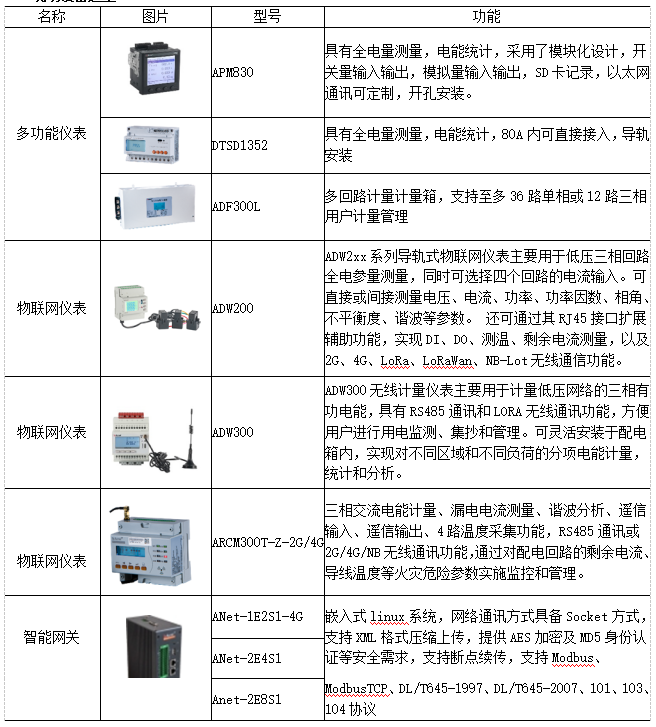
7.4 On site equipment selection
8 Conclusion
The energy management system aims to reduce energy consumption and improve energy utilization efficiency. The information management and network communication platform are the core of the energy management system, and the foundation is the identification, data collection, and evaluation of energy factors. The energy management system can effectively reduce the production energy consumption of enterprises by analyzing energy consumption data, implementing reasonable energy-saving strategies, and implementing energy monitoring systems. The application of energy management system in cement production can effectively improve the energy utilization efficiency of cement production enterprises, reduce the production cost of cement, and enhance the competitiveness of cement enterprises. Cement production enterprises not only increase economic benefits, but also promote the development of circular economy. The implementation of energy management systems in enterprises to achieve the harmonious unity of enterprise benefits and social benefits is not only a corporate social responsibility, but also an inherent requirement for the development of the enterprise itself.