-
E-mail
qingqingshi@email.acrel.cn
-
Phone
18706162823
-
Address
No. 5 ASEAN Road, ASEAN Industrial Park, Nanzha Town, Jiangyin City, Jiangsu Province
About Us
Jiangsu Ankerui Electric Appliance Manufacturing Co., Ltd
Date: 2020-08-20Read: 19
Abstract:In recent years, oil fume pollution in China's catering industry has become one of the main sources of urban air pollution. Nowadays, environmental problems are becoming increasingly prominent and seriously restricting people's physical health. It is necessary to pay attention to and take a series of effective measures to control the oil fume pollution in the catering industry.
Keywordscatering; Pollution; governance
1. Reasons for Oil Fume Pollution in the Catering Industry
During the process of heating cooking oil, the increase in temperature will cause different components to evaporate in a sequential manner. At around 10 degrees Celsius, there will be a phenomenon of vaporization of higher boiling point components, resulting in denser oil bubbles and a large amount of visible oil fumes. As the temperature continues to rise, it begins to vaporize the high boiling points of the cooking oil, resulting in the production of a large amount of smoke, which is often blue in color. At this time, when food is added to oil, there will be a rapid vaporization and expansion phenomenon in the food, and some will experience condensation problems, resulting in mist that combines with oil fumes to form smoke. These mixed gases will gradually decrease in temperature during the rising process and combine with other air and mixtures, leading to the production of aerosols.
Oil fume has multiple components, including not only liquid and solid particles, but also solid-liquid mixed particles, which float together in a gas medium. Generally, there are two main forms of existence, namely liquid gas-liquid gel and solid gas-liquid gel. It has a low settling speed, so it stays suspended in the air for a longer period of time. Through research, it has been found that oil fume pollutants contain many complex components, including not only organic gases but also some high molecular weight compounds. These gases float in the air for a long time and can cause other substances to adsorb, posing serious harm to the human body.
2. Measures for Controlling Oil Fume Pollution in the Catering Industry
2.1 is the aqueous solution absorption method: The aqueous solution absorption method is a commonly used method in the treatment of oil fume pollution. Oil fume purifiers are developed using this method. After the airflow distribution grille filters the oil fume gas, the oil and gas can enter the purifier evenly. The oil and gas entering the purifier will be cleaned by the aqueous solution in the purifier, or high-pressure spray nozzles can be used to spray water mist in the direction of the airflow. The droplets will be captured while colliding with the oil mist particles. These purified gases will be discharged through a water baffle. If the aqueous solution absorption method is used to treat oil fumes, alkaline degreasers and deodorizers are usually added to the aqueous solution to enhance the degreasing effect and effectively remove odors. At present, this method is generally applied to small and medium-sized catering units because it has only a small exhaust resistance, low process difficulty, and does not require excessive investment of funds. However, it should be noted that this method has many drawbacks, such as a lack of stable purification rate and good energy consumption.
2.2 is the electrostatic adsorption method: The main material used in this method is metal components, which are used to construct an electrode system. When high voltage is applied to the two poles, an electric field will be generated between the opposite electrodes, because the opposite electrodes have different shapes and sizes, so the generated electric field is not uniform. As the voltage gradually increases, the electric field strength near the cathode will also gradually reach a certain height, and the electric field space will receive a large number of negative ions transported by ionized gas. During the process of passing oil and gas in an electric field, the particles of oil fume mist will collide with negative ions. Under the corresponding action, the particles of oil fume mist will move towards the direction of the oil collecting electrode. At this time, there is a neutralizing effect on the surface of the oil collecting electrode, and the surface of the oil collecting electrode will adsorb those oil fume mist particles that have lost their charge. The oil fume exhaust gas is well purified. The main characteristics of electrostatic oil fume purifiers are: easy circulation of smoke, low noise, low energy consumption, and the ability to produce various types of oil fume treatment equipment according to the requirements of the unit scale used. They have high purification rates, but due to their complex structure, they require significant investment costs.
2.3 is the filtration method: The oil fume is purified by using the filtration method, mainly by using the filtration layer to filter the oil fume and remove the smoke particles. Generally, the filtration layer is composed of many materials such as metal wire mesh and particulate matter. If the filtration adsorption principle is used to scientifically make the oil fume purifier, there will be no very complex structure and process, and ideal results can be obtained. Strong cohesiveness and adhesion are the characteristics of oils and fats, so frequent cleaning and maintenance of filter materials require the use of filter type oil fume purifiers, otherwise the purification efficiency will be affected. Usually, this method is not applied in the treatment of oil fume pollution because it does not have a high purification rate and there are complex procedures for cleaning and maintaining the filter media.
2.4 is a combination method for controlling oil fume pollution: the method of comprehensively applying two or more oil removal mechanisms is called the combination method for purifying oil fume. Oil fume purifiers made using the principle of combination method can effectively enhance equipment functions and better purify oil fume. Therefore, in the future, this direction will be developed. Specifically, this includes the following aspects:
2.4.1 Oil fume purifier using condensation and action: The working principle of this oil fume purifier is mainly to condense steam. The relatively small particles of oil fume mist are condensation nuclei, which gradually expand into larger particles, so that those oil fume mist particles can be better captured. Its purification process is as follows: the oil fume in the form of gas enters the saturation chamber cell, and under the action of fine water mist, the smoke will reach saturation or even supersaturation. In this way, larger oil fume particles will settle and pass through the saturated smoke in an inner tube. When passing through the throat of the tube, a large acceleration will be obtained, but the static pressure will be reduced, resulting in a similar expansion phenomenon. Afterwards, water droplets will evaporate and the smoke will enter the stage of gradual expansion of the Venturi tube. The airflow velocity will be reduced, generating a large static pressure, and then condensing water vapor. This will cause the water vapor to condense on the surface of the condensation core formed by small oil fume mist particles, collide between the two, and then become a coarser polymer. In order to further wash the oil fume gas, a water spray nozzle is installed at the outlet of the Venturi tube, and the gas is purified and dehydrated before being discharged into the atmosphere.
2.4.2 Electrostatic filtration oil fume purifier. Static oil fume purifier can improve the purification efficiency of oil fume. A filtering cell device is installed before the oil and gas enter the electrostatic adsorption cell stage. When the oil fume mist particles collide with the filter layer, the filter layer intercepts and screens them. The larger oil fume mist particles in the filtered and purified oil fume gas have been removed. After being purified by the filtering layer, the oil fume gas enters the electrostatic treatment cell for further purification.
In the urban atmospheric environment, oil fume pollution from the catering industry has become the main source of pollution. Although oil fume pollution has received sufficient attention from people and the treatment technology is constantly maturing and improving, there are still many problems in the specific application process. Different governance technologies have their own advantages and disadvantages, and the catering industry needs to make reasonable choices based on its own situation.
3 Ankerui AcrelCloud3500 Catering Oil Fume Monitoring Cloud Platform
The Acrelcloud-3500 restaurant lampblack online monitoring system is a set of reliable and fully functional online real-time monitoring system for restaurant lampblack developed by using sensor sensing, mobile Internet and other technologies to meet the needs of the catering industry's lampblack emission regulation. Mainly responsible for overall data management, basic information management, monitoring data display and statistical analysis of online monitoring of oil fume areas, and providing data services and office support for related business processes and on-site work.

3.1 Main functions of the platform
The online monitoring system for cooking fumes in the catering industry consists of four parts: real-time data monitoring, alarm data monitoring, data analysis and hazard analysis maintenance, and data services. It supports displaying the real-time monitoring status of various catering enterprises through the download of a mobile APP interface.
(1) Platform login
Enter the platform address, it is recommended to use Google, Firefox, 360 browser. This feature is used for users to log in to the system

Enter the username and password, click the "Login" button, and if the username and password are incorrect, prompt the user to enter the correct username and password; If the username and password are correct, you can successfully log in to the system.
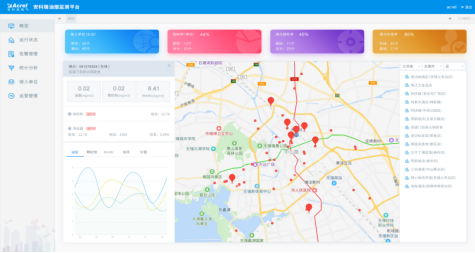
(2) Platform homepage
The homepage displays an overview of the connected enterprise, including the failure rate, exceedance rate, and online rate of the oil fume monitoring equipment. The chart section includes a detailed list of oil fume monitoring points, their specific locations, monitoring data images (including oil fume concentration, particulate matter concentration, NMHC concentration, etc.), as well as electrical field and alarm information.
(3) Alarm data monitoring
The system generates corresponding emission exceeding alarms based on the collected oil fume values; Analyze the operation data of the purifier and upload the corresponding alarm events such as operation, shutdown, and malfunction of the purification equipment.
(4) Data analysis

Run time analysis, offline analysis; Alarm proportion and ranking analysis; Historical data statistics, etc.

(5) Hazard management
The system analyzes the collected alarm data, generates corresponding hazard records, distributes and handles hazards, promptly handles alarms, and forms a closed loop.
(6) Basic data maintenance
Personal information, permission maintenance, enterprise information entry, corresponding measurement point information entry, etc.

Oil fume monitoring model description (ACY100)


3.2 Equipment selection plan

Note: Dual probes are suitable for situations with dual exhaust channels, with each probe monitoring one exhaust channel.