-
E-mail
jsxxyb@163.com
-
Phone
13655236269
-
Address
No. 361 Shenhua Avenue, Jinhu Economic Development Zone, Jiangsu Province
Jiangsu Xianxian Instrument Technology Co., Ltd
Intelligent spiral vortex flowmeter: advantages and application charm of precise measurement
Date: 2024-12-02Read: 91
In the field of fluid measurement, intelligent vortex flowmeter has gradually become an excellent key equipment in many industrial applications due to its working principle and performance. It has not only demonstrated strong measurement capabilities in traditional industries, but also demonstrated its advantages and wide application value in multiple fields such as power industry, chemical industry, oil and gas. This article will delve into the advantages of intelligent vortex flow meters and reveal why they stand out among many flow meters.
1、 High precision measurement ensures accurate data
The intelligent vortex flowmeter adopts advanced sensor technology and signal processing algorithms, which can achieve high-precision flow measurement in complex and variable fluid environments. The principle of vortex rotation enables the fluid to generate stable vortices when passing through the flowmeter, thus accurately reflecting changes in flow rate. This high-precision measurement capability is undoubtedly crucial for application scenarios that require precise control of fluid flow.
2、 Wide measurement range, strong adaptability
The intelligent vortex flowmeter has an extremely wide measurement range, which can accurately measure from small flow rates to large fluid flows. This wide measurement range enables the flowmeter to adapt to various complex fluid environments and application scenarios, greatly improving the adaptability and flexibility of the equipment.
3、 High stability and long service life
The intelligent vortex flowmeter fully considers the problems of fluid scouring and wear in its structural design, using wear-resistant and corrosion-resistant materials, as well as optimized flow channel design, to ensure the high stability and long life of the flowmeter. This enables the flowmeter to maintain stable measurement performance during long-term use, reducing maintenance and replacement costs.
4、 Intelligent functions enhance user experience
The intelligent vortex flowmeter is equipped with intelligent sensors and microprocessors, which can achieve real-time data collection, processing, and storage. Users can achieve remote monitoring and data transmission by connecting external devices or networks, greatly improving the intelligence level and user experience of the devices. In addition, the flowmeter also has a fault self diagnosis function, which can timely detect and report potential problems, providing convenience for equipment maintenance and upkeep.
5、 Energy saving and environmentally friendly, in line with the trend of sustainable development
The intelligent vortex flowmeter, due to its low-power design, can effectively reduce energy consumption during the measurement process. Meanwhile, its precise measurement capability helps reduce fluid waste and environmental pollution, in line with the current trend of energy conservation, environmental protection, and sustainable development.
6、 Widely applicable to meet different needs
Intelligent spiral vortex flowmeter is not only suitable for application scenarios such as boiler systems, main steam pipelines, condenser systems in the power industry, but also widely used in fields such as chemical engineering, oil and gas, water treatment, etc. Its measurement principle and performance enable the flowmeter to meet the measurement needs of different industries and fields.
The intelligent vortex flowmeter has been widely used in gas and partial liquid flow measurement in many industrial fields due to its simple structure, moderate accuracy, good stability, wide range ratio, and low maintenance. Its main application scope includes:
Core applicable areas
1. Natural gas metering:
Core application scenarios: This is one of its main application areas. Especially suitable for:
Urban gas transmission and distribution: metering for gate stations, regional pressure regulating stations, industrial users, commercial users, and residential users.
Small compressed natural gas/liquefied natural gas refueling stations: Trade metering or process control of incoming and outgoing natural gas.
Oil/gas fields: metering of wellhead gas production, gas gathering stations, and natural gas processing plants.
Industrial furnace gas metering.
2. Compressed air/industrial gas metering:
Widely used for measuring the main and branch pipes of compressed air systems in factories, for energy consumption monitoring, cost sharing, leak detection, and process control.
Suitable for flow measurement of common industrial gases such as nitrogen, oxygen, carbon dioxide, etc. (attention should be paid to gas purity and specific physical properties).
3. Steam metering (mainly saturated steam):
Suitable for measuring saturated steam flow in factory steam main lines and branch lines after steam separation cylinders. Commonly used for energy management and cost accounting.
Attention: For superheated steam, special attention should be paid to the accuracy of temperature and pressure compensation. Long term stability may be slightly inferior to specially designed vortex flowmeters, but it is still a commonly used option.
4. Chemical and Petrochemical Industry:
Measurement of light hydrocarbon gases, flare gases, vent gases, reaction gases, process gases (such as hydrogen, chlorine), etc.
Partially measurable process liquids (must meet low viscosity requirements).
5. Exhaust gas/smoke metering:
Suitable for measuring large flow gases such as boiler flue gas and process exhaust gas (commonly used in environmental monitoring and waste heat recovery processes).
Attention: It is necessary to pay attention to the corrosiveness, dust content, and temperature of the gas, and choose appropriate materials and protection (such as split installation and blowing devices).
6. HVAC/Energy Management:
Measurement of cold/hot water circulation flow rate (requires selection of liquid specific models, paying attention to temperature and pressure ranges).
Measurement of refrigerant flow in air conditioning systems (such as chilled water and cooling water).
Measurement of air supply volume for cold/hot air ducts (less commonly, differential pressure or hot air ducts are usually used).
Main application advantages (driving its application in these fields)
• No mechanical movable parts: simple and sturdy structure, high reliability, and minimal maintenance (except for batteries).
Good anti vibration performance: Compared to some mechanical flow meters, it has lower sensitivity to pipeline vibration.
The requirements for the upstream straight pipe section are relatively low: the typical requirement is the first 5D and then 3D (D is the inner diameter of the pipeline), which has advantages in some situations where installation space is limited.
Integrated temperature and pressure sensors: capable of temperature and pressure compensation, directly outputting standard state flow rate (such as standard condition volume flow rate), particularly suitable for gas metering.
Digital signal output: easy to integrate into DCS, PLC, SCADA systems, and energy management systems.
Wide range: Typical range ratios can reach 1:10, 1:15 or higher (some models), which can adapt to situations with large flow changes.
Moderate and reliable measurement accuracy: Typically, gas accuracy is within ± 1.0% to ± 1.5% R (specific range), while liquid accuracy is around ± 1.0% R, meeting the requirements of most industrial and trade handovers (especially for trade measurement of small and medium flow gases).
Local display and data storage: Equipped with a LCD screen, it can read instantaneous, cumulative flow, temperature, pressure and other parameters on site, and has data storage function (such as battery powered).
• Relatively convenient installation: Flange connection is the mainstream method.
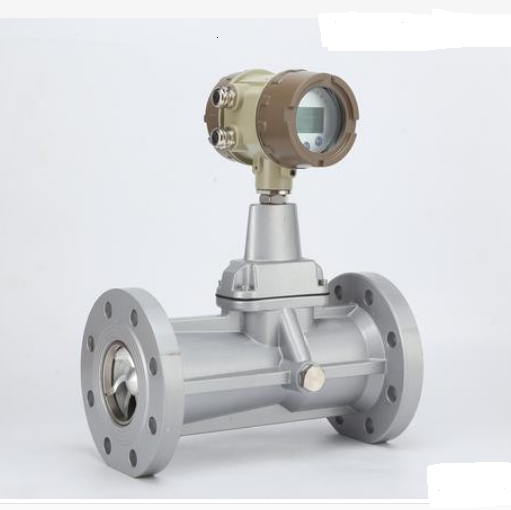
Product example image: