-
E-mail
sales@systester.cn
- Phone
-
Address
No. 1929 Meili Road, Huaiyin District, Jinan City
Jinan Sike Testing Technology Co., Ltd
Key influencing factors of friction coefficient of plastic film
Date: 2025-11-22Read: 10
Hello everyone, this is Jinan Sike.
Today we will explore the importance of the Coefficient of Friction (COF) of plastic films in packaging processes, particularly the differences in COF between conventional and high-temperature conditions and their impact on actual production.
In the high-speed automated packaging process, the friction coefficient of the film directly affects production efficiency, packaging appearance, and product safety. Room temperature COF is a fundamental indicator, while high-temperature COF can more accurately reflect the actual performance of materials under conditions such as heat sealing, hot filling, or high-temperature storage and transportation, and is an important basis for evaluating material applicability.
1、 The basic concept of coefficient of friction (COF)
·Static friction coefficient: reflects the magnitude of the force required for two contact surfaces to start relative motion from a static state, affecting the stability of the packaging bag on a slope or the initial tension required for the film roll during unwinding.
·Dynamic friction coefficient: reflects the magnitude of the force required for two surfaces to maintain relative uniform motion, affecting the smoothness of film operation, transport stability, and pagination effect in equipment.
It should be noted that COF is not an inherent property of the material, but is influenced by various factors such as surface characteristics, grinding materials, temperature, humidity, speed, etc.
2、 The difference and connection between conventional COF and high-temperature COF

Internal mechanism analysis
At room temperature, lubricants (such as erucic acid amide) form a lubricating film on the surface of the film, which helps to reduce COF.
Under high temperature conditions, the film itself may soften, surface viscosity may increase, and the lubricant may migrate or dissolve
The failure of the lubrication film is the main reason for the significant increase in high-temperature COF.
3、 The Influence of High Temperature COF on Materials and Packaging
Neglecting high-temperature COF is like only considering ideal road conditions and ignoring the impact of complex environments on vehicle operation. Its practical significance includes:
The significance of material development and suppliers
High temperature COF can be used to evaluate the temperature resistance of smooth systems and provide a basis for formula optimization.
Products with stable high-temperature COF data typically exhibit better process adaptability and reliability.
Conducting high-temperature testing in advance can help prevent issues such as stacking adhesion or poor sealing caused by high temperatures.
2. Impact on packaging processing and use
During the high-speed bag making process, high temperature COF may cause problems such as poor opening, stuck conveying, adhesive sealing, or surface scratches.
Stacked packaging bags in high temperature environments may be affected by adhesion during use, or may not operate smoothly in vending machines.
Excessive friction may also increase the risk of heavy or sharp objects breaking during transportation.
3. Application considerations in specific scenarios
Hot filled products (such as juices and seasonings) require the film to maintain good smoothness at high temperatures.
The high-temperature sterilization packaging should ensure that there is no stacking or adhesion after steaming.
It is necessary to comprehensively consider the impact of temperature changes throughout the entire process from production to sales on packaging performance.
4、 How to effectively address the challenges of high-temperature COF
1. Clarify data requirements
In addition to conventional COF, suppliers should be required to provide COF test data under specific high temperature conditions.
2. Conduct simulation testing
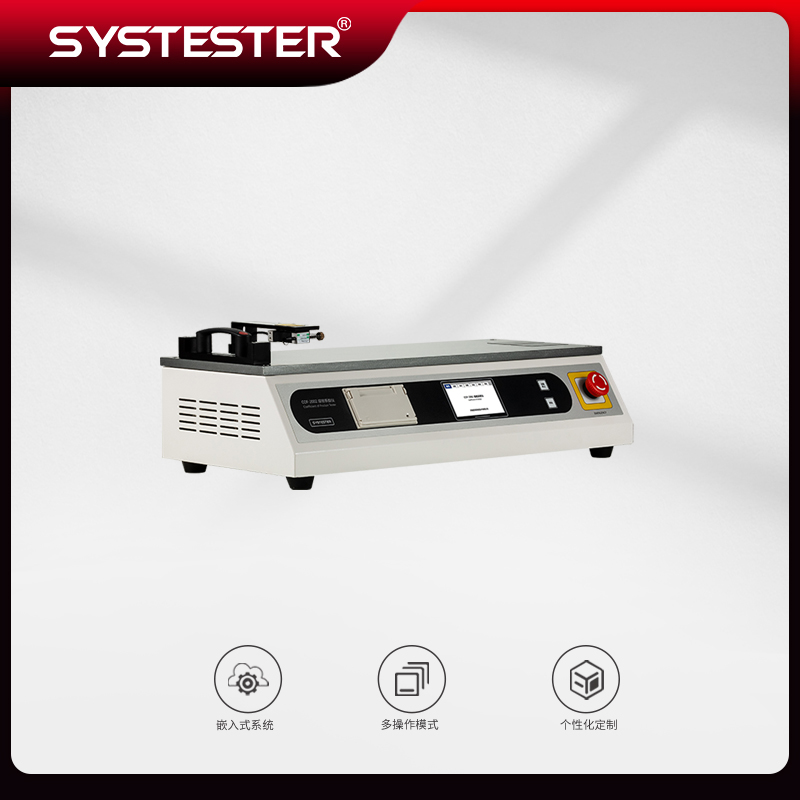
Using Jinan Sike COF-2002 temperature controlled friction coefficient instrument, simulate the actual temperature of the production line for pre machine verification.
3. Promote formula optimization
Cooperate with suppliers to use temperature resistant lubricants or inorganic anti adhesion agents (such as silica), or consider using heat-resistant and low adhesion materials such as COC as composite layers.
4. Reasonably adjust the process
Properly reduce the heat sealing temperature or adjust equipment parameters to adapt to the temperature sensitivity of the material, but attention should be paid to
This type of method has limited effectiveness.
summary
Conventional COF reflects the basic performance of materials at room temperature, while high-temperature COF reflects their actual performance under real working conditions. With the continuous development of packaging technology, relying solely on room temperature data for decision-making is no longer sufficient to meet complex needs. Incorporating high-temperature COF into the material evaluation system can help optimize product performance in material development, assist packaging and processing enterprises in ensuring production stability, and reduce quality risks for end users. Accurately grasping the friction characteristics of thin films in high-temperature environments is an important part of adapting to modern packaging technology requirements.
Thank you for reading this issue. Follow Jinan Sike and "Sike Film Art Museum" to learn more about professional knowledge and technical applications of packaging materials.