-
E-mail
185945738@qq.com
-
Phone
15306360531
-
Address
3rd Floor, Building 1, Weifang High tech Zone Optoelectronic Industry Accelerator (Phase I), No. 155 Guangdian Road, Yuqing Community, Xincheng Street, Weifang High tech Zone, Shandong Province
Shandong Leiente Intelligent Technology Co., Ltd
Precautions for Operation and Use of Rotational Viscometer @ Viscometer
Date: 2025-11-06Read: 10
In many fields such as industrial production, scientific research, and quality control, the viscosity of fluids is a crucial physical property. It not only affects the flow characteristics and transmission efficiency of fluids, but is also closely related to the performance, stability, and processing technology of products. Whether it is the lubrication effect of lubricating oil, the smoothness of coatings, or the taste and texture of food, precise control of viscosity is indispensable. As a specialized instrument for measuring fluid viscosity, the rotational viscometer has become a tool in many industries due to its high accuracy, reliability, and wide applicability.
Working principle of rotary viscometer
The basic working principle of a rotational viscometer is based on Newton's law of internal friction, which states that the internal frictional force (viscous resistance) generated when two adjacent layers of fluid slide relative to each other inside the fluid is proportional to the velocity difference between the two layers of fluid, proportional to the contact area of the fluid layers, and related to the properties of the fluid itself, but not to the pressure at the contact surface.
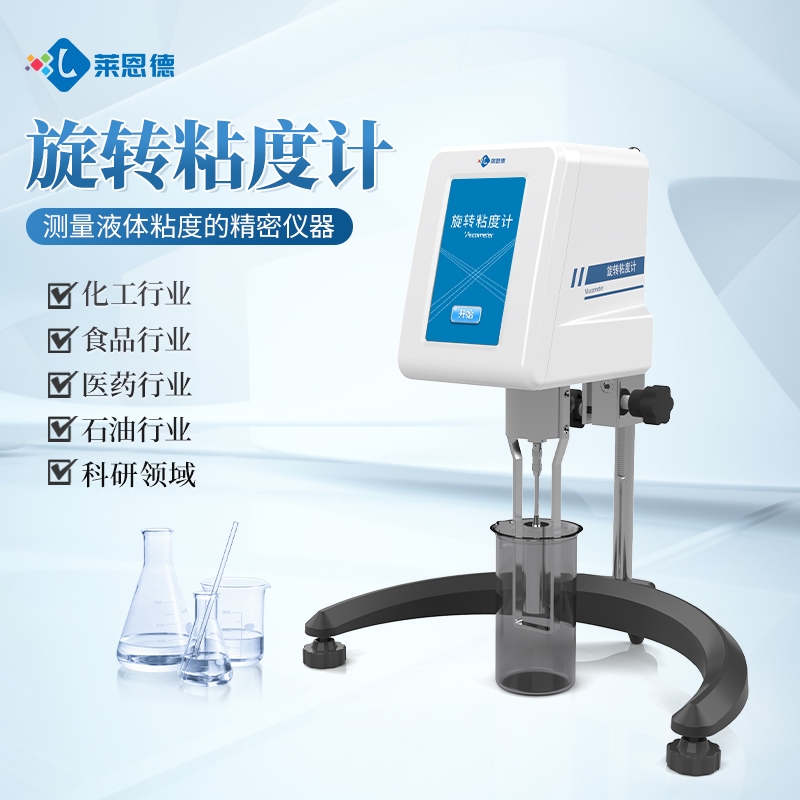
A typical rotational viscometer consists of a rotor and a measurement system. When measuring, immerse the rotor in the measured fluid and rotate it at a certain angular velocity. Due to the viscous resistance of the fluid, it will hinder the rotation of the rotor, causing the actual speed of the rotor to be lower than the set speed. The measurement system calculates the viscosity value of the measured fluid based on a pre-set mathematical model and calibration parameters by detecting changes in rotor speed or the magnitude of torque applied to the rotor.
Taking the common coaxial cylindrical rotational viscometer as an example, it consists of an inner cylinder (rotor) and an outer cylinder (stator) forming a coaxial cylindrical structure. The inner cylinder rotates and the outer cylinder is fixed. When the inner cylinder rotates in the fluid, the fluid generates viscous resistance to the inner cylinder. By measuring the torque required for the rotation of the inner cylinder and combining the geometric dimensions, rotational angular velocity, and other parameters of the inner and outer cylinders, the viscosity of the fluid can be accurately calculated.
Types and characteristics of rotational viscometers
1. Coaxial cylinder rotational viscometer
Features: High measurement accuracy, suitable for measuring low to medium viscosity fluids. It has a wide measurement range and can accurately measure the viscosity of Newtonian and non Newtonian fluids. Due to the design of the coaxial cylindrical structure, the shear rate experienced by the fluid during the measurement process is relatively uniform, and the measurement results are less affected by the fluid flow state.
Application scenario: Commonly used in industries such as petroleum, chemical, pharmaceutical, etc., for viscosity measurement of low to medium viscosity fluids such as lubricants, solvents, and drug solutions.
2. Cone plate rotational viscometer
Features: The rotor of the cone plate rotational viscometer is a cone, and the stator is a flat plate. This structure enables the shear rate of the fluid between the conical plates to be very uniform, enabling precise measurements with very small sample sizes. It has unique advantages in measuring non Newtonian fluids and can accurately reflect the viscosity changes of fluids at different shear rates.
Application scenario: It is widely used in polymer materials, food, cosmetics and other industries to measure the viscosity characteristics of non-newtonian fluids such as polymer solutions, food sauces, cosmetics lotion, etc.
3. Parallel plate rotational viscometer
Features: Composed of two parallel flat plates, one of which rotates and the other is fixed. The structure of the parallel plate rotational viscometer is relatively simple, the sample loading is convenient, and it is suitable for measuring fluids with higher viscosity. It can measure over a wide range of shear rates and meet the viscosity testing needs of some special fluids.
Application scenarios: Widely used in industries such as rubber, plastic, and paint to measure the viscosity of high viscosity fluids such as rubber compounds, plastic melts, and paint coatings.
Operation and use of rotary viscometer
1. Preparation work
Instrument calibration: Before using a rotational viscometer, calibration is required to ensure the accuracy of the measurement results. Calibration usually uses a standard viscosity liquid and follows the requirements of the instrument manual to compare the measurement results with the standard values and adjust the calibration parameters of the instrument.
Sample preparation: Prepare an appropriate amount of sample based on the properties of the measured fluid and measurement requirements. The sample should be uniform, free of bubbles, and in a stable state at the measured temperature. For some temperature sensitive fluids, it is necessary to strictly control the temperature of the sample.
Rotor selection: Select the appropriate rotor based on the expected viscosity range of the fluid being tested. The selection of the rotor should follow the recommended range in the instrument manual to ensure the accuracy and reliability of the measurement results.
2. Measurement process
Install rotor: Carefully install the selected rotor onto the drive shaft of the rotational viscometer, ensuring that the rotor is securely installed without any looseness.
Set parameters: According to the measurement requirements, set the measurement parameters of the rotational viscometer, such as rotational angular velocity, measurement time, etc. Different fluids and measurement purposes may require different parameter settings.
Immerse the sample: Slowly immerse the rotational viscometer with the installed rotor into the measured sample, ensuring that the rotor is immersed in the sample and the distance between the rotor and the container wall and bottom meets the requirements to avoid boundary effects on the measurement results.
Start measurement: Start the rotational viscometer and the rotor begins to rotate. The instrument will automatically measure the speed or torque of the rotor and calculate the viscosity value of the fluid according to a preset algorithm. During the measurement process, the temperature of the sample should be kept stable to avoid interference from external factors.
Reading result: After the measurement is completed, the instrument will display the viscosity value of the measured fluid. Record the measurement results and process and analyze the data as needed.
3. Precautions
Temperature control: Temperature has a significant impact on the viscosity of fluids, so it is necessary to strictly control the temperature of the sample during the measurement process. A constant temperature water bath or temperature control device can be used to maintain the temperature stability of the sample.
Sample uniformity: Ensure that the sample is uniform and free of bubbles, otherwise it will affect the accuracy of the measurement results. Before measurement, the sample can be appropriately stirred or degassed.
Rotor cleaning: After each measurement is completed, the rotor should be cleaned in a timely manner to avoid sample residue affecting the next measurement. When cleaning the rotor, a suitable solvent should be used and the rotor should be dried before the next measurement.
Application of Rotational Viscometers in Various Industries
1. Petrochemical industry
In petrochemical production, a rotary viscometer is used to measure the viscosity of various oil products such as crude oil, lubricating oil, fuel oil, etc. Viscosity is one of the important indicators for evaluating the quality of oil products, which directly affects the flow performance, lubrication effect, and combustion efficiency of oil products. By accurately measuring the viscosity of oil products, process parameters during production can be controlled to ensure product quality meets standard requirements.
2. Pharmaceutical industry
In the pharmaceutical industry, the viscosity of drugs can affect their solubility, stability, and bioavailability. Rotational viscometers can be used to measure the viscosity of drug solutions, suspensions, and creams, providing important data for drug development and production. For example, in the production of injections, it is necessary to control the viscosity of the drug to ensure smooth and safe injection.
3. Food industry
The taste and texture of food are closely related to viscosity. A rotational viscometer can be used to measure the viscosity of various foods, such as sauces, juices, milk, ice cream, etc. By adjusting the viscosity of food, the taste and stability of food can be improved, meeting the needs of consumers. For example, in chocolate production, controlling the viscosity of chocolate can give it appropriate fluidity and spreadability.
4. Coatings and paint industry
The viscosity of coatings and paints can affect their construction performance and coating quality. Rotational viscometers can be used to measure the viscosity of coatings and paints, helping manufacturers adjust formulations and production processes to ensure that products have good leveling, adhesion, and coverage. For example, in the production of automotive coatings, precise control of the viscosity of the coating can ensure the uniformity and glossiness of the coating.
As an important viscosity measuring instrument, the rotational viscometer plays an irreplaceable role in industrial production and scientific research. It provides critical data for production, research and development, and quality control in various industries by accurately measuring the viscosity of fluids. With the continuous advancement of technology, the performance and functions of rotary viscometers are also constantly improving, with higher measurement accuracy, more convenient operation, and wider applicability. In the future, rotational viscometers will continue to be widely used in more fields, making greater contributions to promoting the development and progress of various industries.