-
E-mail
185945738@qq.com
-
Phone
15306360531
-
Address
3rd Floor, Building 1, Weifang High tech Zone Optoelectronic Industry Accelerator (Phase I), No. 155 Guangdian Road, Yuqing Community, Xincheng Street, Weifang High tech Zone, Shandong Province
Shandong Leiente Intelligent Technology Co., Ltd
The detection principle and application fields of phosphate concentration detector
Date: 2025-12-18Read: 10
Phosphate is an important nutrient element in aquatic ecosystems. Moderate amounts of phosphate can promote the growth of aquatic organisms, but excessive phosphate can cause eutrophication of water bodies, leading to algae proliferation, decreased dissolved oxygen in water, and ultimately causing fish death, water quality deterioration, and ecological disasters such as "algal blooms" and "red tides". Therefore, accurate monitoring of phosphate concentration in water is a key link in water environment governance and water resource protection. The phosphate concentration detector, as a specialized analytical instrument for quantifying the phosphate content in water, has become a core equipment in environmental monitoring, water management, industrial production and other fields due to its fast, accurate and convenient detection advantages, and has built a solid "phosphorus" control line to protect the water environment.
1、 Core definition and detection significance of phosphate concentration detector
Phosphate concentration detector is a specialized instrument based on specific chemical or physical principles, used for qualitative and quantitative analysis of phosphate content in the form of orthophosphate, total phosphate, etc. in water. Its detection targets include various types of water bodies such as surface water, groundwater, drinking water, industrial wastewater, and aquaculture water. The detection results directly reflect the degree of eutrophication and pollution of the water bodies.
From the perspective of practical application value, the detection significance of this instrument is reflected in multiple dimensions: for environmental monitoring departments, it can real-time grasp the dynamics of phosphate pollution in watershed water bodies, providing data support for the formulation of water pollution prevention and control policies; For drinking water plants, strict control of the phosphate content in the effluent can ensure the safety of drinking water; For industrial enterprises (such as chemical, printing and dyeing, food processing, etc.), the concentration of phosphate discharge in production wastewater can be monitored to ensure compliance with discharge standards and avoid polluting surrounding water bodies; For the aquaculture industry, precise control of phosphate concentration in aquaculture water can create a suitable growth environment for aquatic organisms and improve aquaculture efficiency.
2、 The mainstream detection principle of phosphate concentration detector
At present, phosphate concentration detectors mainly use detection principles such as chemical colorimetric method (spectrophotometry), ion chromatography method, electrode method, etc. Among them, chemical colorimetric method has become a widely used mainstream technology due to its simple operation, moderate cost, and sensitivity that meets conventional detection needs.
1. Chemical colorimetric method (spectrophotometric method)
The core principle of this method is to use chemical reactions to convert phosphates in water into colored compounds, and then measure the absorbance of the colored compounds through a spectrophotometric module. Based on the linear relationship between absorbance and phosphate concentration, the content of phosphates in the sample is calculated. Common colorimetric systems include ammonium molybdate spectrophotometry (including ascorbic acid reduction method, stannous chloride reduction method, etc.).
Taking the classic ascorbic acid reduction molybdenum blue method as an example, the detection process is divided into three key steps: first, sulfuric acid solution is added to the water sample to adjust the acidity, so that the phosphate in the water sample reacts with ammonium molybdate to form phosphomolybdic acid; Secondly, ascorbic acid is added as a reducing agent to reduce the phosphomolybdic acid into a blue phosphomolybdic blue complex; Finally, the spectrophotometer of the instrument measures the absorbance of the complex at a specific wavelength (usually around 700nm), and automatically calculates the concentration of phosphate based on a pre calibrated standard curve. This method has the advantages of high sensitivity, good selectivity, and wide detection range. It can detect phosphates as low as 0.01mg/L in water and is suitable for routine detection in various types of water bodies.
2. Ion chromatography method
The principle of ion chromatography is similar to that of an ion chromatography analyzer. Phosphate ions in water samples are separated by an ion exchange chromatography column, and the separated phosphate signal is detected by a conductivity detector to achieve quantitative analysis. The advantage of this method is that it can simultaneously detect multiple anions (such as phosphate, nitrate, sulfate, chloride ions, etc.), with high detection accuracy and strong anti-interference ability. It is suitable for precise detection of phosphate in complex water bodies (such as industrial wastewater), but the instrument cost is high and the operation is relatively complex, making it more suitable for professional laboratories or monitoring scenarios.
3. Electrode method
The electrode method uses a specialized phosphate selective electrode to form a primary cell with a reference electrode. When the electrode is immersed in a water sample, phosphate ions will interact with the sensitive membrane on the electrode surface, generating a potential difference related to phosphate concentration. By measuring this potential difference with an instrument, the phosphate concentration can be converted. This method is easy to operate, fast in detection speed, and does not require complex sample pretreatment, making it suitable for rapid on-site detection. However, the detection sensitivity is relatively low and susceptible to interference from other ions in the water sample, making it suitable for preliminary screening scenarios with low requirements for detection accuracy.
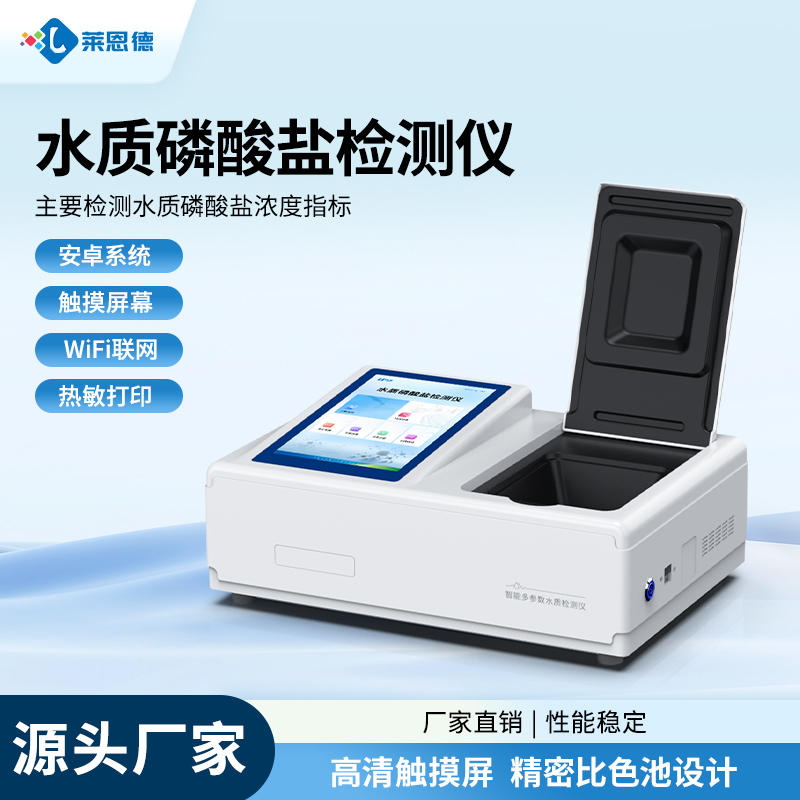
3、 Core structure composition of phosphate concentration detector
Phosphate concentration detectors with different detection principles have certain structural differences, but mainstream spectrophotometric detectors usually consist of sample pretreatment modules, color reaction modules, spectrophotometric detection modules, data processing modules, and auxiliary modules (such as power supply and printing modules), which work together to ensure the efficiency and accuracy of the detection process.
1. Sample pre-processing module
This module is mainly used to process interfering substances in water samples, adjust the acidity of water samples, and ensure the smooth progress of color reactions. The core components include a sample digestion device (used to decompose insoluble phosphates in water samples and convert them into detectable orthophosphate), a filtration device (to remove suspended particles in the water sample and avoid interfering with the detection signal), and an acidity adjustment component (such as a quantitative liquid addition device, which accurately adds acid solution to adjust the pH value of the water sample). For complex water samples containing organic matter, a UV digestion module may also be equipped to disrupt the structure of the organic matter and eliminate its interference with the color reaction.
2. Color reaction module
The color reaction module is a key component for converting phosphate into colored compounds, mainly composed of a reaction tank and a quantitative dosing device. The reaction tank is made of corrosion-resistant materials (such as quartz and polytetrafluoroethylene) to ensure that it does not react with the color reagent; Quantitative dosing devices (such as peristaltic pumps and injection pumps) can accurately add chromogenic reagents such as ammonium molybdate reagents and reducing agents, and are equipped with stirring components to ensure thorough mixing of water samples and reagents, ensuring uniform color reaction. Some instruments also have a constant temperature control function, which improves the stability and reproducibility of color reactions by adjusting the reaction temperature.
3. Spectral detection module
The spectral detection module is the core detection unit of the instrument, mainly composed of a light source, monochromator, colorimetric dish, and photodetector. The light source usually uses tungsten or xenon lamps to provide stable visible or ultraviolet light; Monochromators are used to screen out monochromatic light of specific wavelengths (matching the absorption wavelength of colored complexes) to ensure detection selectivity; A colorimetric dish is used to hold the sample solution after color development and is exposed to monochromatic light irradiation; Photodetectors (such as photodiodes and photomultiplier tubes) convert the light signal transmitted through the colorimetric dish into an electrical signal and transmit it to the data processing module. The performance of this module directly determines the detection sensitivity and accuracy of the instrument.
4. Data processing module
The data processing module consists of a microprocessor and specialized detection software, responsible for receiving electrical signals transmitted by the photodetector, converting them into absorbance values, and then calculating the concentration of phosphate in the sample based on pre stored standard curves. At the same time, this module has multiple practical functions: it can automatically complete the calibration and storage of standard curves, support blank sample calibration, and reduce system errors; Equipped with data storage, query, and statistical functions, it can record information such as testing time, sample number, and testing results; Some instruments are also equipped with touch screens and printing modules, which facilitate on-site operation and real-time output of testing reports.
5. Auxiliary module
The auxiliary modules include a power module (providing AC or DC power, supporting laboratory fixed use and on-site mobile testing), a waste liquid collection module (collecting waste samples and reagents after testing to avoid environmental pollution), and a shell protection module (adopting waterproof and dustproof design, adapting to complex on-site testing environments), etc., to ensure the stable operation and safety of the instrument.
4、 The main application scenarios of phosphate concentration detector
Phosphate concentration detectors, with their diverse detection advantages, are widely used in multiple fields related to water environment and have become the "main force" in water quality monitoring.
1. Environmental monitoring field
The environmental monitoring department is one of the main users of this instrument, commonly used for monitoring phosphate concentration in natural water bodies such as surface water, lakes, reservoirs, and groundwater in river basins. By conducting regular or real-time monitoring, we can grasp the trend of changes in the degree of eutrophication of water bodies, promptly identify the sources of phosphate pollution, and provide accurate data for water environment quality assessment and pollution control plan formulation. For example, in lakes prone to eutrophication, such as the Taihu Lake Lake and Dianchi Lake, the monitoring personnel can use portable detectors to conduct on-site inspection, quickly screen areas where phosphate exceeds the standard, and provide support for emergency response.
2. Drinking water treatment and supply field
In the production process of drinking water plants, the water quality phosphate concentration detector is used to monitor the phosphate content of raw water, sedimentation tank effluent, filtered water, and factory water, ensuring that the drinking water meets the requirements of the "Sanitary Standards for Drinking Water" (GB 5749-2022). At the same time, some drinking water plants will add phosphate scale inhibitors to the water. The instrument can monitor the concentration of phosphate after addition, accurately control the amount of scale inhibitors, and avoid secondary pollution of water quality caused by excessive addition.
3. Industrial wastewater treatment and discharge monitoring
Industrial enterprises such as chemical, printing and dyeing, electroplating, food processing, and fertilizer production often contain large amounts of phosphate in their production wastewater. Enterprises need to use this instrument to monitor the phosphate concentration before and after wastewater treatment, ensuring that the treated wastewater meets the "Comprehensive Wastewater Discharge Standard" (GB 8978-1996) or industry-specific discharge standards before discharge. In addition, the instrument can also be used for process control of industrial wastewater treatment processes. By monitoring the phosphate concentration in key links such as reaction tanks and sedimentation tanks in real time, optimizing treatment process parameters, improving treatment efficiency, and reducing treatment costs.
4. Aquaculture and agricultural irrigation fields
In the aquaculture industry, excessive concentration of phosphate in water can lead to massive growth of algae, consumption of dissolved oxygen, and cause anaerobic death of aquaculture organisms; If the concentration is too low, it cannot meet the growth needs of aquatic organisms. Therefore, farmers can use this instrument to regularly detect the phosphate concentration in the aquaculture water, regulate the water quality by adding an appropriate amount of phosphorus source or changing the water, and ensure the healthy growth of aquaculture organisms. In the field of agricultural irrigation, instruments can monitor the phosphate concentration of irrigation water to avoid soil eutrophication caused by high phosphate wastewater irrigation, which affects crop growth and soil ecological balance.
5、 Precautions for using phosphate concentration detector
To ensure the accuracy of the test results and the service life of the instrument, the following points should be noted when using a phosphate concentration detector:
1. Sample collection and preservation: When collecting water samples, representative sampling points should be selected to avoid collecting surface floating debris or bottom sediment; After water sample collection, it should be tested as soon as possible. If it cannot be tested in a timely manner, a fixative (such as sulfuric acid) should be added to adjust the pH value to below 2, stored in refrigeration, and tested within the specified time to prevent changes in phosphate form.
2. Instrument calibration: Before testing, it is necessary to calibrate the instrument with a standard phosphate solution, draw a standard curve, and ensure that the correlation coefficient of the calibration curve meets the requirements (usually R ² ≥ 0.995); Regularly calibrate and verify the instruments to avoid deviation in test results caused by instrument drift.
3. Reagent management: Color reagents should be prepared correctly according to the instructions, and the concentration and expiration date of the reagents should be strictly controlled; Reagents should be sealed and stored away from direct sunlight and high temperature environments to prevent deterioration and affect color development.
4. Instrument maintenance: Regularly clean reaction tanks, colorimetric dishes, and other components to remove residual samples and reagents and avoid cross contamination; Check the performance of core components such as light sources and photodetectors, and replace aging light sources in a timely manner; When the instrument is not used for a long time, it should be stored properly according to the instructions and regularly turned on for maintenance.
5. Interference elimination: For complex water samples containing a large amount of interfering ions (such as chloride ions, sulfate ions, heavy metal ions), interference elimination treatment (such as adding masking agents, diluting water samples, etc.) should be carried out in advance to ensure the accuracy of the detection results.
6、 The development trend of phosphate concentration detector
With the continuous improvement of water environment governance requirements and the rapid development of detection technology, phosphate concentration detectors are developing towards portability, intelligence, high precision, and multi parameter integration.
In terms of portability, research and development of portable detectors with smaller size, lighter weight, and lower power consumption, equipped with large capacity batteries and on-site sampling components, supporting long-term detection in outdoor power-off environments, meeting the needs of emergency monitoring and on-site inspections; In terms of intelligence, combining IoT and artificial intelligence technologies, automatic sampling, calibration, detection, and data uploading of instruments can be achieved. Operators can remotely view detection data through mobile phones or computers to improve monitoring efficiency; In terms of high precision, optimizing the spectral detection module and signal processing algorithm, reducing the detection limit of the instrument, improving detection accuracy, and meeting the precise detection needs of low concentration phosphate water bodies (such as drinking water); In terms of multi parameter integration, the detection of phosphate is integrated with the detection of other water quality indicators such as nitrate, ammonia nitrogen, COD, etc., enabling one instrument to simultaneously detect multiple pollutants, reducing monitoring costs and improving monitoring efficiency.
In short, phosphate concentration detectors, as key equipment for water environment monitoring, play an irreplaceable role in safeguarding water resource security and preventing eutrophication of water bodies. With the continuous innovation of technology, its detection performance will continue to improve, and its application scenarios will continue to expand, providing stronger technical support for promoting the modernization of water environment governance systems and governance capabilities.