-
E-mail
841106043qq.com
-
Phone
13645368788
-
Address
Oulong Technology Park, No.1 Jinma Road, Hanting District, Weifang City, Shandong Province
Shandong Wanxiang Environmental Technology Co., Ltd
Water Conservancy Remote Sensing Automatic Rainfall Monitoring Station: Automatically telemetry rainfall conditions to assist in water conservancy management and control
Date: 2025-12-19Read: 14
WX-YJ3, Wanxiang Environment, Shandong, supports environmental monitoring in multiple fields. In water management work, rainfall monitoring is the core basis for water resource scheduling, flood control, reservoir management, and water supply guarantee. Traditional water conservancy rainfall monitoring relies on regular manual observation and wired transmission, which has problems such as data lag, limited coverage, high labor costs, and high observation risks in adverse weather conditions, making it difficult to meet the precision and intelligence needs of modern water conservancy management. The water conservancy telemetry automatic rainfall monitoring station takes automated telemetry technology as its core, combined with IoT transmission methods, to achieve all-weather automatic monitoring, remote transmission, and intelligent warning of rainfall conditions, providing efficient and accurate data support for water conservancy management work.
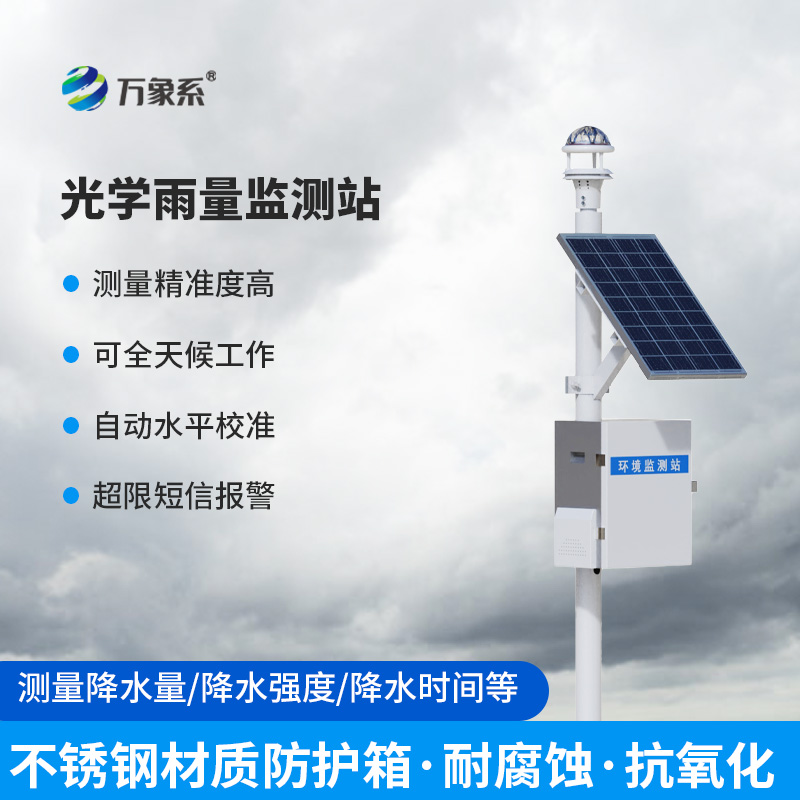
The core advantage of this monitoring station lies in "fully automated telemetry", which eliminates reliance on manual labor. Equipped with a high-precision optical rainfall sensor, designed with a pure sine infrared light source and built-in narrowband filter, it can effectively resist common factors such as strong light, wind and sand, water flow vibration, mosquito interference, etc. in water conservancy scenes. The 78 square centimeter rain sensing surface ensures the accuracy and stability of rainfall measurement. The system can achieve 24-hour automatic monitoring, accurately collect multi-dimensional data such as rainfall status, one minute rainfall, five minute rainfall, ten minute rainfall, one hour rainfall, daily rainfall, etc., and monitor rainfall duration with precision down to seconds, providing refined rainfall data for water management. The sensor adopts an arc-shaped raindrop contact surface design, which does not store rainwater and achieves maintenance free operation, greatly reducing the department's operation and maintenance costs.
In terms of telemetry transmission and data management, monitoring stations have demonstrated a level of intelligence. By adopting wireless remote telemetry transmission mode, real-time rainfall data can be quickly uploaded to the water management IoT platform, breaking through the geographical limitations of traditional wired transmission and achieving centralized control of multiple water monitoring points such as reservoirs, irrigation areas, and river channels. Management personnel can log in to the platform through computers, mobile phones, and other terminals to intuitively view multi-dimensional rainfall data. The platform automatically generates visual charts such as hourly rainfall change curves and monthly daily rainfall bar charts, clearly presenting the trend of rainfall changes and providing direct data support for water conservancy decision-making. The cloud platform supports custom setting of daily boundary time, which can adjust the daily rainfall statistics cycle according to water management needs. At the same time, it allows flexible setting of daily rainfall alarm thresholds. When the rainfall reaches the preset flood warning and irrigation scheduling thresholds, the system will immediately send warning information to the designated water management personnel's mobile phones through SMS alarm, ensuring that relevant personnel are aware of the rain situation dynamics and quickly initiate response plans.
The structural design and performance advantages of this monitoring station enable it to adapt to complex outdoor water conservancy scenarios. The core of the system consists of optical rain sensors, low-power collectors, solar power supply systems, pole supports, etc. The modular design of each component makes maintenance and replacement extremely convenient in the later stage. The stainless steel protection box has excellent corrosion resistance and oxidation resistance, and its waterproof grade reaches IP66. It can resist the high humidity, rain and dew, and sediment erosion common in the water conservancy scene, and can operate stably even in rainstorm, flood and other weather. The static power consumption of the low-power collector is less than 1mA. Combined with a solar power supply system and MPPT automatic power point tracking technology, it can efficiently convert solar energy, ensuring long-term unmanned and stable operation in remote water conservancy areas without mains power, and solving the problem of power supply for traditional monitoring equipment.
In the practical application of water management, this monitoring station plays an irreplaceable core role. In reservoir management, real-time rainfall data can provide scientific basis for reservoir storage and regulation, avoid the reservoir water level exceeding the limit due to rainstorm weather, and ensure the safety of reservoir operation; In irrigation area scheduling, through the analysis of long-term rainfall monitoring data, irrigation timing can be accurately grasped, water resources can be allocated reasonably, irrigation efficiency can be improved, and water resource costs can be saved; In flood control work, comprehensive rainfall data and intelligent warning functions can provide timely and accurate decision-making support for flood control command departments, deploy flood control materials and personnel in advance, and reduce losses caused by flood disasters. In addition, the system supports the expansion of modbus485 sensors, which can add monitoring elements such as water level, flow rate, temperature and humidity according to water management needs, achieving multi-dimensional comprehensive monitoring of "rain+water+weather", and further improving the water monitoring system. The historical rainfall data stored on the platform can be exported in EXCEL format, providing long-term and reliable raw data for water conservancy engineering planning, hydrological analysis, flood prevention plan optimization, etc., and helping to upgrade the precision and intelligence of water conservancy management work.