-
E-mail
356217374@qq.com
-
Phone
15628828075
-
Address
13th Floor, Building A7-2, Hanyu Jinggu Business Center, No. 7000 Jingshi East Road, Jinan Area, China (Shandong) Pilot Free Trade Zone
Shandong Yao'an Electronic Technology Development Co., Ltd
Ammonia gas leak causes 1 death, investigation report on poisoning accident in Guangdong company released!
Date: 2025-12-19Read: 10
Accident details
Recently, the Guangfang website of Yangjiang Binhai New Area (Yangjiang High tech Zone) in Guangdong Province released an accident investigation report, stating that the accident occurred on February 16, 2025,A liquid ammonia leakage accident occurred in a company in the region, resulting in one person being poisoned by inhaling ammonia gas and dying despite rescue efforts.
According to the investigation team, the gas poisoning accident was determined to be oneGeneral production safety liability accidents caused by inadequate safety management of production and operation units, illegal operations by operators resulting in ammonia gas leaks, and insufficient emergency response capabilities.
Direct cause of the accident: The installation of the flange on the outlet side of the safety valve has hidden dangers such as inconsistent bolt length and diameter, misaligned, eccentric, missing, and damaged flange gaskets, insufficient and uneven bolt pre tightening force, and the installation quality of the safety valve does not meet relevant standards and specifications.



What should I do if there is a liquid ammonia leak
Ammonia is an important chemical raw material
Widely used in the production process of the industrial and trade industry
Ammonia gas is pressurized or cooled to obtain liquid ammonia
Liquid ammonia is toxic and easily volatile
It is a hazardous chemical with a high incidence of accidents
Once leaked, it will cause poisoning to personnel
Hazards such as combustion, explosion, and environmental pollution
So, what should we do in the face of liquid ammonia leakage?

01
Install gas alarm
Selection of Ammonia Probe
Ammonia is both a combustible gas and a toxic gas,So which type of detection alarm should be installed? According to the core provisions of GB/T50493-2019 "Design Standard for Detection and Alarm of Combustible and Toxic Gases in Petrochemical Industry":For single component gas media that are both flammable and toxic gases, toxic gas detectors should be installed.
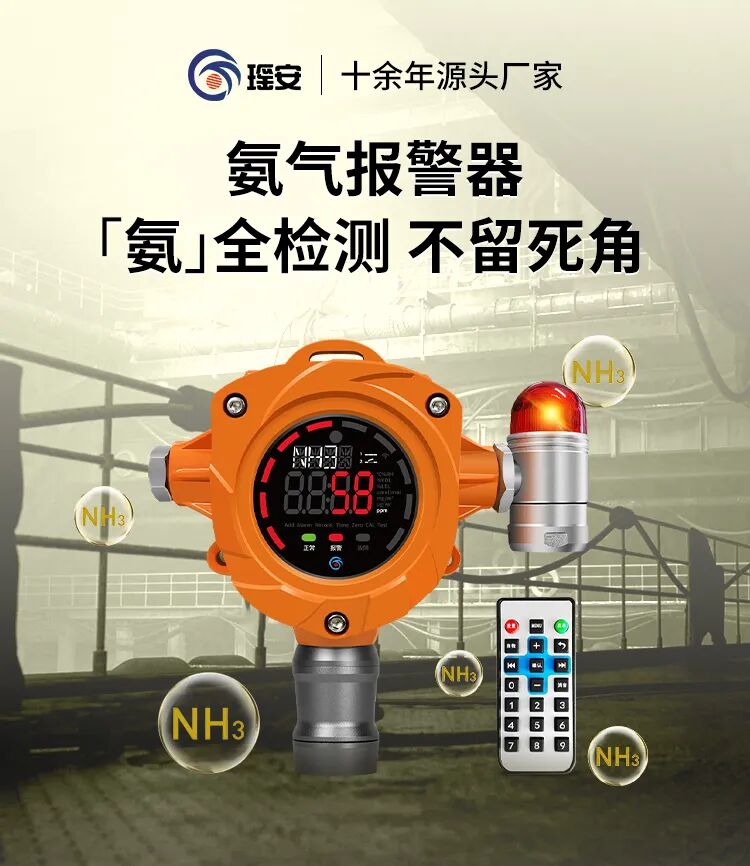
The ammonia gas formed by the volatilization of liquid ammonia is flammable, but the more prominent danger is strong toxicity.Inhaling a small amount of ammonia gas in the human body can irritate the respiratory tract, eyes, and other mucous membranes. Inhaling a large amount can cause lung swelling and even death. Moreover, when ammonia reaches the toxic concentration, it is far from reaching the explosive concentration. For example, the occupational exposure related toxic alarm values are mostly in the tens of ppm level, while the concentration corresponding to the lower explosive limit (15% VOL) is much higher than this.
The toxic gas probe adopts electrochemical sensors, which can accurately detect trace leaks and warn of poisoning risks in advance;And combustible probes are usedCatalytic combustion sensorIt can only detect high concentration leaks to prevent explosions and cannot capture the toxic hazards of early trace leaks.
Installation requirements for detectors
The ratio of the molecular weight of ammonia gas medium to the molecular weight of ambient air is about 0.59, which is less than 0.8,Determine that its gas is lighter than airWhen detecting flammable or toxic gases that are lighter than air,The installation height of the detector should be within 2.0m above the release sourceThe detector should be installed in a location that is free from impact, vibration, strong electromagnetic field interference, and easy to maintain. The installation location of the detector should be between the surrounding process pipelines or equipmentThe clearance should not be less than 0.5m.
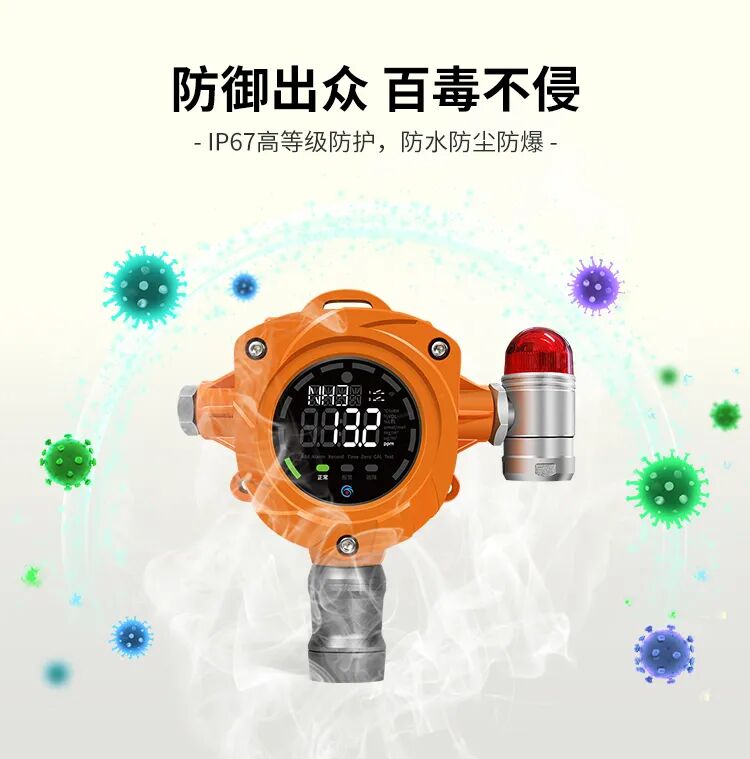
The release source is located in the equipment area arranged outdoors or in an open factory building,Toxic gas detectorWithin its coverage areaThe horizontal distance between any release source should not exceed 4m.
Toxic gas detectors located within the coverage area of enclosed or partially poorly ventilated semi open factories where the release source is locatedThe horizontal distance between any release source should not exceed 2 meters.
The release source of flammable or toxic gases that are lighter than air is located in a closed or partially poorly ventilated semi open factory building,In addition to installing detectors above the release source, combustible or toxic gas detectors should also be installed at the highest point in the factory where gas is prone to accumulate.
02
Leakage disposal measures have been taken
initial response
1.When the ammonia control system triggers an ammonia leak alarm or smells ammonia, on-site personnel immediately activate the sprinkler system to prevent a large amount of ammonia from spreading and report to the shift supervisor. While ensuring their own safety, they inspect the leak point.
If there is a large amount of ammonia odor, the supply of liquid ammonia should be immediately stopped, the ammonia main valve of the unit's denitrification device should be closed, and the denitrification device should be stopped.
3.When there is a leak in the liquid ammonia pipeline, the liquid ammonia supply pump should be stopped immediately,Close the door quickly before shutting down the ammonia station evaporator. Contact the relevant person in charge and organize personnel to rush to the leakage point of the liquid ammonia pipeline for dilution and disposal.
When the safety of the main engine operation is threatened due to an ammonia system leakage accident, the shift supervisor should be contacted in a timely manner to ensure the safety of the main engine operation.
During the accident, the shift supervisor and unit leader shall clearly record the situation of the denitrification accident and the accident handling process, and wait for future reference.
emergency response
1. After the members of the emergency response team arrive at the scene of the accident, they will make corresponding disposal decisions based on the accident status and degree of harm, perform their respective duties, and carry out emergency response work.
If someone inhales ammonia gas, they should be quickly evacuated from the scene, maintain respiratory function, and sent to the hospital for treatment.
3.When a small amount of liquid ammonia leaks, absorb and dilute it with clean water.
4.When a large amount of liquid ammonia leaks, use spray water and strong running water to dilute and disperse the leaked ammonia gas, so as to reduce the ammonia content in the air. Block the leak and transfer the liquid ammonia from the leaking container to a safe container.
When a storage tank or container leaks and cannot be sealed, the method of diverting liquid ammonia can be used to transfer it to other containers or storage tanks. The technical personnel of the accident unit are responsible for pouring the tank and transferring it, and the firefighters are responsible for using misty water to cover and assist in the operation.
6.When the valve or other parts of the liquid ammonia storage tank are damaged and leak, and closing the valve or plugging measures are ineffective, acidic substances can be added to the fire truck water tank to spray onto the tank or container, absorbing and neutralizing ammonia gas.
7. For ammonia gas gathered in buildings and trenches, doors, windows, and skylights can be opened to disperse it through natural ventilation or by using explosion-proof mechanical air supply methods.
In the event of a large amount of liquid ammonia leakage, all personnel who have not taken effective protective measures should be quickly evacuated from the contaminated area and moved upwind. After evacuating personnel to a safe area, immediately count the number of people and report any shortage to the on-site emergency command center.
9. Police should be stationed within 200 meters around the leakage area, strictly restricting personnel access and prohibiting all open flames.
10.When liquid ammonia is on fire, it can be extinguished by such extinguishing agents as foggy water and insoluble foam. If a fire has occurred during the leakage process, the fire guan wall shall be continuously cooled by jet water. After the temperature or pressure of the tank body decreases, measures such as closing the valve and plugging the leakage shall be taken to extinguish the fire.