-
E-mail
356217374@qq.com
-
Phone
15628828075
-
Address
13th Floor, Building A7-2, Hanyu Jinggu Business Center, No. 7000 Jingshi East Road, Jinan Area, China (Shandong) Pilot Free Trade Zone
Shandong Yao'an Electronic Technology Development Co., Ltd
Immediately self check! A list of 100 fatal hazards has been released, and safety checks will be conducted to thoroughly investigate these items
Date: 2025-12-05Read: 9
According to the news from the management department of Yingji, the 2025 central safety production assessment and inspection work has been fully launched! Starting from November, 22 central safety production assessment and inspection teams will gradually enter 31 provinces, autonomous regions, municipalities directly under the central government, and Xinjiang Production and Construction Corps across the country to conduct the annual "safety assessment"!
To assist various units in accurately identifying hidden dangers, we are attaching the "List of 100 Common Problems in Central Safety Production Assessment and Inspection, including four categories, which can be compared and self inspected!
01 Safety management category (20 items)
Failure to appoint dedicated security administrators as required, and unclear security responsibilities of the management team.
The main person in charge of the enterprise failed to fulfill their responsibilities as a responsible person for safety production and did not regularly study major safety issues.
The safety production rules and regulations are copied from the template, which includes content unrelated to the main business and is disconnected from actual production.
The safety production responsibility system does not cover all positions, and the responsibilities of personnel at all levels are vague.
The "three simultaneities" of safety production in new construction and renovation projects have not been reported and filed with relevant departments.
No safety risk classification and control mechanism has been established, and major hazard sources have not been identified, evaluated, and recorded.
The safety expenses have not been fully extracted according to regulations, or have been diverted to non safety production areas.
Outsourced and collaborative teams are 'only focused on outsourcing' and lack unified security management and training.
Lack of safety assessment mechanism, failure to link safety performance with salary and promotion.
Not conducting regular safety self inspections and delaying and perfunctory response to regulatory requirements for rectification.
Major safety hazards have not been listed for supervision and no special rectification plan has been formulated.
The security management department lacks sufficient authority to effectively supervise the security work of various departments.
No safety production reporting system has been established, and employees have no feedback after discovering hidden dangers.
Enterprise leaders and safety managers lack understanding and mastery of core safety systems and standards.
No equipment and facility safety management system has been established, and there is a lack of regular maintenance plans.
The recruitment of special operation personnel is not strictly monitored, and there are cases of unlicensed employment or expired certificates.
The review of safety qualifications for partners is merely a formality, and unqualified units are accepted to carry out related operations.
The construction of safety production standardization has stagnated, and there is no regular self-evaluation and improvement.
No regular safety management evaluation mechanism has been established, and the system has not been revised in accordance with regulations and production changes.
There are violations of concealing security issues and evading supervision.
02 On site management category (40 items)
(1) General industry (10 items)
The safety warning signs on the production site are missing, vague, or improperly placed.
The fire escape and evacuation routes are blocked by materials and the width does not meet the regulatory requirements.
The electrical circuits are randomly connected, with damage and aging, and there are no protective measures in place.
The material stacking is chaotic, with overweight and ultra-high stacking, blocking the work channel and fire-fighting facilities.
The homework personnel did not wear labor protection equipment as required, and the damaged protective equipment was not replaced in a timely manner.
Failure to clean up oil stains and accumulated water on the workshop floor in a timely manner can easily lead to slipping and falling accidents.
There is no isolation protection set up in the cross operation area, and there is no dedicated person to supervise on site.
The safety protection devices of the equipment are missing or damaged, and have not been repaired or replaced in a timely manner.
No work permit has been obtained for confined space operations, and pre measures such as ventilation and testing have not been implemented.
Smoking and illegal use of open flames at the work site have not been stopped.
(2) Hazardous chemicals and gas industry (10 items)
Liquefied petroleum gas cylinders are illegally placed upside down, stacked in multiple layers, and not stored upright.
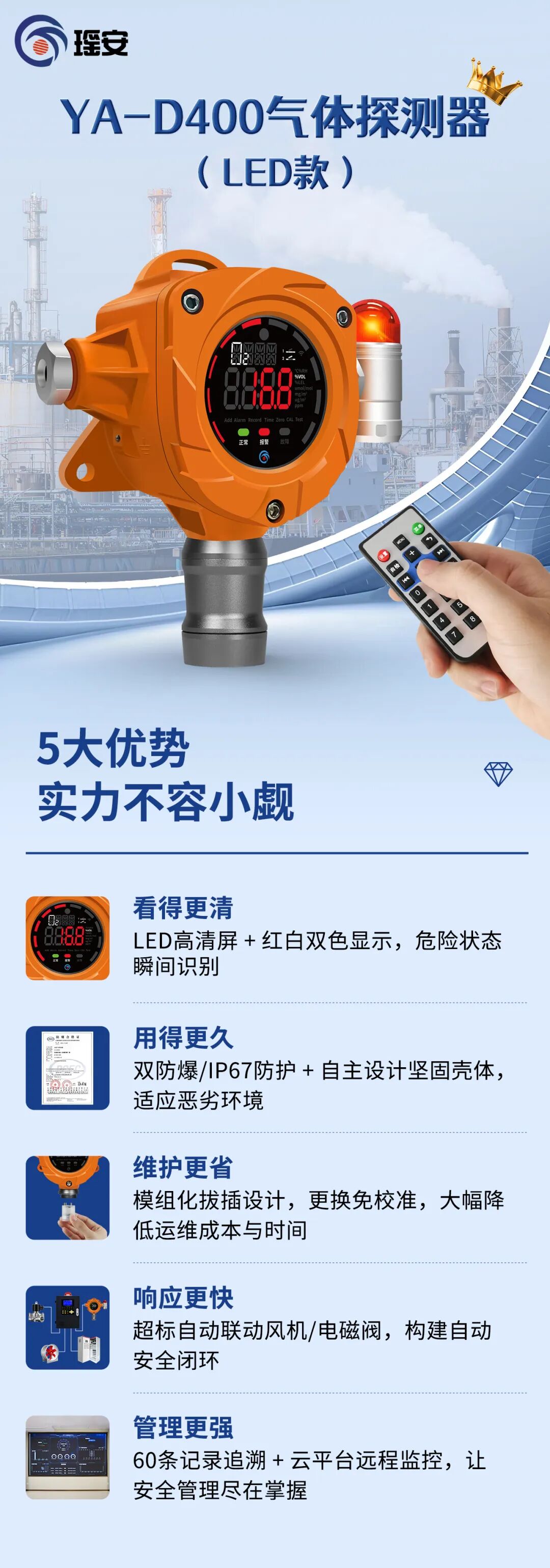
The selection of gas leak detection equipment was incorrect, and a methane detector was used instead of a propane detector.
The equipment in the pump room and storage tank area is leaking, and the leakage value exceeds the safe range.
The combustible gas alarm controller shows a leak, but the hidden danger was not promptly investigated.
The storage area for hazardous chemicals is too close to open flames and heat sources without isolation measures.
There is no dedicated person to supervise the loading and unloading of hazardous chemicals, and anti-static and explosion-proof measures have not been implemented.
The ledger of hazardous chemicals is unclear, the records of inbound and outbound inventory are incomplete, and the flow direction is unclear.
The pressure reducing valve and hose of the gas cylinder are aging and damaged, and have not been regularly inspected and replaced.
The disposal of hazardous chemicals does not comply with regulations, and there is a situation of arbitrary disposal.
The use of non explosion proof tools in explosion-proof areas poses a risk of ignition sources.
(3) Construction industry (10 items)
The excavation of the foundation pit was carried out by digging method, but the slope was not set according to the plan and there were no effective support measures.
The scaffolding is not set up in a standardized manner, the spacing between poles exceeds the standard, and the diagonal braces are not continuous or firm.
There are no protective railings or covers set up near the edges or openings, and the safety net is damaged but not replaced.
The approval of the special construction plan for high formwork was incomplete, and the construction was not carried out according to the plan.
The lifting machinery has not been regularly inspected, and the steel wire rope has defects such as broken wires and rust.
There is no warning area set up for lifting operations, no dedicated person to supervise, and there is a phenomenon of high-altitude throwing.
The temporary power supply at the construction site has not achieved three-level distribution and two-level protection.
The personnel working at heights did not fasten their safety belts, or the safety belts were not hung high or used low.
The interlocking device of the construction elevator door failed and was not repaired in a timely manner.
Carrying out dangerous operations such as outdoor high-altitude work and lifting in adverse weather conditions in violation of regulations.
(4) Other specialized industries (10 items)
The conveyor belt terminal of the express sorting site is not equipped with safety protection devices.
The ethanol vapor concentration alarm in the distillery is installed too high and not interlocked with the ventilation facilities.
The dust contaminated workshop did not use explosion-proof electrical equipment, and the power supply line layout did not meet explosion-proof requirements.
The workshop floor, steel frame, and distribution cabinet of the grain processing enterprise have accumulated excessive dust and have not been cleaned up in a timely manner.
There is no call button installed at the entrance of the cold storage, and there is no external call signal display.
The combustible gas alarm probe in the gas boiler room malfunctioned and was not replaced or repaired in a timely manner.
The dynamic monitoring platform for hazardous chemical transportation vehicles has failed, and the warning information has not been processed.
Shipping companies have not signed labor contracts with crew members as required and have not purchased relevant insurance.
The fire prevention distance between Baijiu storage tank farm and buildings is insufficient, and no automatic fire alarm system is set.
The goods in the logistics and warehousing area obstruct the fire-fighting facilities, and the automatic fire extinguishing system cannot be activated normally.
03 Emergency support category (20 items)
No targeted emergency rescue plan has been developed, or the content of the plan is hollow and lacks operability.
The emergency drill became a formality and was not conducted according to the prescribed frequency, with no drill evaluation report.
Insufficient emergency rescue equipment, such as fire extinguishers, first aid kits, etc.
The selection of emergency equipment is incorrect and cannot adapt to potential safety accidents that may occur on site.
The staff are not proficient in using emergency equipment such as leak detectors and respirators.
Emergency lighting and evacuation signs are damaged and cannot be used normally after power failure.
The emergency broadcasting system is malfunctioning, making it impossible to promptly notify personnel to evacuate in the event of an accident.
No emergency rescue team has been established, or the team has not received professional training.
The storage location of emergency supplies is remote, with unclear markings, making it difficult to quickly access them in emergency situations.
The emergency plan has not been linked and coordinated with surrounding enterprises and rescue agencies.
Insufficient reserve of emergency response materials for hazardous chemical spills, such as absorbent cotton, oil containment booms, etc.
After the emergency drill, the problems were not summarized and the emergency plan and process were not optimized and adjusted.
Fire protection facilities are not regularly inspected and maintained, fire hydrants are corroded, and fire extinguisher pressure is insufficient.
The limited space operation is not equipped with emergency rescue equipment and no off-site monitoring personnel have been arranged.
The emergency communication equipment has insufficient power and poor signal, making it impossible to communicate normally in case of an accident.
No accident scene disposal plan has been developed, and employees are unclear about the specific emergency operation steps.
The emergency passage signs are not clear, and there is no auxiliary lighting at night, which affects evacuation efficiency.
Medical emergency supplies have expired and not been replaced, which cannot guarantee the initial treatment of injured persons.
No emergency knowledge training has been conducted, and employees are unclear about the reporting phone number and evacuation route.
Emergency drills did not cover key positions and high-risk scenarios, such as fires and hazardous chemical spills.
04 Archives and Training (20 items)
Falsification of safety production training records, without actual training materials, attendance sheets, and assessment papers.
The hidden danger investigation file is a false closed loop, with only inspection records and no records of rectification and re examination.
The occupational health records are incomplete, and employee physical examination records are missing or not updated in a timely manner.
The safety training content is single and there is no specialized education on job risks.
New employees did not receive Level 3 safety education and training, and were directly assigned to work.
The training records are not classified and archived, making it difficult to search and trace.
Failure to establish training records for special operation personnel, incomplete copies of certificates and other materials.
The safety meeting minutes were perfunctory and did not record the core decisions and requirements for problem rectification.
The lack of equipment maintenance records cannot prove that the equipment is in a safe operating state.
The accident report file is incomplete, without recording the cause of the accident, corrective measures, and accountability.
The safety technical disclosure record is signed by both parties, or the disclosure content does not match the actual process.
The emergency drill footage and written materials have not been retained, making it impossible to support the progress of the drill.
The occupational hazard testing report has not been archived, and the testing results have not been made public to employees.
Training and assessment are merely formalities, and unqualified employees are not arranged for make-up exams or retraining.
The ledger for the use of safety production expenses is unclear and lacks detailed expenditure vouchers.
Employee safety violation records have not been archived and are not used as a basis for assessment and retraining.
The lack of cross departmental security collaboration records makes it difficult to trace responsibility boundaries.
The regulatory authorities have not properly kept the inspection documents, and the rectification response documents have not been archived.
The safety facility acceptance file is incomplete, lacking testing reports and acceptance opinions.
The training instructor lacks relevant qualifications, the training quality cannot be guaranteed, and there is no record of training effectiveness evaluation.
Source: Energy Frontline, copyright belongs to the original author. If there is any infringement, please contact us