-
E-mail
15618576711@163.com
-
Phone
15618576711
-
Address
901, No. 4, Lane 1118, Jintong Road, Putuo District, Shanghai
Shanghai Chifeng Electromechanical Equipment Co., Ltd
Do you really understand the composition of XPA toothed V-belt?
Date: 2022-08-12Read: 10
XPA toothed V-beltIt is generally composed of a cloth cover layer, a stretching layer (top glue), a strong layer (stretching layer), and a compression layer (bottom glue).
1. Cover layer: The cover layer is composed of plain rubber canvas (mainly cotton canvas and polyester cotton canvas) cut at a 45 ° angle. It has excellent elasticity and friction, which can connect the various parts of the V-belt into a whole, protect the other parts of the V-belt from wear and erosion, and increase the straightness of the V-belt.
2. Stretch adhesive layer: The stretch adhesive layer is composed of rubber materials with high elasticity and excellent tensile properties, which can withstand the tensile stress of the V-belt during operation and bending, and play a buffering and protective role in the reinforcement layer of the steel strip.
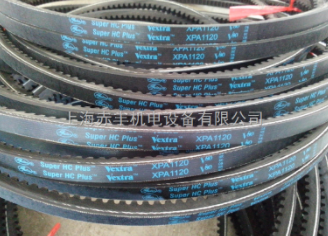
3. Reinforcement layer: The reinforcement layer is the skeleton of the triangular belt. The main types include polyester cord fabric, polyester toughened palm fiber, aramid cord fabric, and impregnated cord fabric. Used to withstand the tensile and other stresses generated during the operation of the V-belt. It is the main stress component in the XPA toothed V-belt transmission process.
4. Buffer adhesive: Around the strong layer, there is a layer of rubber with good bonding strength to the core, called buffer adhesive, which plays a role in fixing the core and can absorb the dynamic shear stress caused by frequent deformation of the core.
5. Compressed rubber layer: The compressed rubber layer is composed of rubber materials with excellent bending fatigue resistance, which can withstand the compressive stress generated during the bending process, maintain the rigidity and elasticity of the V-belt, and increase the cross-section of the V-belt and the friction contact surface with the pulley, thereby improving transmission efficiency.
Due to the different functions of different parts, the rubber formula used is also different. Before installing the XPA toothed V-belt, if the center distance between the two axes is adjustable, the center distance should be shortened first, and then adjusted according to the requirements after installing the tape; If the center distance between the two axes cannot be adjusted, you can first insert one V-belt into the wheel groove, and then rotate the other pulley to install the V-belt. The same method can be used to install a set of triangular straps. During installation, it is strictly prohibited to pry or drag the V-belt with tools to prevent it from stretching or becoming too loose or tight. The correct inspection method is to apply a vertical pressure of about 2 kg in the middle of each belt by hand, with a sinking amount of (20-30mm). If there is anything inappropriate, it should be adjusted in a timely manner. When two or more V-belts need to be replaced, the specified model of V-belt should be selected, and the tightness of each set of V-belts should be consistent. Mixing old and new or reducing the number of triangles is not allowed. Otherwise, the force on the old and new triangular belts will be uneven, and even the old triangular belt may not work, affecting power transmission and shortening the service life of the triangular belt.