-
E-mail
2801283106@qq.com
-
Phone
15821569256
-
Address
No. 121, Building 2, No. 655 Gaoji Road, Sijing Town, Songjiang District, Shanghai
Download
Shanghai Shirun Industrial Co., Ltd
Repeatability testing of electronic scales
Date: 2025-12-16Read: 10
Repeatability testing of electronic scales
Repeatability refers to the consistency between the results obtained from multiple consecutive measurements of the same object under the same measurement conditions. The measurement repeatability of an electronic balance is a required inspection item in JG1036-2008 "Verification Regulations for Electronic Balance", and its technical indicators are also an important basis for selecting an electronic balance. Especially when using an electronic balance as a measuring instrument for verifying weights, the size of repeatability is even more important. -Electronic balance repeatability
When choosing an electronic balance, its repeatability is often determined based on the user manual or brochure of the electronic balance. The smaller the repeatability, the better the repeatability performance of the electronic balance. But when choosing, we should also be aware that the repeatability indicators indicated in the user manual or brochure of the electronic balance may not be consistent with our understanding.
According to the verification method provided in JG1036-2008 "Verification Regulations for Electronic Balance", the repeatability of an electronic balance refers to the difference between the large and small values of the measured values when a weight not less than 80% of the electronic balance's large weight is loaded onto the electronic balance 6 times (10 verifications). There are generally two types of repetitive representations in electronic balance manuals or brochures:
One of them uses the range value of multiple measurements to represent, which is basically consistent with the "Electronic Balance Calibration Regulations", both of which subtract the small value from the large value of multiple measurements;
Another way to express it is through standard deviation, which is to use the standard deviation of a single measurement result obtained by cycling ABA 6 times under a specified load.
The actual operation method is:
Using the same weight for 15 consecutive measurements, the standard deviation of the measurement results is calculated using the Bessel formula. The repeatability calculated in this way is generally considered typical repeatability, and the repeatability obtained by this method is significantly lower than that calculated using the range method. When the user manual or brochure does not indicate typical repeatability or evaluation methods, it is easy to confuse users,
Distinguishing between two types of repetition
When the user manual or brochure of an electronic balance does not indicate the repeatability or evaluation method, we can quickly identify it through simple observation.
Due to the use of standard deviation to represent typical repeatability, its value may sometimes exceed the small division value of the electronic balance by one digit. When this situation is discovered, we can accurately determine it as typical repeatability. There is another situation where if the number of digits is the same and the repeatability is marked as<0.2 (or 0.1) small division values, we can generally conclude that it is typical repeatability
How to choose an electronic balance based on repeatability
How to choose an electronic balance mainly depends on its usage. If a single reading is often used as the final measurement result, it is suitable to choose based on the repeatability (range) of the electronic balance.
When the repeatability given in the electronic balance user manual or brochure is typical repeatability, we can approximately use the typical repeatability sx3.47 to estimate (3.47 is the range coefficient when measuring 15 times). When using an electronic balance and taking the average of multiple measurements as the measurement result, the typical repeatability of the electronic balance can be directly used to determine whether the repeatability of the electronic balance meets the requirements.
If repeatability is given through the range method, the standard deviation obtained by dividing repeatability (range) by the range coefficient corresponding to the number of measurements is used to determine whether the repeatability of the electronic balance meets the experimental requirements.
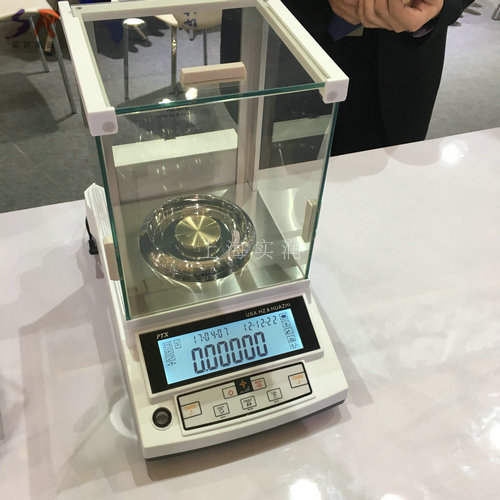
Repeatability testing of electronic scales