-
E-mail
sales@cet-electric.com
-
Phone
18126283820
-
Address
35F, Block A, Building 6, Dashi 1st Road International Innovation Valley, Nanshan District, Shenzhen
Shenzhen Zhongdian Electric Power Technology Co., Ltd
How can three-phase rail meters become a key node in distributed energy measurement?
Date: 2025-11-18Read: 6
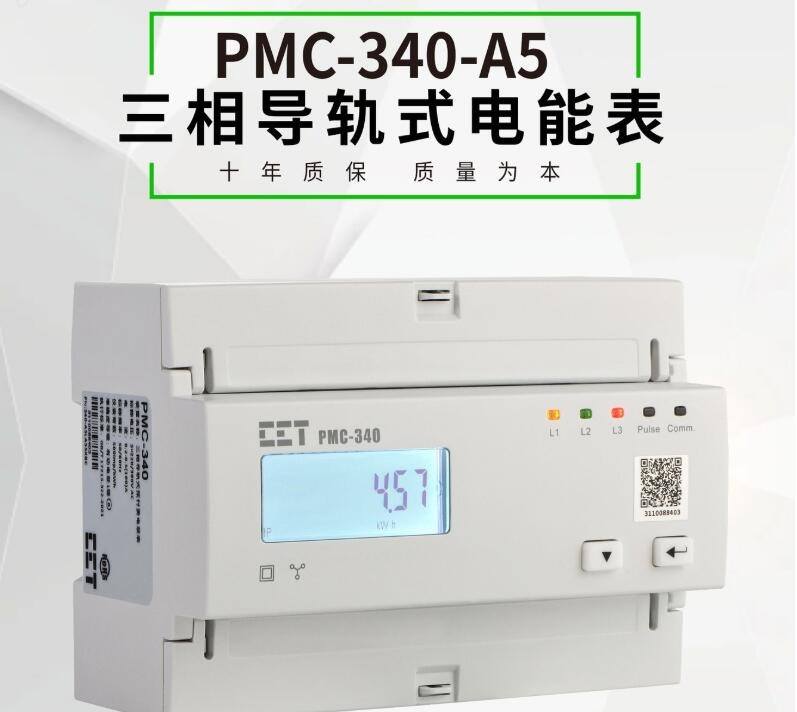
In the traditional centralized power supply mode, the electricity meter is just a "bookkeeping tool" located at the end. But in a distributed energy system characterized by "spontaneous self use and surplus electricity grid connection", the electricity meter needs to become a "data decision center" located at the network hub. The three-phase rail electric meter, with its convenient installation, three-phase measurement capability, rich data dimensions, and flexible communication function, effectively fulfills this role and becomes a "key node" connecting the transmission, use, storage, and distribution links.
1、 From "accounting tool" to "nerve endings": a fundamental shift in roles
In distributed energy systems, the flow of electricity changes from unidirectional to bidirectional/multi-directional.
-Traditional electricity meters: only responsible for measuring the amount of electricity flowing from the grid to users (one-way), with a single function.
-Key node electricity meter: It must be able to measure energy flow in multiple directions simultaneously and with high accuracy
1. The amount of electricity injected into the grid by photovoltaic power generation.
2. The amount of electricity transmitted from the power grid to users.
3. The amount of electricity consumed by the user themselves.
4. The amount of electricity stored in an energy storage battery for charging (taking power from the grid or photovoltaics) and discharging (supplying power to users).
The three-phase rail electric meter is the "advanced accountant" born for this complex flow measurement. It clearly defines the source and destination of each kilowatt hour of electricity, and is the basis for economic settlement and energy efficiency analysis of the system.
2、 The four core values of 'key nodes'
The key lies in the following four aspects:
1. Accurate measurement: the cornerstone of systematic economic settlement
-The core of distributed energy projects, especially photovoltaics and energy storage, is investment return. All revenue calculations, such as "electricity cost savings from self use", "revenue from surplus electricity grid connection", and "peak valley price arbitrage", rely on the absolute accuracy and fairness of electricity meter data.
-The high-precision measurement of three-phase rail electricity meters (usually at 0.5S or 1 level) ensures fairness in the interests of both buyers and sellers, and is a technical guarantee for project credibility and financial feasibility.
2. The 'perception organ' of the system: achieving real-time monitoring and intelligent control
-It is not only an 'accountant', but also a 'perceptron'. By monitoring all parameters such as voltage, current, power, power factor, and frequency in real-time, it becomes the "eyes" and "ears" of the system.
-Application example:
-Reverse power protection: When surplus power is detected and sent back to the higher-level power grid (without permission), a signal can be immediately sent to cut off the grid switch to protect the safety of the power grid.
-Load management: Real time monitoring of total user load, automatically adjusting non critical loads or initiating energy storage discharge when power approaches critical values, to avoid fines due to overcapacity.
-Power quality analysis: Monitor harmonics, voltage dips/spikes, and help locate the impact of distributed power source access on local grid quality.
3. The 'transportation hub' of data: Empowering Energy Management Systems (EMS)
-The three-phase rail electric meter uploads the collected massive data in real-time to the energy management system (EMS) or cloud platform through communication methods such as RS485, LoRa, 4G, etc.
-In this role, it is a data gateway. The EMS brain relies on the real-time data it provides for analysis and decision-making, such as:
-Determine whether to charge or discharge the battery based on the current power generation and consumption.
-According to the time of use electricity price, determine when to buy electricity from the grid and when to sell electricity to the grid.
-Without the key node of electricity meters providing accurate and timely data, all optimization strategies of EMS will become passive water.
4. The 'flexibility' of installation: facilitating rapid deployment of distributed projects
-The rail mounted installation is a huge advantage compared to traditional transformer connected electric meters. It can be directly mounted on a standard DIN rail, with installation as simple as installing a circuit breaker, without the need for complex transformer wiring and calibration.
-This "plug and play" feature greatly shortens installation time and reduces construction costs, making it particularly suitable for widespread application in compact distribution boxes, existing distribution cabinet renovations, and distributed energy projects that require rapid deployment.
3、 The role of "nodes" in typical application scenarios
1. Industrial and commercial rooftop photovoltaic+energy storage system:
-Node location: Installed at the grid access point (grid connection point).
-Function: Accurately measure the photovoltaic power generation, on grid electricity, and off grid electricity, and link with the energy storage system to achieve demand management, peak valley arbitrage, and optimize project revenue.
2. Integrated charging station for light storage and charging:
-Node location: Installed on the power supply line of the charging station.
-Function: To measure the energy consumption of charging stations, while coordinating with photovoltaic and energy storage systems to optimize energy dispatch within the station, reduce capacity demand on the power grid, and achieve green charging.
3. Regional microgrid:
-Node location: Installed at the connection between the microgrid and the main grid (grid/off grid), as well as at the outlets of various important loads or distributed power sources.
-Function: As the "main table" and "sub table" of microgrids, it is the core measuring equipment for internal settlement, stable operation, and friendly interaction with the main grid of microgrids.
The three-phase rail electric meter has evolved from a simple measuring tool to an infrastructure that integrates precise measurement, real-time monitoring, data exchange, and intelligent control. It is like the "nerve endings" of a distributed energy network, accurately sensing the pulse of energy in every part of the system, and gathering information to the "brain" (EMS), thereby achieving efficient, stable, and economical operation of the entire system. The fundamental reason for becoming a 'critical node'.