-
E-mail
yang.yi@niumag.com
-
Phone
18516712219
-
Address
No. 97 Qinglian Road, Huguan Industrial Zone, Suzhou City
Suzhou Neway Analytical Instrument Co., Ltd
How to achieve monitoring of the regulation process of hydrate amino acid promoter? Low field nuclear magnetic resonance technology provides solutions
Date: 2025-12-18Read: 102
Application background: From "blind screening" to "precise regulation"
With the increasing demand for clean energy worldwide, utilizing hydrate technology for gas storage and separation has become crucial. However, in practical applications, problems such as slow hydrate formation rate, long induction time, and difficulty in controlling product morphology still exist. Traditional research methods often rely on static observation or offline sampling analysis inside pressure vessels, which not only makes it difficult to capture the transient process of hydrate formation, but may also damage internal structural information due to sample extraction. Therefore, the academic community urgently needs a technology that can penetrate the interior of the sample and accurately feedback changes in water phase and fluid distribution.
Core principle: "Signal decoding" in the microscopic world
The core of low field nuclear magnetic resonance (LF-NMR) technology is to detect the magnetic resonance properties of hydrogen nuclei.
When a sample placed in a constant magnetic field is excited by radio frequency pulses, hydrogen nuclei absorb energy and undergo energy level transitions; After the pulse stops, the hydrogen nucleus releases energy and generates a resonance signal. In hydrate research, water in different states has different transverse relaxation times (T2). By analyzing the T2 relaxation spectrum, we can decompose complex mixed signals into:
Short T2: Component: usually corresponding to water bound to the lattice or pore walls of hydrates;
Long T2: Component: usually corresponds to liquid free water or water in large pores.
This "fingerprint like" analysis enables us to accurately distinguish the degree of hydrate formation, pore filling, and the adsorption/activation effect of promoters on water molecules.
Application of Hydrate Amino Acid Promoter Regulation
In the study of amino acids (such as leucine, methionine, etc.) as hydrate kinetics promoters, LF-NMR mainly plays the following three core functions:
Real time monitoring of generated dynamics
By continuously collecting T2 spectra, the process of hydrate formation can be tracked in milliseconds. Research has shown that after adding amino acids, the short relaxation component signal representing the hydrate phase in the T2 spectrum rapidly increases, and the induction time is significantly shortened. This intuitively proves that amino acids lower the nucleation barrier and accelerate the phase transition process.
Quantitative evaluation promotes efficiency
Compared to qualitative visual observation, LF-NMR can calculate hydrate saturation at different times by integrating the T2 spectral peak area. For example, in a CO2 hydration system, as the reaction progresses, the long T2 signal representing liquid water decays, while the short T2 signal representing solid/semi-solid hydrates increases. This quantitative relationship provides data support for screening the optimal concentration of amino acids.
Analyze micro mechanisms
How do amino acids promote the formation of hydrates? LF-NMR combined with relaxation time analysis suggests that amino acid molecules may be embedded on the surface of hydrates through hydrogen bonding, altering the local ordering of water molecules and thus affecting the shape of the T2 distribution curve. This is crucial for understanding the molecular level mechanism of action of "green accelerators".

Figure 1: Nuclear magnetic signals at different stages of hydrate formation

Figure 2: Layered NMR signals at different stages of hydrate formation
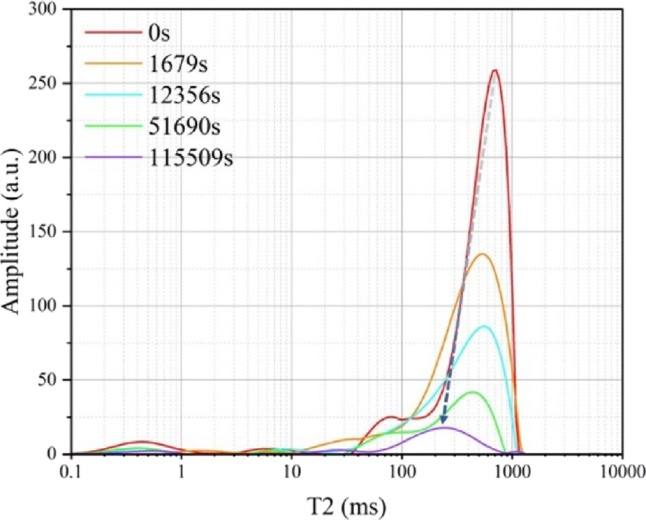
Figure 3: T2 spectrum during hydrate formation process
Advantage comparison: LF-NMR vs traditional methods
Why do more and more scientists tend to choose low field nuclear magnetic resonance in the research of amino acid promoters?
Traditional detection methods
Destructive: Typically requires centrifugation, filtration, or drying of samples, making it impossible to continuously monitor the same batch of samples.
Time consumption: Chemical titration or color reaction often takes several minutes or even hours.
Single information: mainly obtaining final weight or volume data, lacking insight into internal microstructure.
Low field nuclear magnetic resonance (LF-NMR)
Non destructive real-time: The sample is in situ throughout the entire process and can be continuously monitored for hours or even days.
Multidimensional characterization: simultaneously providing information on water content, porosity, fluid distribution, and phase changes.
High precision: Low repeatability error, able to capture small concentration changes and kinetic differences.
The monitoring of the regulation process of hydrate amino acid promoters is undergoing a transition from "macroscopic observation" to "microscopic analysis". Low field nuclear magnetic resonance technology, with its keen perception of hydrogen nuclear magnetism, has successfully solved the shortcomings of traditional methods in real-time and non-destructive aspects. It can not only record every moment of hydrate formation like a "movie camera", but also see through the fluid distribution inside the sample like a "CT scanner". For the development of efficient and environmentally friendly amino acid hydrate accelerators, LF-NMR is an indispensable "eye of wisdom".