-
E-mail
hkt@huikete.com.cn
-
Phone
13921186818
-
Address
Room 1001, Building 6, Xiexin Center, No. 19 Hefeng Road, Xinwu District, Wuxi City
Wuxi Huikete Measurement and Control Technology Co., Ltd
The difference between 485 and RS485
Date: 2025-12-09Read: 13
In the field of industrial communication, these two terms are indeed a high-risk area for confusion. The simple and direct answer is: "485" is usually used as an imprecise colloquial term or abbreviation, referring to the "RS-485" standard. In the vast majority of industrial application scenarios, they refer to the same thing - the serial communication electrical interface defined by the TIA/EIA-485 standard. Below is a detailed breakdown of their connections and differences, as well as why this kind of mixing occurs.
Core concept clarification:
RS-485 (full name TIA/EIA-485-A)
Essence:This is an international standard officially released by the Electronic Industries Association/Telecommunications Industry Association of America. It clearly defines the electrical characteristics of transmitters and receivers in digital communication systems.
Key features:
1) Differential signal transmission: Using a pair of twisted pair wires (A/B or+/-) to transmit voltage differences, it has strong resistance to common mode interference and is suitable for long-distance, noisy industrial environments.
2) Multipoint communication: Multiple (usually up to 32) transceiver devices can be mounted on a bus.
3) Half duplex mode: At the same time, the bus can only be used for sending or receiving, and cannot be used simultaneously. Direction needs to be controlled through mechanisms such as request sending/clearing sending.
4) Positioning: RS-485 only defines the electrical specifications of the physical layer, namely "how many volts represent 1, how many volts represent 0, how much load can be carried, and how far the transmission distance is". It doesn't care about data format and protocol.
2.“485”
Essence:This is an industry slang, abbreviation, or "jargon" widely circulated among engineers, salespeople, and project sites.
meaning:When people say 'use 485 communication', 'connect a 485 line', or 'this sensor outputs 485', 99% of the time they are referring to communication interfaces that comply with the RS-485 electrical standard.
Ambiguity:This abbreviation is not rigorous because it ignores a core point: RS-485 is just an electrical standard, and it is not a complete communication protocol in itself.
How to understand the key to their relationship: a classic metaphor, imagine you have to communicate with people in Chinese:
Chinese ": defines pronunciation rules (similar to electrical characteristics) and basic grammar (similar to signal logic).
A specific conversation: "Hello, please send me the temperature data." (This is like an application layer protocol).
here
485 "/RS-485 is equivalent to" using Chinese ". It ensures that both parties can use the same "pronunciation system" to transmit signals.
The actual protocols running on the 485 bus, such as Modbus RTU, Profibus DP, BACnet MS/TP, etc., are equivalent to the specific content and rules of the conversation.
Important distinction: RS-485 vs. RS-232, another common confusion is comparing "485" with "232", which helps to understand:
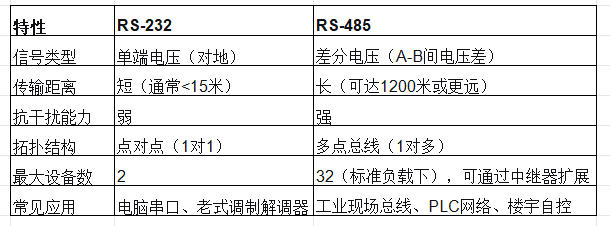
When selecting a humidity sensor, if its communication method is labeled as "RS-485" or simply "485", you need to clarify the following points:
1. The electrical interface has been determined: it uses differential signals and can be reliably connected to your PLC or data collector over long distances (tens to hundreds of meters), resistant to electrical interference that may exist near the transmission window.
2. Protocol not yet determined: You must further confirm the specific application layer protocol used by the sensor. The most common is Modbus RTU, but it may also be a custom protocol from other vendors.
3. Wiring: Usually, A (+), B (-) or Data+, Data - identifiers are seen, as well as a signal ground (GND). It must be connected correctly.
4. Configuration: It is necessary to set a station address (such as 1, 2, 3...) and the same communication parameters (baud rate, data bits, stop bits, parity bits, such as 9600, 8, 1, N) for each device (including sensors) on the bus.
Summary and Suggestions:
Starting from technical rigor, please use "RS-485". Standard terminology should be used in documents, drawings, and procurement specifications.
When hearing "485", it should be understood as RS-485 interface and immediately asked: "So, what is the specific communication protocol? Is it Modbus RTU? ”
For your humidity sensor: After confirming that it has an RS-485 interface, the most critical step is to verify the protocols it supports and ensure that your control system (such as PLC) can support and configure the protocol to read data.
In short, "485" is a colloquial reference, while "RS-485" is a standard name that refers to the same thing at the physical interface level. But the complete communication solution is RS-485 electrical standard+application layer communication protocol.