-
E-mail
1714578587@qq.com
-
Phone
15989761119
-
Address
Room 502, Taiwan Business Association Center, No. 2029 Mingzhu South Road, Zhuhai City
Zhuhai Obert Measurement and Control Technology Co., Ltd
What is a hazardous area? How can intrinsically safe humidity sensors help reduce risks?
Date: 2025-12-08Read: 10
The safety of personnel in industrial or process driven work environments has always been an important concern for regulatory agencies. Therefore, the Health and Safety Executive (HSE) in the UK defines a hazardous area as "any place where explosive environments may occur in large quantities, where special precautions are required to protect the safety of workers". Although the exact wording may vary from country to country, security agencies and industries around the world generally agree with this definition.
To trigger an explosion, there must be three elements: fuel (gas, liquid, powder, or dust); Sufficient concentration of oxygen (above the ignition threshold of 16.2%); Ignition source (flame, hot surface, electrostatic discharge or spark). Removing one or more of these elements will prevent explosions.
However, in many applications, the raw materials or products used or processed are fuel sources, ranging from natural gas, refined petroleum derivatives to vapors of chemicals and solvents, powder products such as milk and flour. Therefore, removing the fuel source as a component is not an option.
In most cases, eliminating the presence of oxygen is impractical. If the location does not require personnel and can be enclosed, an inert gas/air mixture can be introduced: for example, increasing the nitrogen concentration to safely lower the oxygen level below the ignition threshold. However, in large-scale production or process areas that require manual external locations or applications, it is impossible to reduce the oxygen content in the surrounding atmosphere.
A good choice is often to either remove potential ignition sources or isolate them in a way that does not pose a risk.
Controlling these factors depends on the combination of common sense and typical practices defined by health and safety organizations, as well as the correct design, installation, and operation of electrical equipment. This must comply with standards established by national and international security organizations such as ATEX, UKCA, IECEx, GOST and TR CU, NEC and CEC.
Classification of Hazardous Areas
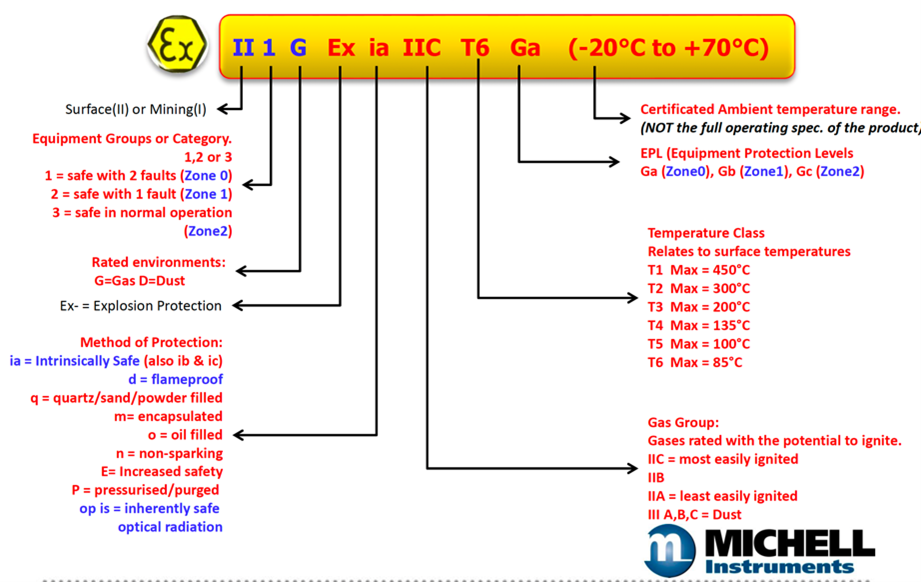
Generally speaking, a series of categories constitute the specifications of products such as the explosion-proof Easeside PRO XP. This device is used in explosive areas. These categories define the design purpose, level environment, safety level, gas composition, operating temperature, and equipment protection level of the product. See the following example:
Intrinsic Safety (I.S.) products
When manufacturing intrinsically safe products, reduce the energy required or generated to a level that will not cause ignition: for example, when using Easidew I.S. dew point transmitters, the risk of sparks is eliminated and the operating temperature is maintained at the lowest possible level. In addition, they often include specialized fail safe mechanisms, current isolated outputs, advanced sealing, and enclosures with protection levels of IP65 or higher.
At Michell, we have a range of intrinsically safe, explosion-proof, and fire-resistant sensors and systems for measuring dew point, micro water, and hydrocarbon dew point. These products include Easew I.S. dew point transmitters, explosion-proof Easew PRO XP, and Liquidew I.S. liquid-phase water analyzers.
It should be noted that installing intrinsically safe and certified dew point sensors or transmitters will not result in the entire water or hydrocarbon dew point measurement system reaching I.S. In a typical I.S. system, the safe operation of each component depends on the integrity of all other components: for example, the safety of a dew point sensor will depend on the amount of energy provided through a power interface, which can be located within or outside the designated I.S. area. Therefore, careful system design and installation are crucial, and our I.S. technical team provides extensive advice and technical support to ensure that the I.S. dew point and humidity measurement system is specific and operates efficiently and safely.
We have a professional team for humidity installation in hazardous areas.
With nearly 50 years of experience in developing innovative precision sensors, we have a professional team for dew point and gas measurement applied to specific hazardous and explosive areas.
Last Article: Oxygen and humidity: an expensive combination
Next Article: Application of Industrial Dew Point Sensor