09,22,2026 19 views
In the field of modern analytical chemistry, ion chromatography, as an efficient separation and detection device specifically designed for analyzing ionic compounds, has become a core tool in various fields such as environmental monitoring, food safety, biomedicine, and industrial production due to its high sensitivity, high selectivity, and fast accuracy. It can accurately "capture" trace or even trace amounts of ion components in samples, providing reliable data analysis support for scientific research exploration and practical production, and helping humans to have a deeper understanding of the microscopic composition and characteristics of substances.
1、 Basic definition and core principles of ion chromatography
Ion chromatography is a liquid chromatography analysis instrument developed based on the principle of ion exchange chromatography. It is mainly used for separating and detecting cations (such as Na ⁺, K ⁺, Ca ² ⁺, Mg ² ⁺, etc.) and anions (such as Cl ⁻, SO ₄ ² ⁻, NO ③⁻, HCO ③⁻, etc.) and can also be used for analyzing some polar organic compounds in solutions. The core principle is to utilize the difference in affinity between different ions and ion exchange resins to achieve efficient separation of mixed ions, and then convert the separated ion signals into quantifiable electrical signals through a detector, ultimately obtaining information on the types and contents of each ion in the sample.
Compared with traditional liquid chromatography, the significant feature of ion chromatography is the use of ion exchange stationary phase and conductivity detector (or other ion selective detector), and suppressors are usually required in anion analysis to reduce the background conductivity of the eluent and improve detection sensitivity. This special design enables it to address the analytical challenges of ionic compounds in a targeted manner, making up for the shortcomings of other chromatographic techniques in this field.
2、 The core components of an ion chromatograph
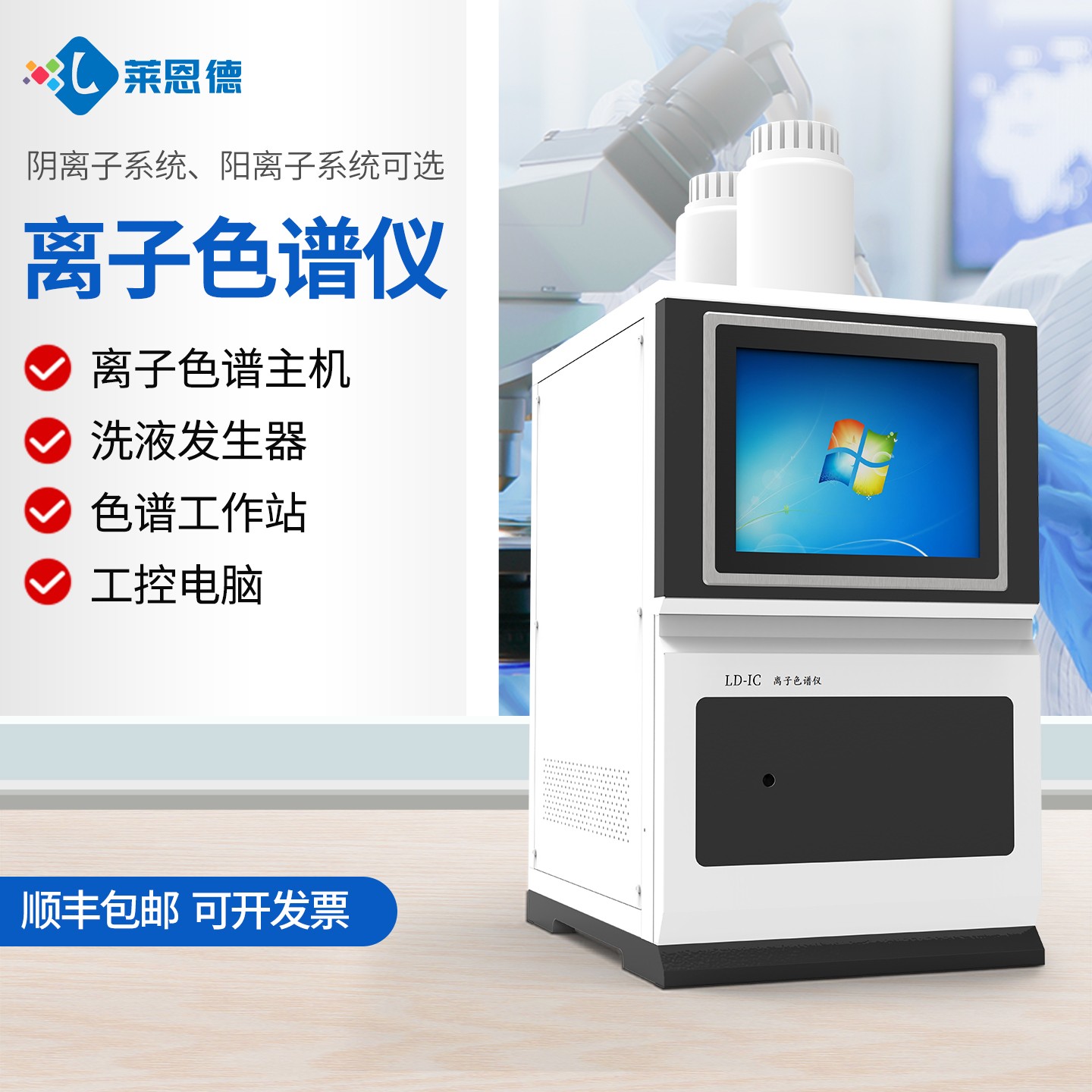
A complete ion chromatograph mainly consists of five parts: eluent system, injection system, separation system, detection system, and data processing system. Each component works together to ensure the efficiency and accuracy of the analysis process.
(1) Rinse solution system
The eluent system is the "power source" of the ion chromatograph, mainly composed of eluent bottles, high-pressure pumps, online degassing devices, etc. Its core function is to provide a stable and continuous eluent (usually a buffer solution with a certain ionic strength) for the separation process, and to transport the eluent to the separation column at a constant flow rate through a high-pressure pump. The online degassing device is used to remove bubbles from the washing solution, avoiding interference from bubbles on the separation effect and detection signal. The stability of the high-pressure pump directly affects the accuracy of the eluent flow rate, which in turn determines the repeatability and reproducibility of separation, making it a key component in the eluent system.
(2) Sample injection system
The function of the injection system is to accurately and quantitatively introduce the sample to be analyzed into the eluent flow path, so that it enters the separation column together with the eluent for separation. The common injection methods include manual injection and automatic injection. Manual injection is suitable for analyzing small amounts of samples and is easy to operate but has poor repeatability; Automatic injection is achieved through an injector to automatically extract and inject samples, which has the advantages of high injection accuracy, good repeatability, and continuous injection. It is widely used in the analysis of batch samples. The sealing of the injection system and the accuracy of the injection volume are important prerequisites for ensuring the reliability of the analysis results.
(3) Separation system
The separation system is the "core heart" of ion chromatography, mainly composed of a separation column and a protective column, among which the separation column is a key component for achieving ion separation. The separation column is filled with ion exchange resin, which can be divided into cation exchange column and anion exchange column according to different analysis objects. When the mixed ion sample flows through the separation column with the eluent, different ions undergo reversible ion exchange reactions with the fixed ions on the resin. Due to the different affinities of each ion to the resin, their migration speed inside the column also varies. Ions with weak affinities flow out of the separation column first, while ions with strong affinities flow out later, thus achieving the separation of mixed ions one by one. The protective column is installed at the front end of the separation column to filter impurities in the sample, prevent impurities from contaminating the separation column, and extend the service life of the separation column.
(4) Detection system
The function of the detection system is to convert the separated ion signal into an electrical signal that can be detected and quantified. Common detectors include conductivity detectors, UV visible detectors, amperometric detectors, etc. Among them, conductivity detectors are commonly used in ion chromatographs. In anion analysis, due to the high background conductivity of the eluent, it can interfere with the detection of sample ions. Therefore, a suppressor needs to be added between the separation column and the detector. The core function of a suppressor is to reduce the background conductivity of the eluent while increasing the conductivity signal of the sample ions, thereby significantly improving the detection sensitivity. For example, in anion analysis, suppressors can convert high conductivity cations in the eluent into low conductivity hydrogen ions, effectively reducing background interference.
(5) Data processing system
The data processing system consists of a computer and specialized chromatography workstation software, which is used to receive the electrical signals transmitted by the detector and convert them into chromatograms. Through the chromatographic workstation, operators can perform qualitative and quantitative analysis on chromatograms. Qualitative analysis mainly relies on the retention time of each ion (i.e. the time from injection to outflow from the detector), and compares it with the retention time of the standard sample to determine the type of ion in the sample; Quantitative analysis calculates the accurate content of each ion in the sample by measuring the area or peak height of the chromatographic peak, combined with standard curve method, external standard method, internal standard method, and other methods. In addition, the data processing system also has functions such as data storage, report generation, and spectrum comparison, which facilitate the management and analysis of experimental data.
3、 The main application areas of ion chromatography
With its efficient separation and precise detection capabilities for ionic compounds, ion chromatography has been widely used in various fields such as environment, food, medicine, industry, agriculture, etc., providing strong technical support for quality control, scientific research exploration, and problem investigation in various industries.
(1) Environmental monitoring field
In environmental monitoring, ion chromatography is an important tool for analyzing ion pollutants in water quality, soil, and atmosphere. For example, it can be used to detect anions such as fluoride ions, chloride ions, bromide ions, nitrate ions, nitrite ions, sulfate ions, as well as cations such as sodium ions, potassium ions, calcium ions, magnesium ions, etc. in drinking water, surface water, groundwater, and industrial wastewater, to timely grasp the pollution status of water bodies and provide data support for environmental governance and water quality protection. In addition, it can also be used to analyze exchangeable ions in soil and water-soluble ions in atmospheric particulate matter, helping to trace and control air pollution and soil pollution.
(2) Food safety field
Food safety is closely related to human health, and ion chromatography plays a key role in food testing. It can be used to detect additives (such as nitrite, nitrate, phosphate, etc.), pollutants (such as fluoride, heavy metal ions, etc.), and nutrients (such as minerals such as potassium, sodium, calcium, magnesium, etc.) in food. For example, detecting the nitrite content in meat products to avoid the harm of excessive nitrite to the human body; Detecting fluoride ion content in drinking water and food to prevent fluorosis; Detect mineral content in dairy products and evaluate the nutritional value of food. Strict ion detection can effectively ensure the quality and safety of food.
(3) Biomedical field
In the field of biomedicine, ion chromatography is widely used in drug development, drug quality control, and biological sample analysis. For example, it can be used to detect impurity ions (such as chloride ions, sulfate ions, etc.) in drugs, ensuring the purity and safety of the drugs; Analyze electrolytes in living organisms (such as potassium, sodium, chloride, bicarbonate, etc. in blood and urine) to assist in the diagnosis and treatment of diseases; Studying the metabolites of drugs in the body provides important experimental data for drug development. In addition, it can also be used to detect ion modification sites in biomolecules, assisting in proteomics and metabolomics research.
(4) Industrial production field
In industrial production, ion chromatography is an important equipment for achieving quality control in the production process and product performance testing. For example, in the electronics industry, it can be used to detect trace ion impurities in semiconductor materials and electronic component cleaning solutions to avoid impurities affecting the performance of electronic components; In the chemical industry, it can be used to monitor the generation and consumption of ions during chemical reactions, optimize reaction conditions, and improve product yield and quality; In the power industry, it can be used to detect the ion content in boiler water and cooling water, prevent equipment scaling and corrosion, and ensure the safe and stable operation of power equipment.
4、 The development trend of ion chromatography
With the continuous advancement of technology, ion chromatography is developing towards high sensitivity, high resolution, rapid analysis, intelligence, and miniaturization. In terms of detection technology, the development of new detectors (such as the combination of mass spectrometry detectors and ion chromatographs) has further improved the sensitivity and selectivity of detection, enabling precise analysis of trace ions in more complex samples; In terms of separation technology, the development of new ion exchange materials (such as efficient and fast separation columns) has shortened analysis time and improved separation efficiency; In terms of intelligence, ion chromatography has gradually achieved functions such as automated sampling, automatic calibration, and automatic fault diagnosis, reducing the labor intensity of operators and improving analysis efficiency and data reliability; In terms of miniaturization, the development of portable ion chromatographs has made rapid on-site detection possible, widely used in fields such as environmental emergency monitoring and food safety on-site testing, providing timely data support for rapid response and decision-making.
In addition, the combination of ion chromatography with other analytical techniques (such as atomic absorption spectrometer, inductively coupled plasma mass spectrometer, etc.) has also become a development hotspot, which can achieve comprehensive analysis of various forms and types of substances in complex samples, expanding the application scope of ion chromatography. In the future, with the continuous breakthroughs in materials science, electronic technology, computer technology and other related fields, ion chromatography will play an important role in more emerging fields, providing stronger technical support for scientific research and social development.