
09,22,2026 10 views
Preface
Driven by the dual forces of the global Industry 4.0 wave and digital transformation, the instrumentation industry is undergoing a profound transformation from traditional measurement tools to intelligent perception terminals. As a "multiplier" in the manufacturing industry and a "pioneer" in scientific research, the technological level of instruments and meters directly determines industrial production efficiency and research innovation capabilities. From 2025 to 2030, the Chinese instrument and meter industry will usher in a triple opportunity period of policy dividend release, accelerated technological iteration, and upgraded market demand.
oneThe current development of the industryAnalysis of the situation
(1) The dual resonance of policy driven and market expansion
The rapid development of China's instrumentation industry is attributed to the strong support of national strategies. From "Made in China 2025" to the "14th Five Year Plan", the policy level clearly proposes to break through bottleneck technologies such as sensors and intelligent measurement and control devices, and promote the localization rate of key instruments. Taking the Yangtze River Delta region as an example, Suzhou Industrial Park has gathered 43% of the country's instrument manufacturing enterprises, forming a complete industrial chain from core component research and development to system integration. The policy dividend not only gave birth to billion level industrial clusters, but also promoted the industry to shift from scale expansion to value leap - the proportion of industrial automation instruments increased from 35% in 2020 to 43%, and environmental monitoring instruments developed rapidly at a compound growth rate of 12.5%.
(2) Technological integration reshapes industrial genes
Intelligence, miniaturization, and greenization have become the core directions of industry technological evolution. The deep integration of AI algorithm and industrial Internet enables traditional instruments to have independent diagnosis and adaptive calibration capabilities. The car size level laser radar launched by an enterprise has reduced the cost by 40% through the integration of AI edge computing module, and promoted the penetration rate of automatic driving significantly. In the field of miniaturization, MEMS technology has reduced the size of sensors to the millimeter level, and the detection accuracy of quantum dot sensors has improved by 20 percentage points compared to traditional technologies. Emerging products such as portable water quality detectors and wearable medical monitoring devices are reshaping their application boundaries. In terms of green transformation, the market size of carbon emission monitoring instruments has exceeded 20 billion yuan, and low-power design and recyclable materials have become research and development priorities. The market share of high-precision gas detectors from Focus Technology has increased to 28%.
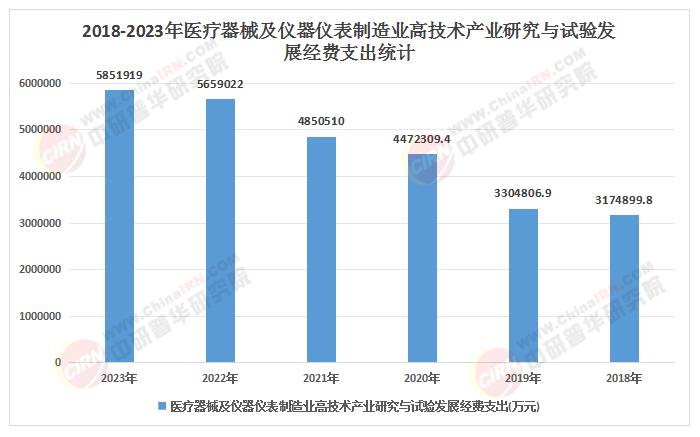
(Data source: Comprehensive industry reports, market research, and public data compilation)
2、 Market analysis of competitive landscape
(1) Vertical integration strategy of top enterprises
The industry concentration continues to increase, with CR5 companies breaking through 38% market share, and top companies building a moat through "technology mergers and acquisitions+research and development innovation". A certain enterprise broke the foreign technology monopoly with its independently developed atomic force microscope, and its annual order volume increased by 200%; Another enterprise has formed a differentiated advantage in the field of environmental monitoring by acquiring overseas spectrometer companies, improving its technology chain layout. This vertical integration mode not only improves gross profit margin, but also promotes the localization rate of advanced mass spectrometer market to exceed 15%.
(2) The path of "specialization, refinement, novelty" for small and medium-sized enterprises
In segmented fields, small and medium-sized enterprises achieve breakthroughs by focusing on scenario based innovation. Taking medical diagnostic equipment as an example, the market size of POCT devices with microfluidic chip technology is growing at an average annual rate of 40%, and imaging diagnostic systems based on AI algorithms are generating new investment opportunities. At the policy level, the 14th Five Year Plan explicitly requires the localization rate of key instruments to be increased to 70% by 2025, with financial subsidies covering 30% of research and development costs, providing a window period for technological breakthroughs for small and medium-sized enterprises.
(3) Gradient development model of regional collaboration
The industrial layout presents a collaborative feature of "Eastern R&D+Central Western Manufacturing". The Yangtze River Delta relies on innovation hubs such as Suzhou Industrial Park and Shanghai Zhangjiang Science City, focusing on the research and development of core components; The Pearl River Delta has formed a billion dollar industrial cluster in fields such as smart meters and environmental monitoring equipment; The central and western regions have attracted industrial transfer through tax incentives and land policies, and the orders for vibration monitoring systems supporting a wind power base in Xinjiang have increased by 300% in three years. This gradient development model not only avoids homogeneous competition, but also enhances overall competitiveness through industrial chain collaboration.
3、 Supply and demand analysis
(1) Demand side: Emerging application scenarios erupt
According to the "In depth Market Research and Investment Strategy Forecast Report on China's Instrumentation Industry from 2025 to 2030" by China Research Institute Puhua, the rapid development of fields such as intelligent manufacturing, biomedicine, and new energy is driving the upgrading of the demand structure for instrumentation. In the field of semiconductor manufacturing, high-precision instruments such as atomic force microscopes and spectrometers have become key tools for chip process validation, and there is an urgent need for domestic substitution; In the medical field, gene sequencers and intelligent diagnostic devices benefit from the continuous release of precision medicine policies and the demand for ultrasound devices; In the field of environmental monitoring, the demand for VOCs and PM2.5 online monitoring systems has maintained a high growth rate of 25%, and the construction of smart cities has driven an explosion in demand for air quality sensors in intelligent transportation monitoring systems.
(2) Supply side: Technological iteration and capacity optimization
Enterprises enhance their supply capacity through modular design and dynamic technology tracking mechanisms. For example, a certain enterprise establishes a monthly technology evaluation mechanism to ensure that product iteration efficiency is six months to one year faster than the market; Another enterprise ensures a stable supply of special alloys and reduces external risks by investing in upstream material companies. In terms of production capacity layout, leading enterprises are accelerating the construction of regional spare parts warehouses. Enterprises that complete their layout before 2025 can gain a cost advantage of 15% to 20%.
4、 Analysis of Industry Development Trends
(1) Intelligence: A paradigm shift from hardware to services
The "hardware+data services" model will become mainstream, with 20% of industry revenue coming from value-added services, including equipment leasing, predictive maintenance, remote operations, and more. The intelligent laboratory management system improves experimental efficiency by over 30% through remote monitoring of equipment and real-time data analysis; The instrument leasing service launched by a certain enterprise achieves full lifecycle management through IoT technology, and the penetration rate has increased from 12% in 2023 to 28% in 2025.
(2) Greening: Technological Revolution under the Goal of Carbon Neutrality
Low power design, recyclable materials, and carbon emission monitoring technology have become research and development priorities. The International Energy Agency predicts that the demand for carbon emission monitoring equipment will maintain an average annual growth rate of 21% from 2025 to 2030. Chinese companies' quantum sensing technology can detect weak magnetic fields generated by neural activity, providing non-invasive research tools for neuroscience. In the industrial field, smart meters provide users with energy-saving optimization solutions through real-time analysis of electricity consumption data, which has received enthusiastic market response.
(3) Globalization: from technology introduction to standard output
Chinese instrument and meter companies are expanding their international markets through technology output, brand cooperation, and other means. The industrial communication standards led by a certain enterprise have been internationally recognized, clearing technical barriers for the export of domestic equipment; In the "the Belt and Road" countries, Chinese enterprises have significantly increased their share of equipment exports in power, environmental monitoring and other fields. The demand for domestic instruments and meters in Southeast Asia, the Middle East and other regions has surged due to the acceleration of infrastructure construction.
5、 Investment Strategy Analysis
(1) Track selection: Focus on the three major growth poles
Semiconductor manufacturing testing equipment: Benefiting from the domestic substitution policy and the expansion of chip production capacity, there is a strong demand for equipment such as atomic force microscopes and spectrometers.
Biomedical precision instruments: Precision medicine drives the growth of the gene sequencer and intelligent diagnostic equipment market, and the demand for portable devices in the primary healthcare market continues to be released.
Environmental online monitoring system: The expansion of the carbon emission trading market has driven the demand for related equipment, and the demand for VOCs and PM2.5 online monitoring systems has maintained high growth.
(2) Regional Layout: Grasping the Policy Dividend Window Period
The Chengdu Chongqing Economic Circle has implemented 12 investment projects worth over one billion yuan by undertaking the transfer of industries from the eastern region, and is expected to form a 200 billion yuan industrial cluster by 2028. Driven by the new energy and new materials industries, the growth rate of the central and western regions ranks first, with a year-on-year increase of 22% in instrument and meter procurement in provinces such as Hubei and Sichuan.
(3) Risk prevention and control: building a diversified supply chain system
The dependence on imported key sensor chips still exceeds 60%, and enterprises need to accelerate the transformation of results through industry university research cooperation. For example, a certain enterprise and a university jointly establish a joint laboratory to tackle cutting-edge technologies such as quantum sensing and miniaturized spectrometers, shortening the research and development cycle; Another enterprise ensures a stable supply of special alloys and reduces external risks by investing in upstream material companies.