-
E-mail
879367234@qq.com
-
Phone
18861632831
-
Address
No. 5 ASEAN Road, ASEAN Science and Technology Industrial Park, Nanzha Town, Jiangyin City, Jiangsu Province
Product Categories
- Smart Energy Monitoring System
- Light storage and charging intelligent energy management platform
- ARD series intelligent motor protector
- ARB5 arc protection device
- Photovoltaic Coordination Controller
- data gateway
- APView series power quality online monitoring device
- Car communication charging station
Jiangsu Ankerui Electric Appliance Manufacturing Co., Ltd


Ankerui Microgrid Energy Consumption Photovoltaic Energy Storage Coordination Controller
NegotiableUpdate on 11/20
- Model
- Nature of the Manufacturer
- Producers
- Product Category
- Place of Origin
Overview
The ACCU-100 Ankrui micro grid energy consumption photovoltaic energy storage coordination controller of Ankrui Company can realize the collaborative optimization management of multiple devices in the optical storage and charging scene by integrating data acquisition, edge computing and strategy control functions. Through all-weather data collection and analysis, the intelligent coordination controller can monitor the operation status and health status of photovoltaic, wind energy, energy storage systems, and charging piles in real time. On this basis, the system aims to achieve safe, economical, and optimized operation, and formulates and executes control strategies to accurately regulate and control the microgrid.
Product Details
Ankerui Company'sACCU-100Ankerui Microgrid Energy Consumption Photovoltaic Energy Storage Coordination ControllerThrough the integration of data acquisition, edge computing and policy control functions, the collaborative optimization management of multiple devices can be realized in the optical storage and charging scene. Through all-weather data collection and analysis, the intelligent coordination controller can monitor the operation status and health status of photovoltaic, wind energy, energy storage systems, and charging piles in real time. On this basis, the system aims to achieve safe, economical, and optimized operation, and formulates and executes control strategies to accurately regulate and control the microgrid.
-
Product Introduction
ACCU-100Ankerui Microgrid Energy Consumption Photovoltaic Energy Storage Coordination ControllerIt is an intelligent coordination controller applied in the fields of microgrids, distributed generation, energy storage, etc. The device meets the system's requirements for connecting photovoltaic systems, wind power generation, energy storage systems, and charging piles. Through all-weather data collection and analysis of the microgrid system, the operation status and health of photovoltaic, wind power, energy storage systems, and charging piles are monitored. Based on this, with the goal of safe and economic optimization operation, the optimal control strategy is obtained to implement regulation and control of the microgrid, realizing the real-time dynamic adjustment function of distributed energy, energy storage systems, and loads in the microgrid, promoting the local consumption of new energy, improving the stability of grid operation, and compensating for load fluctuations; Effectively implement demand management for microgrids, improve operational efficiency, reduce power supply costs, and ensure safe, reliable, and economical operation of microgrids.
2. Product features
This product has the following functional features:
Data collection: Supports real-time operation of multiple channels such as serial port and Ethernet, meeting the requirements for various wind and photovoltaic inverters, energy storage and other equipment access;
Communication Management: Supports Modbus RTU、Modbus TCP、IEC 60870-5-101、IEC 60870-5-103、IEC60870-5-104、MQTT According to the communication protocol, cloud edge collaboration (combined with Ankerui Smart Energy Management Cloud Platform for remote operation and maintenance), OTA upgrade, on-site/remote switching, and local human-machine interaction (optional) can be achieved;
Edge computing: flexible alarm threshold setting, active uploading of alarm information, data consolidation calculation, logic control, breakpoint continuation, data encryption, 4G routing;
Strategy management: anti backflow, planning curve, peak shaving and valley filling, demand control, active/reactive power control, photovoltaic energy storage coordination, etc., and support strategy customization;
System security: User permissions designed based on an untrusted model to prevent unauthorized users from infiltrating; Based on data encryption and data security verification technology, data calibration and tamper proof mechanisms are adopted to achieve data authentication and traceability;
Operational safety: Collect and analyze signals and measurement data from the entire station, including batteries, temperature control, and fire protection, to achieve operational safety warning and prediction.
3. Product parameters
The ACCU-100 microgrid controller is mainly responsible for data collection, local control strategies, and cloud data exchange for industrial and commercial photovoltaic storage and charging new energy power stations. The supported capacity is: energy storage capacity: ≤ 400kW, photovoltaic capacity: ≤ 400kWp.

Figure 3-1 Schematic diagram of ACCU-100 product
The typical hardware configuration and accessory parameters of the ACCU-100 microgrid controller are shown in Table 3-1.
Table 3-1 Typical Configuration Parameters Table

4. System architecture

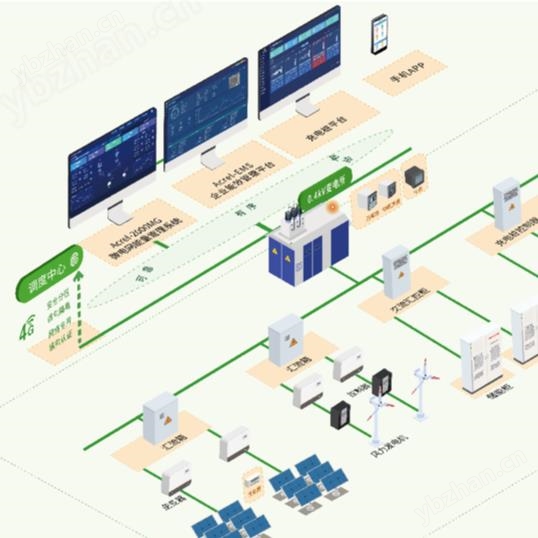
Figure 4-1 System Architecture Diagram
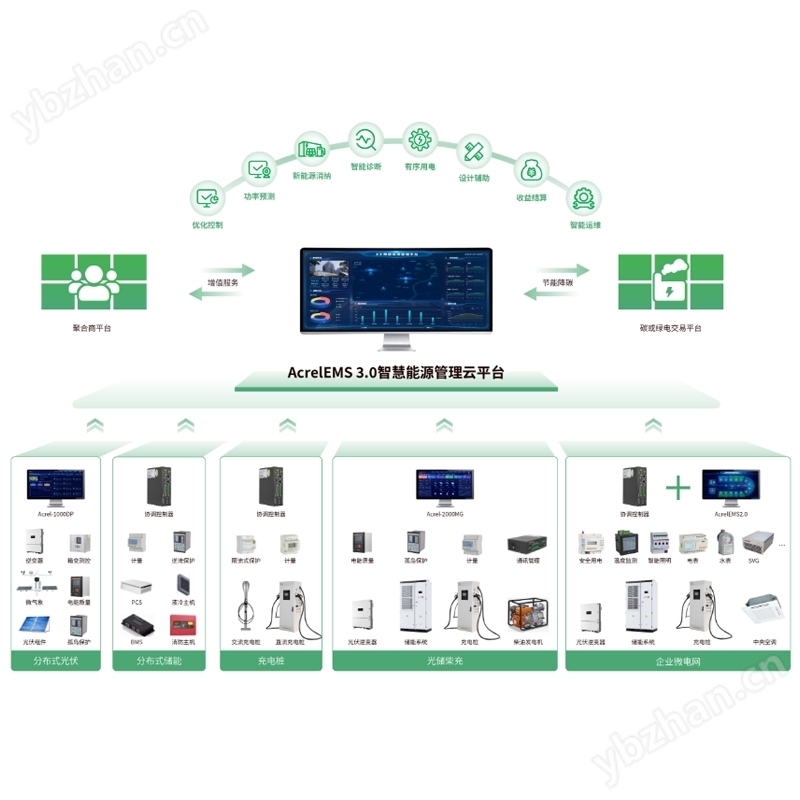
ACCU-100 coordinated controller: controls the output and power demand of energy storage devices, distributed energy sources, and adjustable load devices, and can perform light storage replacement based on economic benefit models while meeting scheduling requirements to reduce wasted light. And interact with cloud platforms to respond to cloud policy configurations. Intelligent Energy Management Cloud Platform EMS3.0: Meets the access of massive data across sites and regions. Through data analysis, it calculates and controls various indicators such as resource, electricity, loss, indicator, maintenance, and contribution at each site. Through diversified forecasting, it analyzes power generation and consumption trends, and combines electricity price data, production plans, and load demand to provide the best control solution. Simultaneously providing remote monitoring and operation and maintenance functions.
5. Performance indicators
Table 5-1 Performance Indicators of ACCU-100 Coordinated Controller

6. Appearance dimensions
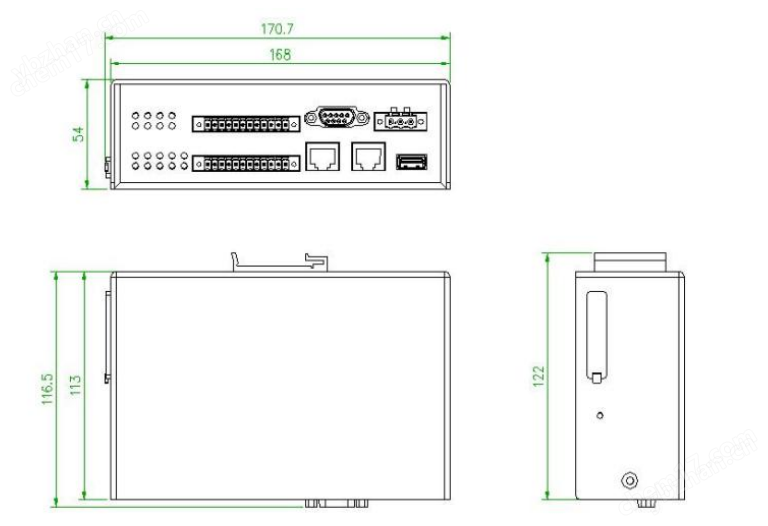
Figure 6-1 Appearance dimensions of the device
System architecture and working principle
7.1 System Architecture

The system architecture of the ACCU-100 microgrid coordination controller includes a field layer, a control layer, and a cloud layer. Its design aims to achieve efficient management and intelligent control of the light storage and charging system:
On site layer: including photovoltaic modules, energy storage units, electric vehicle charging piles, and other load equipment, connected to the controller through interfaces such as RS485 and Ethernet.
Control layer: ACCU-100 is responsible for data acquisition, edge computing and strategy implementation to ensure optimal operation of the system under complex load conditions.
Cloud layer: Integrated with the smart energy management cloud platform to achieve remote monitoring, strategy adjustment, and operation and maintenance management.
7.2 Working principle
The ACCU-100 controller achieves intelligent management of the light storage and charging system through the following steps:
1. Data collection: Real time monitoring of photovoltaic power generation, energy storage status, and charging pile operation. The data is transmitted to the controller through a multi-channel interface for local processing and uploading.
2. Data analysis and edge computing: analyze based on the collected data, including load forecasting, energy storage battery health assessment and charging demand scheduling.
3. Optimize control strategy: The controller adjusts the operation modes of photovoltaic power generation, energy storage systems, and charging piles based on data analysis results to achieve comprehensive optimization of peak shaving, load balancing, and grid safety.
8. Analysis of Application Scenarios for Optical Storage Charging
8.1 Collaborative management of photovoltaic and energy storage systems
Peak shaving and valley filling strategy:
Peak period: When electricity prices are at their peak, the controller prioritizes using electricity from energy storage batteries to reduce the use of high priced electricity.
Low valley period: During the low valley period of electricity prices, photovoltaic power generation is used to charge the energy storage system and reserve energy for future peak use.
Anti backflow control: When the photovoltaic power generation exceeds the local load demand, the controller will automatically adjust the charging power of the energy storage system to avoid power backflow to the public grid. This is of great significance for the safety of grid connection.
8.2 Intelligent Management of Electric Vehicle Charging Stations
Demand control: By monitoring the power load in real-time, ACCU-100 can dynamically adjust the charging power of the charging pile to ensure that it does not exceed the rated capacity of the transformer, thereby avoiding overload risks.
Intelligent scheduling: When multiple charging stations are running simultaneously, the controller optimizes the power allocation of each charging station based on load forecasting and electricity demand scheduling, ensuring efficient utilization of power resources.
Time of use charging strategy: Based on electricity prices and load conditions, the system can automatically adjust the charging time to reduce the overall electricity cost of the enterprise.
8.3 Management of microgrid islanding mode
Island detection and switching: In the event of a power grid failure or outage, the ACCU-100 can quickly detect the system status and switch to island operation mode to ensure continuous power supply to critical loads.
Energy storage system backup power: The controller monitors the state of charge (SOC) of the energy storage battery to prioritize the power supply to important loads in the event of a power grid failure. Ensure uninterrupted power supply to critical loads during power outages through flexible backup strategies.
8.4 Load forecasting and energy efficiency optimization
Load forecasting: through historical data analysis and machine learning algorithm, the controller can predict future power demand and adjust the strategy of photovoltaic power generation and energy storage system in advance to improve the overall power efficiency.
Energy efficiency management: The controller integrates data from photovoltaic, energy storage, and charging stations, adjusts system operating parameters in real-time, maximizes energy utilization efficiency, and reduces waste.
8.5 Collaboration with Smart Energy Management Platform
Cloud monitoring and operation: ACCU-100 seamlessly connects with the smart energy management platform to achieve remote monitoring and maintenance management of photovoltaic charging stations. The platform provides real-time alerts, predictive maintenance, and strategy optimization recommendations through big data analysis.
OTA upgrade and security management: The controller supports OTA remote upgrade and data encryption, ensuring continuous improvement of system security and performance.
9. Technical advantages
Highly integrated: Supports multiple communication protocols (Modbus, MQTT, IEC 104) and seamlessly integrates with devices from different brands.
Edge computing capability: the controller has the edge computing function to realize local data analysis and decision-making, improve system response speed, and reduce dependence on the cloud.
Data security and system stability: Built in data encryption and user permission management mechanisms ensure the safe and reliable operation of the system.
10. Future prospects
With the continuous development of integrated light storage and charging technology, the ACCU-100 microgrid coordination controller will play a greater role in a wider range of application scenarios in the future, such as smart cities, industrial and commercial parks, and independent power grids in remote areas. Future technology development directions include more intelligent prediction algorithms, more efficient edge computing capabilities, and more flexible distributed energy management strategies to achieve more efficient energy use and further reduce carbon emissions.
Similar Product Recommend