-
E-mail
weiscope@163.com
-
Phone
13538978162
-
Address
802, 8th Floor, Quanfeng Commercial Building, No. 8 Erheng Road, Yuancun, Tianhe District, Guangzhou City
Product Categories
Guangzhou Weiyu Optical Instrument Co., Ltd
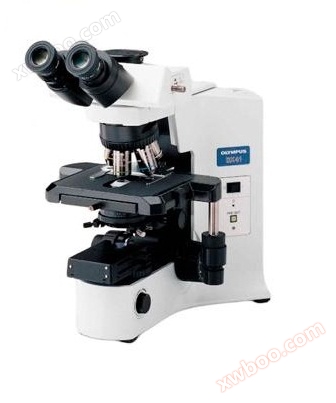
BX41 Research grade Biological Microscope
NegotiableUpdate on 02/15
- Model
- Nature of the Manufacturer
- Producers
- Product Category
- Place of Origin
Overview
Universal research grade upright Olympus microscope, meeting various observation methods
Product Details
Universal research grade upright Olympus microscope, suitable for various observation methods. Equipped with advanced UIS2 optical system, providing superior optical image quality, it is an ideal choice for DIC and fluorescence observation. Strong scalability and operability, with a range of accessories available for selection.
Combining multiple observation methods, from bright field to fluorescence
Mingchang Observation
The image is brighter and has excellent resolution and flatness at all magnifications. The PLAPON objective with a wide field of view, combined with the chromatic aberration and spherical aberration correcting condenser U-AAC, can provide excellent resolution and flatness at low to high magnifications.Polarized observation
High resolution observation of the birefringence structure of cells. Even without staining, teeth, bones, muscle tissue, nerve tissue, myosin fibers, and mitotic axis can all be observed. There are two types of intermediate attachments used for water inspection or water inspection/cone lens. By using various compensators, a wide range of delays can be observed. In addition, specialized polarizing observation lenses, objective converters, rotating stages, objectives, and simple polarizing attachments can also be used.Dark field observation
There is a perfect dark field effect from low magnification to high magnification.Observation of phase contrast
High contrast, high-resolution imaging allows for careful observation of the interior of cells and live bacteria.New fluorescence system with high signal-to-noise ratio (S/N) capable of capturing extremely weak fluorescence
The ideal situation for fluorescence observation is to capture high contrast images with the lowest amount of excitation light irradiation, thereby minimizing the chance of cell damage and fluorescence attenuation. Olympus Corporation has designed the objective lens of the UIS2 system with precision, which can capture with weak excitation light.
|
project |
BX41 |
|
|
Microscope frame |
optical system |
UIS2 optical system |
|
focus |
Vertical movement of the stage: 25mm stage travel with coarse adjustment limiter. The coarse adjustment knob can adjust the torque |
|
|
Illuminator |
Built in transmitted light Kohler illumination device |
|
|
fluorescent illuminator |
100W Mercury Lamp Illuminator |
|
|
Nosepiece |
/6-pole converter |
|
|
observing tube |
Wide field of view (22 fields of view) |
Wide field of view three eye observation tube, tilt angle of 30 degrees. |
|
Wide field ergonomic binocular observation tube, tilt angle 0-25 degrees |
||
|
Ultra wide field of view (26.5 fields of view) |
Ultra wide field of view three eye observation tube, tilt angle of 24 degrees |
|
|
stage |
Ceramic surface coaxial stage, equipped with left-hand or right-hand low position drive device, with rotating device and torque adjustment device. |
|
|
condenser |
·Abbe (numerical aperture 1.1); Shake out color correction (numerical aperture 0.9); ·Color aberration and spherical aberration (numerical aperture 1.4) |
|