-
E-mail
sdgerte@126.com
-
Phone
13589335800
-
Address
Hengda Yulan International, Liuting Street, Chengyang District, Qingdao City
Product Categories
Shandong Geert Environmental Technology Co., Ltd

Bag dust detector
NegotiableUpdate on 02/28
- Model
- Nature of the Manufacturer
- Producers
- Product Category
- Place of Origin
Overview
As a supporting equipment for dust removal in the later stage, the bag dust detector is used for all types of dust collectors and process dust flow detection. It can convert the detected charge signal into a current signal through the circuit and transmit it through 4-20mA. This product has accurate detection data, good dynamic performance, high sensitivity, and can achieve real-time measurement. It can reflect the operating status of the bag in a timely manner, realize bag breakage alarm, and provide safety guarantee for production.
Product Details
| brand | Other brands | Price range | discuss personally |
|---|---|---|---|
| security level | Non explosion proof category | Working principle | Other methods |
| Origin category | domestic | application area | Environmental protection, chemical industry, geology and mining, energy, metallurgy |
Bag dust detectorMain principle:
1. Principle of light absorption
The air pump extracts a certain volume of dusty air, and the dust is trapped on the filter paper. The light beam passes through the filter paper and shines on the silicon photovoltaic cell. The change in illuminance received by the silicon photovoltaic cell causes a change in the output current intensity of the silicon photovoltaic cell. Within a certain range, the amount of dust retained by the filter paper is linearly related to the output current of the silicon photovoltaic cell, which is converted into dust concentration through a set calculation program and displayed.
2. Beta ray principle
Developed based on the principle that dust particles can absorb beta rays. When the beta rays generated by the radioactive source inside the detector pass through dust particles, the dust particles absorb the beta rays. The dust concentration is calculated and displayed based on the linear relationship between the amount of beta rays absorbed by the dust and the dust mass.
3. Principle of Light Scattering
The dust analyzer sucks the aerosol to be tested into the detection chamber through a sampling pump. The aerosol to be tested is divided into two parts at the branching point, and one part is filtered into clean air through an efficient filter as a protective sheath gas to protect the components in the sensor room from contamination by the gas to be tested. The other part of the aerosol, as the sample to be tested, directly enters the sensor room. When detecting, the laser emitted by the laser diode first forms a thin layer surface light source through a lens group. When thin layer light is irradiated on the aerosol flowing through the sensor chamber, scattering occurs, and the scattered light intensity is detected by a photodetector. After being illuminated, the photodetector generates an electrical signal proportional to the mass concentration of the aerosol. Then multiply by the voltage calibration coefficient, which is obtained by measuring specific concentrations of aerosols.
4. Induction principle
Utilize the dynamic charge induction between dust particles passing through the probe to generate a signal. The communication electrostatic technology determines the disturbance amount of the AC signal by monitoring the standard deviation of the charge signal, and determines the dust emission amount based on the magnitude of the instantaneous disturbance amount.
Bag dust detectorProduct features:
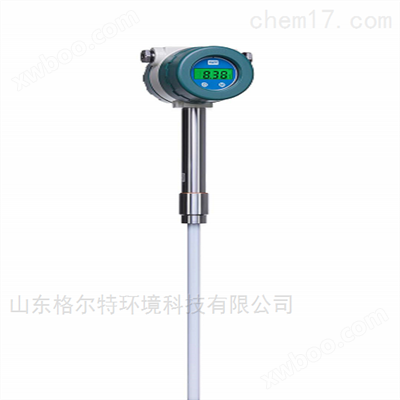
1. By using communication coupling technology, the detection sensitivity of dust is high, the linearity is good, and dust contamination of the probe does not affect the measurement sensitivity. It is maintenance free and requires no cleaning.
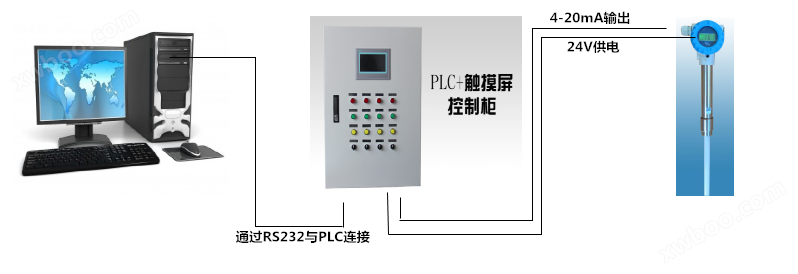
2. Standard two-wire 4-20mA current output, strong anti-interference ability, easy long-distance signal transmission, no special requirements for signal transmission wires, linear relationship between output current and dust concentration, convenient for subsequent PLC data processing.
3. The installation and use are completely consistent with the two-wire pressure transmitter, and on-site engineering and technical personnel can use it correctly without any special training. The installation is convenient and the operation is reliable.
4. The integrated transmitter output 4-20mA current in the junction box is electrically isolated from the dust sensing probe to achieve safe signal transmission.
Product application areas:
The GLT-F dust concentration detector is widely used in various industrial applications, including steelmaking, power generation, petroleum, chemical, pharmaceutical, building materials processing, coal mining and mining, cement manufacturing and packaging industries. Typical applications include detecting damaged filter bags in bag filters, recovering powdered materials, monitoring the total amount of product transportation, or monitoring the concentration of smoke and dust emissions from boilers of various sizes and fuels.
Application in the steel industry
In steel plants, there are many work areas accompanied by a large amount of scattered smoke and dust. The presence of these dust particles not only affects the health of workers, but also affects the normal operation of factory equipment and product quality.
There are many fugitive dust emissions in blast furnace process engineering, which seriously pollute the surrounding environment. Installed near the fugitive point, it can effectively monitor the concentration changes of fugitive smoke and dust. Together with the chimney dust monitor, it forms a dust monitoring system to monitor the dust concentration in various parts of the steel plant in real time, providing indispensable information for management personnel's decision-making.
Paper mill applications
In the papermaking process, a lot of dust is generated during the pressing of paper blanks into finished products, which directly affects the quality of the paper products. Therefore, it is necessary to strictly control the dust concentration during this process.
Installation will promptly and accurately report the dust concentration situation on site to the manager, so that they can make effective instructions to control the dust concentration and ensure paper quality.
parameter
|
operating ambient temperature |
-20 ℃~60 ℃ (electronic components) |
|
Operating environment vibration |
Continuous oscillation, any direction, any frequency: root mean square value 2g (20m/s2) |
|
Operating environment electromagnetic field |
At 50 Hz=60 A/m (equivalent to a magnetic field of 50 AT in a 1 meter x 1 meter square electromagnetic coil) |
|
Protection of operating environment |
Protection level: IP66/NEMA4 aluminum alloy shell, suitable for installation in non corrosive environments, stainless steel probe |
|
Pipeline gas pressure |
-0.1 – 1MPa |
Pipeline gas flow rate |
1m/s~30m/s |
|
Pipeline gas temperature |
0 ℃~250 ℃ (260 ℃~800 ℃ can be customized) |
|
Pipe OD |
0.1 meters to 4 meters |
|
Probe structure |
The standard probe is 16mm in diameter, with a length ranging from 100mm to 1000mm. The probe material is rare earth amorphous alloy, |
|
Dust particle size range |
The nominal range is 0.1 μ M to 200 μ M, and it can still receive signals outside the nominal range, but the signal characteristics are slightly different. |
powder material |
Including: dust, coal powder, flour, dust, smoke, graphite, manganese dioxide, quicklime and other various particulate matter |
|
zero drift |
(Time) Less than 1% of the range per year. |
|
zero drift |
Within the temperature range, below 1% of the measuring range. |
|
Full-scale drift |
(Time) Less than 1% of range per year |
Full-scale drift |
Within the temperature range, below 1% of the measuring range. |
|
Line stability |
All components of the system are made of high stability electronic assemblies. |
|
Noise resistance |
All 50 or 60 Hz audio and harmonics are filtered out before the signal is received |
|
measuring range |
0-10mg/50mg/100mg/200mg/1000mg/30g/100g/m³ |
|
Transmitter output mode |
2-wire system 4-20mA (built-in isolator, explosion-proof and anti-interference) |
|
Transmitter power supply |
24V (available within the range of 15V to 32V) |
|
measurement accuracy |
±5% |
|
Probe length selection |
Please select the probe length according to the formula, i.e. D/3 ≤ L ≤ 2D/3 (Among them: D - Inner diameter of pipeline, L - Probe length) |
Product Site Connection Diagram