-
Phone
156-5028-2386
-
Address
West of Shangfang Village, Jiulong Street, Fangzi District, Weifang City
Product Categories
Shandong Mengzhijie Water Treatment Equipment Co., Ltd

Bbr bioreactor
NegotiableUpdate on 12/26
- Model
- Nature of the Manufacturer
- Producers
- Product Category
- Place of Origin
Overview
Bbr bioreactor, bbr biological turntable, bbr device 1. Equipment overview The disc (biological carrier) in the Bbr bioreactor provides a carrier for the growth and reproduction of Bacillus subtilis, maintaining a sufficient amount of Bacillus subtilis in the BBR device while adsorbing and decomposing pollutants in wastewater
Product Details
Bbrbioreactor,bbrBiological turntable,bbrdevice
1、 Equipment Overview
BbrbioreactorThe disc (biological carrier) in the medium is Bacillus subtilisProvided a carrier for growth and reproductionBBRMaintain sufficient quantity in the deviceBacillus subtilis simultaneously adsorbs and decomposes pollutants in wastewater. Its main characteristics are as follows:
1、BBRThe disc is made of high-quality material polyethylene based resinPVDCA special mesh structure made by manufacturing.
2、bbrdeviceThe porosity is97%Above, it has a large specific surface area, making it easy for water and air to enter and exit. Under uniform aerobic conditions, the treatment effect is good and stable.
3、BBRThe disc is lightweight (with a density of0.05-0.06g/cm3)It does not absorb water, so the motor has low power consumption, and subsequent maintenance and operation are also relatively simple.
4、BBRThe disc has a unique mesh structure that allows microorganisms to maintain a high density of attachment (approximately)10,000~30,000mg/L)Thus, it can adapt to the impact caused by changes in flow rate and organic load, and has extremely high adaptability to low temperatures.
5、bbrRBCThe use of high-quality materials and extremely strong mechanical structures enables this device to operate for a long time.

IIBbrCharacteristics of bioreactors
BbrbioreactorThere are three main characteristics in the application of urban domestic sewage:
1、BBRThe core of craftsmanship is the use ofBacillus (genus Bacillus) is the dominant bacterial genus in the system.
2、To meet the requirements of Bacillus subtilisThe growth environment conditions,BBRThe process adopts biofilm method(BBREquipment and activated sludge process(BBRA combined biochemical treatment process that combines biochemical tanks.
3、BBRThe effluent from the biochemical process can meet the pollutant discharge standards of urban sewage treatment plants(GB18918-2002)First levelAStandard.
IIIBbrbioreactortechnological process
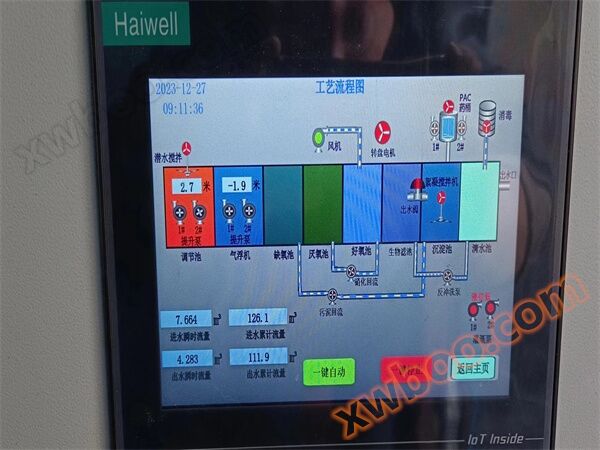
Firstly, the pre treated sewage entersBBRDevice (biofilm method device), inBBRIn the device, by attaching toBBROn the surface of the device carrierbacillusAbsorb and decompose organic matter, ammonia nitrogen, and phosphate in the influent.BBRThe removal rate of organic matter by the device can generally reach40-75%.
BBRDevice self flowing inBBRBiochemical pool, inBBRIn the biochemical pool, by controlling conditions such as dissolved oxygen, it is ensured thatBacillus is in a dominant position, maximizing its ability to efficiently remove organic matter, phosphorus, and nitrogen.
BBRThe effluent from the biochemical tank flows automatically into the secondary sedimentation tank, where the mud and water are separated. The supernatant meets the standard for discharge.
According to Bacillus subtilisThe growth needs and process characteristics require sedimentation tank sludge reflux (sludge reflux) andBBRThe effluent from the biochemical tank is refluxed (internal reflux), and both sludge reflux and internal reflux are carried outBBRBefore the equipment.
To preserve Bacillus subtilisHigh activity requiresBBRAdd nutrients that promote microbial growth and reproduction before the equipment.

4Bbrbioreactorprocess characteristics
BBRThe main characteristics of the process are as follows:
1、BBRThe biochemical process adopts biofilm method(BBRBiological rotary disc device and activated sludge process(BBRCombination process of biochemical pool to maintainBacillus subtilis has high performance in removing various pollutants.
2、BBRThe biochemical process uses sludge reflux to maintain the treatment of urban sewageThe quantity of Bacillus subtilis meets the requirements for removing organic matter; Maintain high activity of Bacillus subtilis and high removal efficiency of various pollutants through internal reflux.
3、To maintain Bacillus subtilisBeing in a dominant position and having high removal efficiency for nitrogen and phosphorus,BBRBiochemical processes control dissolved oxygen to a lower level(DOnot higher1mg/L)Compared to traditional biochemical processes, which generally control dissolved oxygen levels2-4mg/L)Compared to,BBRThe biochemical pool requires much less air, which can effectively reduce energy consumption; addBBRThe device adopts natural ventilation, so thatBBRThe energy consumption of biochemical treatment process is about lower than that of traditional biochemical treatment process30-50%(Comparing only the biochemical part).
4、BBRBiochemical process adoptsbacillusAs a dominant bacterial genus in the system, due to its unique removal mechanism and high removal rate of organic matter, nitrogen, and phosphorus, through reasonable design, its effluent can meet the "Pollutant Discharge Standards for Urban Sewage Treatment Plants"(GB18918-2002)First levelAStandard.
5、Due to the deodorizing ability of Bacillus subtilis itself, its biochemical process and sludge treatment stages do not require additional deodorizing treatment, which can reduce the investment and operating costs of the deodorization system in sewage treatment plants.
6、Due to the self disinfection ability of Bacillus, indicators such as Escherichia coli in the sludge generated by the system can easily meet the requirements of sludge disinfection, creating favorable conditions for the final disposal (resource utilization) of sludge.
7、BBRThe overall construction land for the biochemical system is less than that for traditional processes.
5、 The use of Bacillus subtilis
(1) Introduction to Bacillus subtilis
Bacillus subtilis(Bacillus)A family of bacteria that can form spores (endospores) as rods or cocci. Including the genera Bacillus, Lactobacillus, Clostridium, Desulfobacterium, and Bacillus. They have strong resistance to harmful external factors, are widely distributed, and exist in soil, water, air, and animal intestines.
BbrBioreactors,The utilized Bacillus species mainly include Bacillus licheniformis, Bacillus subtilis, Bacillus subtilis, Bacillus polymyxus, Bacillus subtilis, etc.
(2) Mechanism of Bacillus subtilis in Removing Pollutants
1Removal of organic matter
Bacillus has a high ability to decompose proteins, starch, and fats, and the removal mechanism is as follows:
2Denitrification mechanism
Different from the traditional principle of nitrification and denitrification, Bacillus directly absorbs amine (organic nitrogen), ammonia nitrogen and ammonium salt, which are used by microorganisms to remove nitrogen. Part of the nitrogen element enters the sludge in the form of organic nitrogen, is removed from the system through the discharge of excess sludge, and part of it is converted into nitrogen and discharged into the air.
3Phosphorus removal mechanism
Bacillus is a Gram positive bacterium. Compared with Gram negative bacteria, the cell wall of Gram positive bacteria is thicker and more uniform than that of Gram negative bacteria (bacteria used in general activated sludge processes), mainly composed of peptide bonds connecting peptidoglycans to form the cell wall. The cell wall of Gram positive bacteria contains a large amount of phosphoric acid. That is to say, in the synthesis reaction of microorganisms, phosphate enters the cell wall of Bacillus subtilis in the form of phosphoric acid, and is finally dephosphorylated from the system through the discharge of residual sludge.
Through Bacillus subtilisThe general removal rate of phosphorus removal is50%Above, in order to ensure compliance, auxiliary chemical phosphorus removal is adopted.
4Deodorization mechanism
Bacillus subtilis can absorb substances in the form of ammonia, ammonium salts, hydrogen sulfide, etc. in sewage, remove odor producing components, and greatly reduce the amount of odor produced by the system.
5Disinfection mechanism
Bacillus subtilis can dissolve or kill Escherichia coli and other bacteria in treated water during its growth and metabolism process.
Due to the self disinfection capability of the system, the remaining sludge can enter the final treatment and disposal process without the need for stabilization.
(3) Characteristics of Bacillus subtilis
1、Bacillus has super strong reproductive ability and adaptability in extremely harsh extreme environments such as low temperature, high salinity, and high pressure.
2、The ability to break down proteins and convert starch into glucose.
3、Can decompose fatty acids.
4、Absorbable, transformed, proliferated, and decomposed substances.
5、Bacillus is a nitrogen and sulfur tolerant bacterial species that can absorb substances in the form of ammonia, ammonium salts, hydrogen sulfide, etc. before nitrogen oxidation in wastewater, remove odor producing components, and reduce the amount of system odor produced.
6、Bacillus has the ability to form spores and maintain the proliferation of active bacterial species in harsh environments, thus maintaining its processing capacity.
7、It can secrete antibiotics and has the effect of sterilization.
More aboutBbrbioreactorFor relevant information, please follow the website(www.sdmzjscl.com)!


