-
E-mail
xaslck@163.com
-
Phone
18802933690,18829593940
-
Address
Xi'an High tech Zone New Industrial Park
Product Categories
Xi'an Sanlian Measurement and Control Technology Co., Ltd

Circular orifice gas flowmeter
NegotiableUpdate on 11/19
- Model
- Nature of the Manufacturer
- Producers
- Product Category
- Place of Origin
Overview
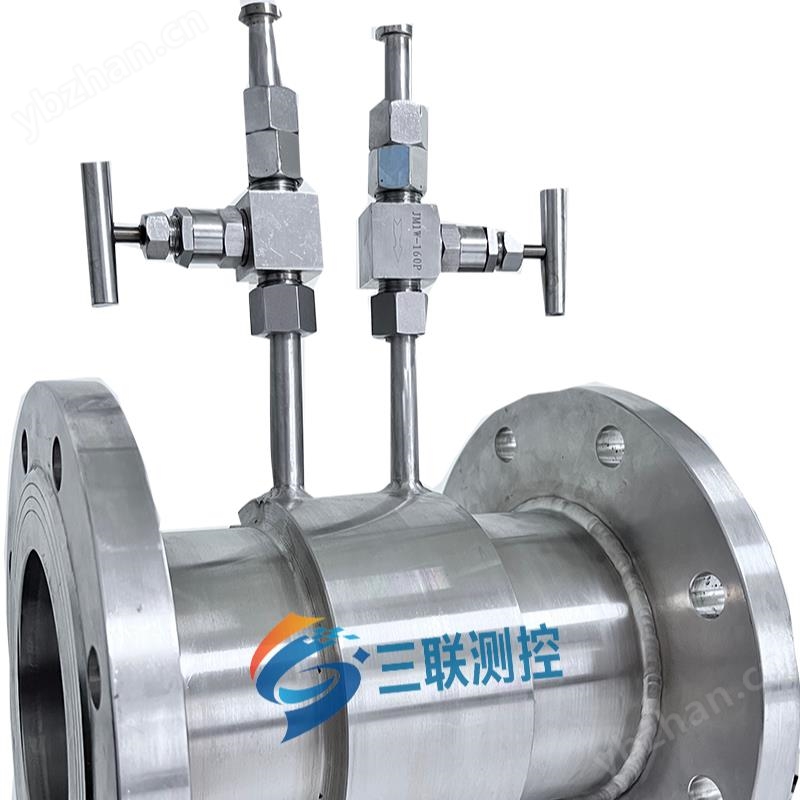
The basic principle of the annular orifice plate gas flowmeter is basically the same as that of the standard orifice plate, but the structure is very different. The annular orifice plate itself comes with a measuring tube, and a coaxial circular plate is fixed in the middle of the measuring tube. The circular plate is fixed to the pipeline by a support frame and is suitable for measuring various fluid media (gas, steam, liquid), such as saturated steam, superheated steam, compressed air, various coal gas, exhaust gas, cooling water, heavy oil, residue oil, fuel oil, condensate, various chemical solutions, etc
Product Details
Overview
The annular orifice plate was produced in the 1930s. The experimental data shows that under severe rotational flow, the outflow coefficient of the standard orifice plate changes by 25%, while the variation of the annular orifice plate is less than 1%. Circular orifice plates do not require long straight pipe sections and can operate under harsh pipeline conditions. The basic principle of annular orifice plate is basically the same as that of standard orifice plate, but the structure is very different. The annular orifice plate itself comes with a measuring tube, and a coaxial circular plate is fixed in the middle of the measuring tube. The circular plate is fixed to the pipeline by a support frame and is suitable for measuring various fluid media (gas, steam, liquid), such as saturated steam, superheated steam, compressed air, various coal gas, exhaust gas, cooling water, heavy oil, residue oil, fuel oil, condensate, various chemical solutions, etc. The annular orifice plate has the characteristics of simple and sturdy standard orifice plate structure, easy installation and use, and does not require long straight pipes, which has the advantage of working under harsh pipeline conditions.
Two working principles
The basic principle of the annular orifice plate is the same as that of the standard orifice plate, which is applicable to the fluid continuity equation and Bernoulli equation. The difference is that after the fluid enters the measuring pipe section, the minimum flow cross-section is different. The minimum flow cross-section of the standard orifice plate is circular, and the minimum flow cross-section of the annular orifice plate is circular. The annular flow surface is equivalent to a circular flow cross-section, with an equivalent aperture of d and an equivalent aperture ratio of
β=d/D, The basic equation is:

Qm: Fluid flow rate through the measuring tube (kg/h)
ε: Flow expansion coefficient
D: Measuring tube inner diameter (mm)
C: Outflow coefficient
ρ: Fluid density (kg/m3)
Δ P: Pressure difference (KPa)
3、 Characteristics
1. Gases containing solid particles, liquids, or droplets are easy to pass through the annular gap of the throttling element without accumulation.
2. Suitable for measuring dirty and corrosive fluids.
3. No need for long straight pipe sections, can work under harsh pipeline conditions
4. Suitable for measuring saturated steam, compressed air, coal gas, furnace exhaust gas, cooling water, condensate, various corrosive chemical solutions, and various fluid media.
5. Low pressure loss, low power consumption, and short required straight pipe section.
6. Under harsh conditions, the outflow coefficient is stable, with high accuracy and good reliability.
Four main technical indicators
1. Nominal diameter: 50 mm to 3600 mm
2. Working temperature: -200 ℃~+530 ℃
3. Nominal pressure: -0.1 MPa to 42 MPa
4. Reynolds number (ReD) range: ordinary type 4 × 10³~1 × 10⁷
5. Accuracy: ± 0.5%, ± 1.0%, ± 2.0%
6. Reference standards: GB/T2624-2006, JJG640-94, and Design Manual for Flow Measurement Throttle Devices
7. Connection methods: flange connection, welding connection
Five structural forms
The annular orifice plate is composed of a circular plate that is coaxial with the pipeline. The circular plate is supported by a tripod, and pressure measuring holes are opened on the upstream and downstream surfaces of the circular plate. The positive and negative pressures are connected to the outside of the pipeline through a pressure conduit, and the differential pressure signal is sent to the differential pressure transmitter through a pressure equalization ring chamber. The pressure measurement method adopts D-D/2 pressure measurement, and its structural form is shown in the figure