-
E-mail
13901257022@126.com
-
Phone
18106760128,13296709520
-
Address
No. 460 Jinhai 1st Road, Wenzhou Economic and Technological Development Zone, Zhejiang Province
Product Categories
Zhejiang Xinlan Technology Co., Ltd


Coriolis mass flowmeter
NegotiableUpdate on 11/20
- Model
- Nature of the Manufacturer
- Producers
- Product Category
- Place of Origin
Overview
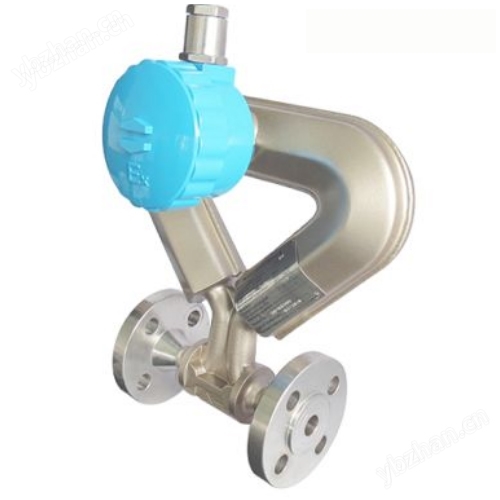
The Coriolis mass flowmeter can directly measure the mass flow rate of the medium passing through the flowmeter, as well as measure the density of the medium and indirectly measure the temperature of the medium. Due to the fact that the transmitter is an intelligent instrument with a microcontroller as its core, more than ten parameters can be derived for user use based on the three basic quantities mentioned above. The flow meter has flexible configuration, powerful functions, high performance price ratio, and is a new generation of flow meters.
Product Details
When fluid flows inside a rotating tube, it generates a force on the tube wall, which was discovered by Coriolis in 1832 while studying turbines, abbreviated as Coriolis force. In 1977, the founder of MicroMotion, an American company, developed the world's first practical Coriolis mass flowmeter based on this principle.
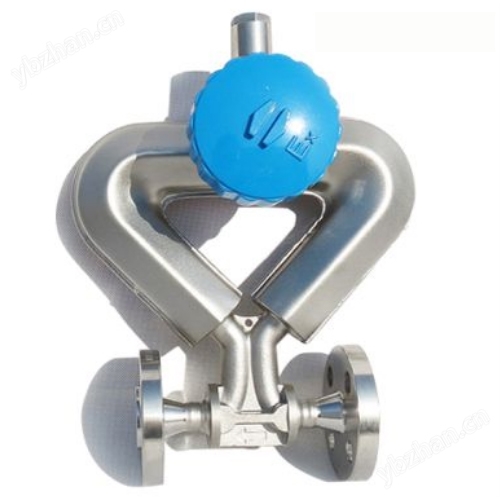
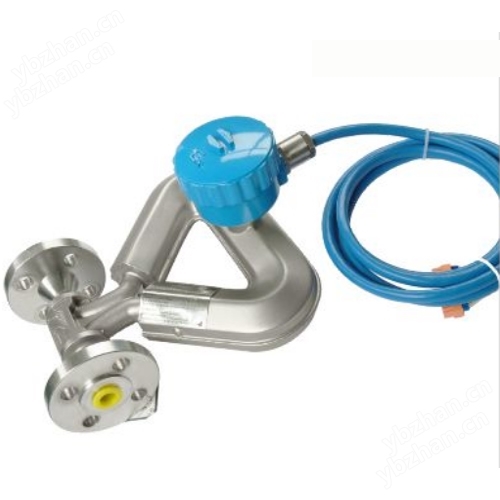
The mass flow meter is based on Coriolis force and has two parallel flow tubes inside the sensor. A coil is installed in the middle and detection coils are installed at both ends. When the excitation voltage provided by the transmitter is applied to the driving coil, the vibrating tube oscillates back and forth in a periodic manner. When the fluid medium in the industrial process flows through the vibrating tube of the sensor, Coriolis force effect is generated on the vibrating tube, causing the two vibrating tubes to twist and vibrate. The detection coils installed at both ends of the vibrating tube will generate two sets of signals with different phases. The phase difference between these two signals is proportional to the mass flow rate of the fluid flowing through the sensor.
The computer calculates the mass flow rate through the vibrating tube. When different media flow through the sensor, the main frequency of the vibrating tube is different, and based on this, the density of the media can be calculated. The platinum resistor installed on the sensor tube can indirectly measure the temperature of the medium.
What are the effects of measuring medium pressure when using a Coriolis mass flowmeter?
When there is a significant difference between the operating pressure and the calibration pressure, changes in the pressure of the measuring medium can affect the tightness of the measuring tube and the degree of the Bourdon effect, breaking the symmetry of the measuring tube and causing changes in the sensitivity of the sensor flow rate and density measurement. This cannot be ignored for high-precision measurement.
Solution: We can eliminate or reduce this impact by compensating the pressure of the mass flow meter and adjusting the zero point under pressure. There are two methods for configuring pressure compensation:
(1) If the operating pressure is a known fixed value, external pressure values can be input on the mass flow meter transmitter for compensation.
(2) If there is a significant change in operating pressure, the mass flow meter transmitter can be configured to poll an external pressure measurement device, and real-time dynamic pressure values can be obtained through this external pressure measurement device for compensation. Attention: When configuring pressure compensation, flow verification pressure must be provided.

The Coriolis mass flowmeter can directly measure the mass flow rate of the medium passing through the flowmeter, as well as measure the density of the medium and indirectly measure the temperature of the medium. Due to the fact that the transmitter is an intelligent instrument with a microcontroller as its core, more than ten parameters can be derived for user use based on the three basic quantities mentioned above. The flow meter has flexible configuration, powerful functions, high performance price ratio, and is a new generation of flow meters.
A flow measurement instrument used to measure the mass flow rate inside a pipeline. Under conditions where the measured fluid is subject to significant changes in parameters such as pressure and temperature, measuring only volumetric flow rate can result in significant measurement errors due to variations in fluid density. In volumetric and differential pressure flow meters, the density of the measured fluid may vary by 30%, which can result in a 30-40% error in flow rate.
With the improvement of automation level, many production processes have put forward new requirements for flow measurement. The chemical reaction process is controlled by the quality (rather than volume) of the raw materials. The heating and cooling effects of steam and air flow are also proportional to the mass flow rate. The strict control of product quality, precise cost accounting, and fuel quantity control of aircraft also require accurate quality flow measurement.

Main technical parameters of Coriolis mass flowmeter:
| model | CNG-15T |
| Accuracy class | 0.2 |
| High flow velocity | 50kg/min |
| density | ±0.002g/cm3 |
| Temperature measurement accuracy | ±1°C |
| Zero stability | 0.009kg/min |
| repetitiveness | 0.05% |
| Great work pressure | 25MPa |
| caliber | 15mm |
| connection port | Customizable |
| fluid temperature | -200~200°C |
| Measurement tube material | Stainless steel 316L |
| sensor housing | Stainless steel 304 |
| relative humidity | ≤ 95%, non condensed |
| crushing damage | ≤0.2MPa |
| Explosion-proof rating | Ex[ib]IIBT1~T6 Gb / Ex[ib]IICT1~T6 Gb |
| atmospheric pressure | 86~106kPa |
| Working Voltage | AC85~265V,DC24V |
| communication protocol | RS485 Modbus RTU |
| packaging | 1set/carton |
| Package dimensions | 630*630*580mm |
| gross weight | 14kgs |
| warranty period | 2 years |