The electricity information collection system is a large-scale, high-performance collection system developed for the distribution network collection business of large-scale provincial power grids. The system supports data collection, data management, external data provision, and quasi real time collection system based on collected data for millions of users. It is the core of marketing automation/two-way interaction applications under the smart grid, the foundation for supporting new marketing businesses, and the key to vertically integrated management applications of marketing businesses.
Neusoft Company conducted research and evaluation on the construction mode of the main station of the collection system, and ultimately determined that the goal of this system construction is the "centralized data business and collection" mode. Based on this, a distributed cloud computing based electricity information collection system will be established.
Main functions
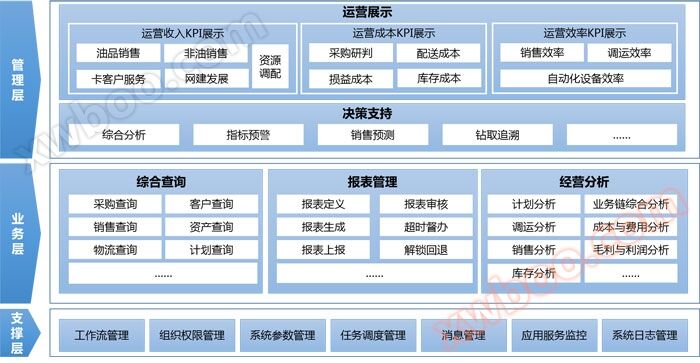
The Neusoft data collection system can be divided into five levels in terms of functionality: platform support layer, data collection and communication layer, operation and maintenance monitoring layer, business application layer, and operation supervision layer.

Operational regulatory layer:From the perspective of business applications, there are significant differences between the functional departments and users of provincial companies and the business application systems of cities. At the provincial company level, the focus is on the overall equipment operation, collection efficiency, key user supervision, installation progress of companies in various cities, implementation of assessment indicators, overall operation of the electricity information collection system, and performance evaluation of various suppliers. Therefore, Neusoft has designed a separate system feature section for the provincial company based on the above characteristics. The functional modules are divided into indicator management and analysis, online rate/collection success rate analysis, IT system operation status, practical analysis of collected data, installation coverage, operation support service assessment, etc.
Business application layer:Business applications are the foundation that supports the daily management of local companies and are the core of this system. According to business characteristics, it can be divided into archive management, energy analysis, automated meter reading, remote on-site management, line loss management, advanced business applications, interface operation monitoring, etc.
Operation and maintenance monitoring layer:The operation and maintenance monitoring layer can be divided into two functional domains: operation and maintenance monitoring management and data management. The focus of system operation and maintenance monitoring is to address the following issues: the construction of an automated system equipment operation and maintenance system; The quality and stability of communication operator channels; The completion of various indicators such as success rate, completeness rate, quality and efficiency of on-site fault resolution.
Collecting communication layer:The collection communication layer can be divided into front-end communication functional domain and data processing platform functional domain in terms of functionality. The front-end communication system consists of communication servers, management servers, load balancing devices, etc. Complete terminal TCP access, protocol packet reception, packet parsing and combination, data storage, packet packaging, data storage, load balancing, and other functions. The data processing platform functions are deployed in the provincial company, completing functions such as collection protocol configuration, collection content configuration, collection strategy management, instruction issuance, message integrity judgment, and initial data calculation.
Platform support layerThe platform support functions serve as the foundation of the system, including the unified integration platform UniEAP of Neusoft, interface interaction platform, workflow support functions, personnel and permission system management, alarm engine, public SMS platform, email system, etc.
Technical Characteristics
Based on years of experience in the construction of information technology such as provincial power information collection and power marketing, and combined with mainstream distributed cloud computing technology frameworks internationally, Neusoft has established the overall technical architecture of its power information collection system. The terminal is connected to the front-end cluster through load balancer F5. The front-end cluster is responsible for receiving and sending messages, and both sent and received messages are cached in a distributed message queue. The distributed event processing service cluster is responsible for handling the issuance of collection tasks and the processing of collection results. The collected raw data will be saved in a massive data storage. Distributed caching service is used to cache archive information. The task management service is responsible for managing and coordinating scheduled tasks throughout the entire system. The collection management service is used to provide high-speed collection tasks for the front-end processor.