-
E-mail
biaozhuo17@163.com
- Phone
-
Address
No. 1088 Fugang Road, Fengxian District, Shanghai
Product Categories
Shanghai Biaozhuo Scientific Instrument Co., Ltd
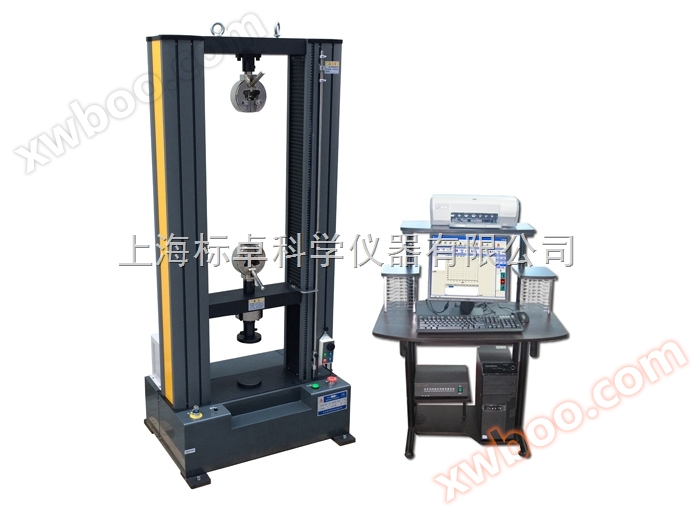
External wall insulation material testing machine
NegotiableUpdate on 01/10
- Model
- Nature of the Manufacturer
- Producers
- Product Category
- Place of Origin
Overview
The external wall insulation material testing machine is suitable for manufacturing industries such as metals, adhesives, pipes, profiles, aerospace, petrochemicals, waterproofing membranes, wires and cables, textiles, fibers, rubber, ceramics, food, pharmaceutical packaging, geotextiles, films, wood, paper, as well as product quality supervision departments at all levels. It is also suitable for teaching demonstrations in colleges and universities.
Product Details
One The main purpose and scope of application of the testing machine
The WDW-10/20/50kN microcomputer controlled insulation material testing machine series (portal structure) produced by our company is mainly used for testing mechanical performance indicators such as tension, compression, and bending of various metal, non-metal, and composite materials. The precise automatic control and data acquisition system enables fully digital adjustment of the data acquisition and control process. In tensile testing, technical indicators such as maximum load-bearing capacity, tensile strength, elongation deformation, and elongation rate of the material are tested. After the experiment is completed, the above detection parameters will be automatically calculated by the main controller based on the test parameter conditions set at the beginning of the experiment, and the corresponding test results will be displayed. Each detection parameter can be queried and displayed or printed after the experiment is completed.
The manufacturing and inspection standards for this testing machine are: "GB/T16491-2008 Electronic Universal Testing Machine" and "JJG139-1999 Tensile, Pressure and Universal Testing Machine" Metrological Verification Regulations; And comply with the testing methods of ASTM, ISO standards, and other industrial standards. Simultaneously meet the user's customized testing and calculation methods.
2、 Product features:
1. Equipped with a remote control box, it can achieve fast/slow lifting adjustment of the crossbeam, with flexible operation and easy switching.
2. It has the function of returning to the initial position after the experiment is completed, which is intelligent, efficient, and fast.
3. It has limit protection function and overload/overcurrent protection function for any working position, reliable and safe.
4. Build a powerful experimental database, where experimental data can be saved, queried, and accessed at any time
5. It can achieve various control methods such as constant rate force control, constant rate stress control, constant rate deformation control, constant rate strain control, constant rate stroke control, load constant rate control, elongation constant rate control, displacement constant rate control, low cycle control, and user programmable control.
6. Multiple test curves can be switched and displayed: stress-strain curve, force deformation curve, force displacement curve, force time curve, deformation time curve, displacement time curve, and stress-strain curve. Partial amplification of the experimental curve and comparison of multiple curve superposition.
3、 Technical parameters:
Serial Number |
Inspection items |
technical requirement |
1 |
Zui Large Testing Machine |
10KN/20KN/50KN |
2 |
Test force resolution |
1/250000 |
3 |
Transform the maximum small reading value |
0.01mm |
4 |
Relative error of indication value |
± 1% within the range of 1% -100% |
5 |
Test force indication repeatability relative error |
≤1% |
6 |
Relative error of zero point of experimental force |
±0.1% |
7 |
Speed range |
0.005-500mm/min |
8 |
Experimental space (height x width) |
800x400mm |
9 |
loading method |
electric |
10 |
Power supply voltage(There must be reliable grounding measures) |
~220V±10% 50Hz |
4、 Structure, Principle, and Characteristics
The external wall insulation material testing machine consists of a main unit, a fully digital measurement and control system, a user software package, functional accessories, and other components.
1. Host
1.1 External wall insulation material testing machineThe host is a portal prestressed frame with high axial stiffness.
1.2 Adopting circular arc synchronous belt pulley reduction, Jining Screw Factory (German PC Company) produces ball screw pair transmission, with no gap in transmission, ensuring precise control of test force and deformation speed.
1.3 The CX WDW3100 machine's moving crossbeam is guided outward by both the ball screw and the guide rod. The special dual guiding structure greatly improves the stiffness, reaching over 2 × 10⁸N/m, and overcomes the swinging of the moving crossbeam.
1.4 adopts a dual space structure, with the upper space used for tensile testing; Conduct compression and bending tests in the lower space.
1.5 Smooth transmission, fast response, and low noise [below 60dB (A)].
1.6 The servo unit adopts a fully digital AC servo motor and driver, with a wide speed range and high accuracy.
2. Measurement and control system
2.1 Unique dual control system, equipped with a large screen LCD display, the measurement and control system can work separately from the computer or be operated online with the computer.
2.2 Mobile control box, convenient for adjusting the moving crossbeam; It has multiple control functions such as fast/slow, step, etc., making it easy to quickly and accurately adjust the position of the moving crossbeam..
2.3 The resolution of force and deformation measurement is high, and there is no distinction between the inside and outside. The resolution remains unchanged throughout the entire process, and users can set it according to their own experimental needs;
2.4 Sensor - The channel bandwidth reaches 4.5Hz, and the measured test data and curves are true.
2.5 Force sensor, using American Shiquan products, with high accuracy and good long-term stability.
2.6 Open data connection interface, which can achieve closed-loop control of load, deformation, displacement, speed, etc., and control constant load, constant deformation, constant displacement, uniform stress rate, uniform strain rate, and constant speed in a multi-step manner. There is no impact conversion between the latter three methods during the test process;
2.7 It has protection functions such as overload, overtravel, overvoltage, overcurrent, and overheating;
The 2.8 force channel interface can be replaced with other types of force sensors. The deformation channel interface can also be replaced with other types of deformation sensors.
3. Computer systems and software packages
3.1 The computer system communicates with the measurement and control system through a serial port, and all operations are incorporated into the computer control during operation. Virtual keyboard operations are performed on the Chinese WINDOWS interface.
3.2 Different test plans can be set according to different requirements for the experiment. Curve types, calculation units, calculation accuracy, displayed information, test conditions, etc. can all be pre-set in the test plan. Users only need to select different test plans to obtain the required information and simplify the operation.
3.3 You can use the mouse to obtain the force and deformation values of any sampling point on the curve.
3.4 selectable stress-strain, force time, force displacement, force deformation, displacement time, deformation time curves, etc; And switch in a timely manner during the experiment, automatically adjust the coordinates during the experiment to ensure the curve is intuitive and complete.
3.5 Real time collection of experimental data, drawing of curves, local enlargement or reduction of curves, and printing of experimental curves;
3.6 Display curves that are continuous, smooth, and of appropriate thickness, with clear curve coordinates and coordinate markings.
3.7 Comparison of superimposed experimental curves within the same group.
3.8 The test results can be accessed freely for reanalysis of the curve; Including data recalculation, curve reproduction, etc.
3.9 The raw data and test results of the experiment can be output to Excel, and reports can be printed for the convenience of users.
3.10 Set control parameters on your own to achieve automatic program operation.
3.11 Design software packages according to user provided standards (such as GB, ISO, DIN, ASTMD, JISK, etc.), which not only support the functions mentioned above, but also provide various complex data processing functions and special control functions.
The above are partial classifications, and necessary attachments can be selected according to actual needs.
4. The performance of the experimental control software package is as follows
A. Software sub permission management:
Software grading management: At the level of management personnel, all experimental functions are open to managers, including the ability to modify force and deformation calibration values; At the teacher usage level, except for the modification rights of force and deformation calibration values, all other experimental functions are open; Usage level, only open to content related to experiments, the scope and permissions of the opening are controlled by the attending teacher and can be determined based on the content of the experiment.
B. Software operation panel:
The software operation panel has the characteristics of simplicity, practicality, and adjustability. Its main functions include displaying relevant test information such as test force, deformation, displacement, time, control mode, test speed, current sample information, and peak force (i.e. the maximum force value in the test). Users can also set the appearance size, style, hiding/displaying, etc. of each related display item according to their own requirements. At the same time, the overall layout of the software can also be flexibly adjusted according to user needs.
The experimental curve window can dynamically and real-time display stress-strain, force deformation, force displacement, force time, deformation time, and displacement time during the experimental process (which can be selected arbitrarily according to the operator's needs), and also has the function of comparing and displaying multiple types of curves on different coordinate axes in the same window, and displaying various curves in the secondary window. This is very meaningful for observing closed-loop control.
C. The software is easy to operate and has high security
The software has good security and there are no incidents of computer crashes or damage to the testing machine caused by software misoperation. To improve the security of the software, error prompts were added before the experiment; The experimental parameters are inputted step by step. If the previous step is not completed, the next step cannot be entered; After entering the experiment, some buttons that are prone to misoperation, such as the quick button and reset button, lose their function.
D. Control function
In addition to the conventional closed-loop control functions of force, deformation, and displacement (velocity), combined with the characteristics of material mechanics experimental teaching, automatic loading or unloading can be carried out during the experimental process according to user settings. In order to observe the cold work hardening phenomenon of materials and verify Hooke's law.
At the same time, users can divide the experiment into several steps and set each step in detail to meet various experimental requirements. Users can also store control information for various experiments as templates for easy retrieval of template content when using them again, without the need for resetting. Change the current control mode at will without interrupting the experiment.
On the software operation panel, there is a button for "removing the extensometer", which allows the extensometer to be removed at any time during the force deformation test and enter the force displacement test state without affecting the progress and results of the test.
To ensure the safety of using the extensometer, in addition to the "remove extensometer" button mentioned above, the function of automatically removing the extensometer is added to the software test parameters. That is, a parameter input window for removing the extensometer is added in the software settings. Before the test, the parameter (the range of this parameter is determined by the range of the extensometer) is input. During the test, if the operator forgets to remove the extensometer, when the deformation of the extensometer reaches the set parameter value, the computer will issue a warning (such as music) to remind the operator to remove the extensometer. These two operations are *. If the "remove extensometer" button is pressed first, the software's remove extensometer parameter command will be invalid. If you start first, the button to 'remove the extensometer' will be disabled.
E. Data processing and analysis functions
(1) Automatic data processing
Automatically process material performance data based on the different materials being tested. If there is a significant yield phenomenon in the material, the upper and lower yield strength and tensile strength should be automatically determined; If there is no obvious yield phenomenon in the material, the upper and lower yield strength should not be calculated, only the tensile strength should be calculated.
For the force deformation curve, the elastic modulus can be automatically calculated (processed according to GB/T 8653-1988), and for materials without obvious yield phenomenon, the specified non proportional tensile strength Rp can be calculated (processed according to GB/T 228-2002). In automatic processing, it is possible to automatically determine whether the material has obvious yielding phenomenon based on the test curve, whether to calculate the upper and lower yield strength or the specified non proportional extension strength Rp
Data automatic processing software, in addition to processing tensile test results, can also automatically process compression test results (processed according to GB/T 7314-2005 regulations).
(2) Manual data processing
a) A fully functional curve analysis window that can freely change the display mode of curves, such as force deformation curve, force displacement curve, force time curve, deformation (or displacement) time curve, stress-strain curve, etc;
b) The curve analysis window has the function of reproducing the experimental process, and during the reproduction process, the corresponding experimental curve can be freely selected.
c) The curve enlargement function allows for the arbitrary enlargement of curves (i.e. multiple amplifications), as well as the ability to manually input given coordinates for enlargement.
d) Key data feature points such as yield point, maximum force, elastic segment, and various auxiliary lines can be found and marked on the curve (or enlarged curve), and the coordinates of these feature points (force, deformation, displacement, sampling time, etc.) can be displayed in real time. At this point, the displayed feature points should be real and valid sampling points. If they are not real and valid sampling points, the coordinates should not be displayed.
e) The tester interprets the relevant data based on the test curve and inputs it into the computer for calculation. Calculate the yield strength and tensile strength of the material by interpreting the upper and lower yield forces and the maximum destructive force; For example, the force deformation curve specifies the non proportional elongation force Fp and calculates the specified non proportional elongation strength Rp of the material; the elastic modulus of the material is calculated based on the elastic straight line segment of the force deformation curve.
f. Comparison of manual processing and automatic processing results.
F. Test (experiment) report
The test (experiment) report includes the experiment title, experiment content, experimental equipment (including measuring tools, extensometer gauge length), sample size parameters, performance calculation results and test curves, as well as the name of the tester, test time, test file name, environmental conditions, etc.
Users can also set the printing content, printing style, and report layout of the report according to their own needs.
Printing method: A4 paper, with the upper part showing the test content and results, and the lower part showing the test curve.
The terms and symbols used in the test (experiment) report and test software shall be expressed in accordance with the requirements of GB/T 228-2002 and GB/T 7314-2005. Feature reports can be prepared according to user requirements.
Similar Product Recommend


