Overview
The gas station maintenance management system, based on the information management concept of the entire life cycle of equipment, comprehensively sorts and controls the relevant ledger information of equipment procurement, operation, maintenance, and scrapping from several aspects such as daily operation and maintenance, periodic inspection and monitoring, and maintenance process management. It focuses on mastering the basic information, distribution, and technical status of equipment, strengthening operation and maintenance management, maintenance resource management, maintenance plan management, and maintenance process management, assisting in maintenance cost analysis, standardizing on-site operation operations, ensuring personnel safety, improving work efficiency, etc., thereby improving the reliability, availability, and safety of equipment asset management, promoting the reduction of operating cost indicators such as equipment procurement and construction costs, operation and maintenance costs, and technical transformation and scrapping costs.
function
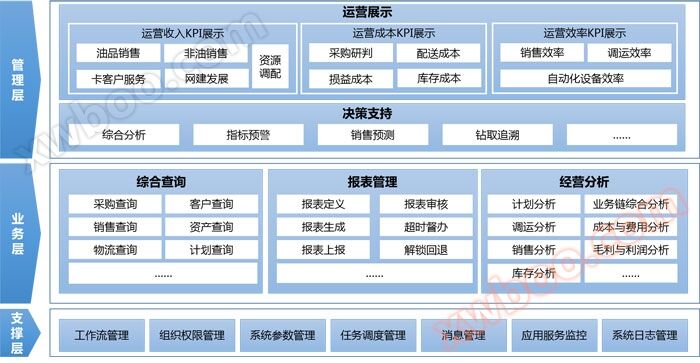
It mainly includes modules such as system management, inspection and maintenance management, daily inspection management, maintenance and renovation management, equipment and facility management, project construction management, payment management, and supplier management.
- Daily inspection management conducts inspections of gas stations and oil depots through the daily and special inspection rules set by the system, and promptly reports equipment and facility problems found during inspections for maintenance and repair.
- The maintenance and repair management realizes the process oriented, standardized, and electronic management of equipment and facility maintenance and repair work orders submitted by gas stations and oil depots on a daily basis. Enterprises choose maintenance, self procurement, repair and renovation methods based on actual situations. Provide data support for analyzing the maintenance rate of equipment and facilities failures.
- The maintenance and renovation management realizes process oriented, standardized, and electronic management of the maintenance and renovation process. It reports the maintenance and renovation plan of the warehouse station through two methods: renovation pool and new addition, as well as adjustments, delays, cancellations, and other business related to the maintenance and renovation plan of the warehouse station.
- Equipment and facility management provides procurement requests, purchase orders, and arrival confirmation functions corresponding to maintenance and renovation plans, as well as procurement requests, equipment procurement, equipment dispatch, arrival confirmation, equipment requisition, equipment allocation, equipment recycling, and other functions for information office equipment.
- Payment management is the process based, standardized, and electronic management of payment requests for maintenance and renovation plans, as well as maintenance and repair reports.
- Supplier management provides input functions for basic information such as suppliers, supplier types, supplier categories, and supplier products, and is used for functions such as maintenance, repair reporting, repair and renovation, equipment and facility management.
- System management is the management of departments, accounts, menus, permission assignments, and automated tasks through backend account management systems.
feature
- Full lifecycle maintenance resource management: achieve full lifecycle management of equipment and facilities, establish a comprehensive equipment and facility ledger, provide flexible equipment and facility warning mechanisms, and unify the management entrance of equipment and facilities.
- Full process inspection and maintenance management: achieve process support for maintenance, renovation, repair, maintenance, and emergency repairs, provide efficient approval and processing processes, and support effective supervision of remote construction.
- Multi level operational management support: supporting horizontal integration and vertical integration of business, providing business support for decision-making, management, and execution at all levels.
- Comprehensive statistical analysis: providing multi-dimensional and different granularity statistical support, supporting flexible combinations of statistical conditions and diverse presentation forms, providing in-depth data analysis and business forecasting.