-
E-mail
xaslck@163.com
-
Phone
18802933690,18829593940
-
Address
Xi'an High tech Zone New Industrial Park
Product Categories
Xi'an Sanlian Measurement and Control Technology Co., Ltd


Intelligent cone flowmeter
NegotiableUpdate on 11/19
- Model
- Nature of the Manufacturer
- Producers
- Product Category
- Place of Origin
Overview
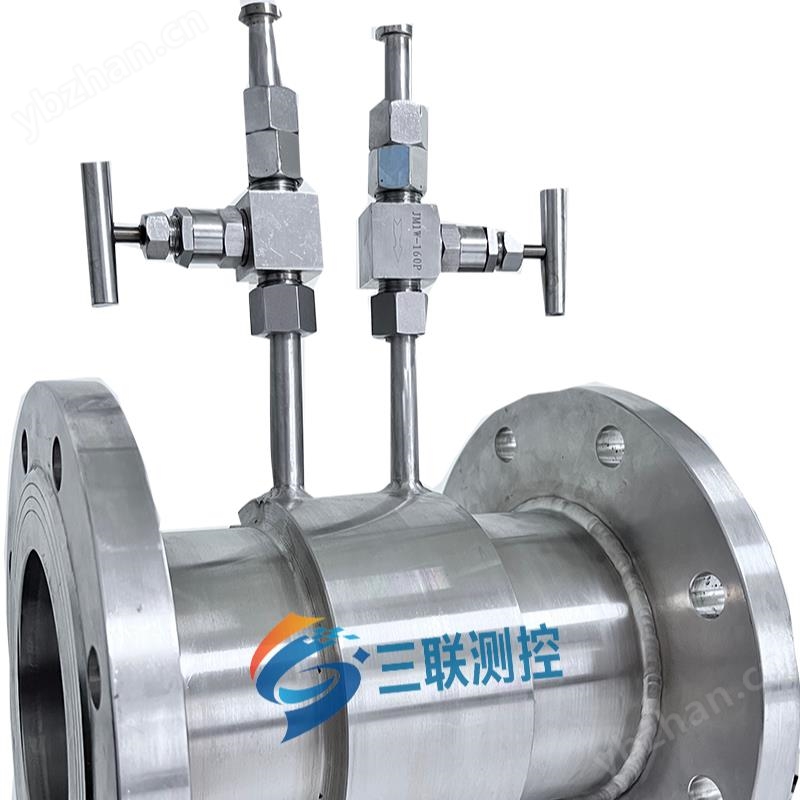
The intelligent cone flowmeter (V-cone flowmeter) is a novel differential pressure flowmeter that emerged in the 1980s. It utilizes the throttling effect generated by the cone in the flow field to measure flow rate. Compared to ordinary flow components, it has changed the throttling layout from central throttling to circular throttling
Product Details
One Overview
The conical flowmeter is a new type of differential pressure flow measurement device that uses a pointed cone installed coaxially inside the measuring tube as the throttling element. It is a new type of throttling device based on the principle of Venturi tube measurement, integrating the advantages of classic Venturi tube, annular orifice plate and wear-resistant orifice plate
2、 Measurement principle
Like other differential pressure instruments, it is also based on the principle of flow continuity and Bernoulli equation to calculate fluid flow rate under operating conditions. Compared with ordinary throttling components, it has changed the throttling layout from central orifice throttling to annular throttling.
We know that in the same closed pipeline, when the pressure decreases, the velocity will increase. When the medium approaches the cone, its pressure is P (H). When the medium passes through the throttling area of the cone, the velocity will increase and the pressure will decrease to P (L), as shown in the figure below. Both P (H) and P (L) are led to the differential pressure transmitter through the pressure tap of the V-shaped cone flowmeter. When the flow rate changes, the differential pressure value will increase or decrease accordingly. That is to say, for stable fluids, the magnitude of the flow rate is directly proportional to the square root of the differential pressure. When the flow rate is the same, the larger the cone throttling area, the greater the differential pressure value generated.
3、 Advantages and disadvantages
🔺 Advantages of V-cone flowmeter:
① Range width ratio
② Low requirements for straight pipe sections
③ Low pressure loss
④ High precision
⑤ Good long-term stability
⑥ Measurable dirty medium
4、 Installation technical requirements
(1) When installing a V-cone flowmeter in a pipeline, it can be horizontal, inclined, or vertical, but it should be easy to install and maintain.
(2) The V-cone flowmeter must be installed on the pipeline corresponding to its nominal diameter.
(3) The upstream and downstream straight pipe sections of the V-cone flowmeter should be circular, with smooth inner walls and an inner diameter equal to the nominal inner diameter of the flowmeter.
(4) During installation, the flow direction of the V-cone flowmeter must be consistent with the flow direction of the fluid. If the ambient temperature of the installation location exceeds 70 ° C, it is recommended to use a split installation form.
(5) The V-cone flowmeter should be equipped with a certain length of straight pipe sections on both the upstream and downstream sides, with a length that meets the upstream 5D and downstream 3D requirements. A long straight pipe section is beneficial for flow measurement.
(6) When installing a V-cone flowmeter, it should be ensured that the flowmeter is concentric with the upstream and downstream straight pipe sections as much as possible.
(7) If it is indeed necessary to install other measuring and control devices such as thermometers and regulating valves on site, it is recommended to install them at the downstream end of the V-cone flowmeter, 2-5 days away