-
E-mail
ebauto18@126.com
-
Phone
13361831617
-
Address
No. 1909 Cao'an Road, Jiading District, Shanghai
Product Categories
Shanghai Yibi Automation Instrument Co., Ltd
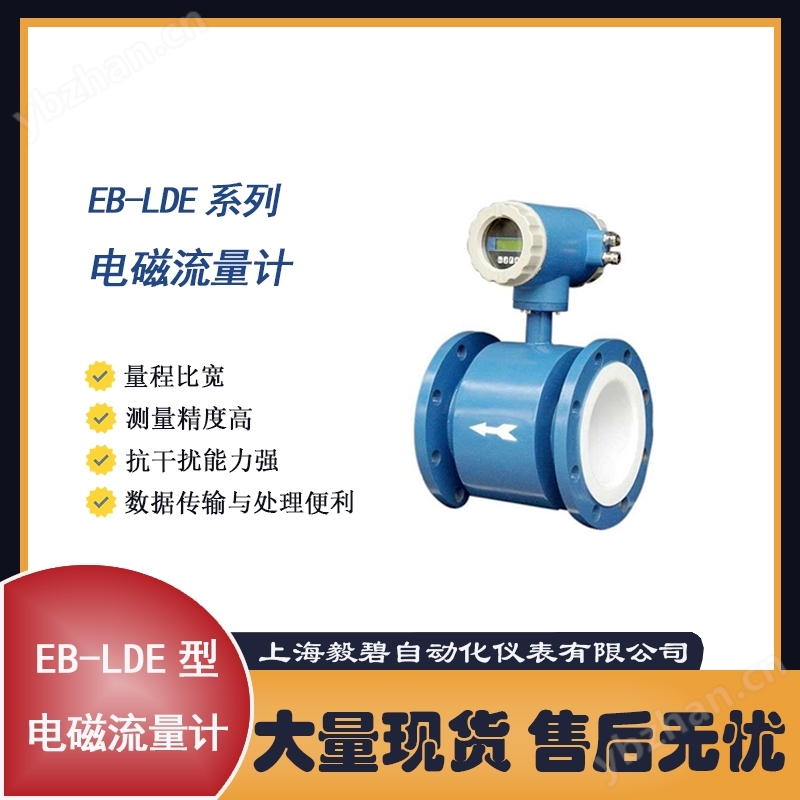
Intelligent electromagnetic induction flowmeter
NegotiableUpdate on 11/19
- Model
- Nature of the Manufacturer
- Producers
- Product Category
- Place of Origin
Overview
Intelligent electromagnetic induction flowmeter is an induction instrument that measures the volume flow rate of conductive medium inside a tube based on Faraday's law of electromagnetic induction. It uses embedded technology with a microcontroller to achieve digital excitation. Electromagnetic flow meters can not only meet on-site display requirements, but also output 4-20mA current signals for recording, regulation, and control purposes. They have been widely used in industrial technology and management departments such as chemical, environmental protection, metallurgy, pharmaceuticals, papermaking, and water supply and drainage.
Product Details
In modern industrial production, precise monitoring and control of fluid flow is a key link to ensure production efficiency, reduce energy consumption, and ensure safety.Intelligent electromagnetic flowmeterAs a flow measurement device that integrates electromagnetic induction technology and intelligent digital technology, it has become the core equipment for fluid measurement in industries such as chemical, water treatment, metallurgy, food and medicine, thanks to its advantages of no mechanical wear, high measurement accuracy, strong anti-interference ability, and wide functional scalability. Compared with traditional flow measurement instruments, it not only achieves accurate collection of flow data, but also endows equipment with data processing, remote interconnection, automation control and other capabilities through intelligent modules, providing important data support for industrial automation and digital transformation.
1、 Product definition and core advantages: redefining fluid measurement standards
Intelligent electromagnetic flowmeterIt is an intelligent instrument based on Faraday's law of electromagnetic induction, used to measure the volumetric flow rate of conductive liquids. It integrates a microprocessor (MCU), digital signal processing chip, industrial communication module, and multifunctional display unit on the basis of traditional electromagnetic flow meters, which can convert raw flow signals into digital information that can be analyzed, transmitted, and controlled, achieving a leap from "single measurement" to "intelligent management". Its core advantages are mainly reflected in the following four aspects:
(1) High measurement accuracy and strong stability
Intelligent electromagnetic flowmeterBy adopting advanced excitation technologies such as low-frequency square wave excitation and dual frequency excitation, it can effectively eliminate pipeline vibration, external electromagnetic interference (such as interference generated by motors and frequency converters), and the influence of electrode polarization on measurement. At the same time, the device is equipped with built-in digital filtering algorithms (Kalman filter, sliding average filter) and multi parameter compensation functions (temperature compensation, pressure compensation), which can correct the influence of medium temperature and pressure changes on measurement results, ensuring high-precision measurement under complex working conditions - the measurement accuracy of conventional models can reach ± 0.5% FS, and some models can even reach ± 0.2% R, far superior to the measurement performance of traditional instruments such as turbine flowmeters and vortex street flowmeters in complex media.
(2) No mechanical wear and tear, long service life
Unlike instruments such as turbine flow meters and waist wheel flow meters that rely on mechanical rotating components,Intelligent electromagnetic flowmeterThere are no movable parts inside the measuring tube, and measurement is only achieved by collecting induced electromotive force through electrodes. This "contactless" measurement method avoids wear and blockage problems of mechanical components, especially suitable for fluids containing particles and fibers (such as slurry, pulp, sewage). Under normal maintenance, the service life of the equipment can reach more than 10 years, significantly reducing the replacement cost and maintenance workload of the enterprise.
(3) Fully functional and adaptable to automation needs
Intelligent electromagnetic flowmeterBreaking through the limitations of traditional instruments that can only measure, it has rich intelligent functions: firstly, multi parameter display, real-time display of instantaneous flow rate, cumulative flow rate, fluid velocity, medium temperature, equipment working status and other information through LCD/OLED display screen, without the need for additional connection to display instruments; The second is automated control, which supports flow upper and lower limit alarms. When the flow exceeds the set range, control signals can be output through relays to achieve automatic start stop of pumps and valves, forming closed-loop control; The third is data storage and traceability, which can store historical traffic data at 1-minute/1-hour intervals (with a storage capacity of tens of thousands of records), support USB or SD card export, and facilitate energy consumption statistics and production process optimization for enterprises; The fourth is fault self diagnosis, which can monitor electrode status, excitation coil faults, air traffic control operation and other abnormal situations in real time, and help operation and maintenance personnel quickly locate problems through sound and light alarms or data signal feedback.
(4) Strong communication and interconnection capabilities, integrated into the industrial Internet of Things
To meet the demands of industrial automation and digitization,Intelligent electromagnetic flowmeterBuilt in multiple industrial communication modules, supporting mainstream communication protocols: In close range scenarios, it can be connected to PLC, frequency converter and other devices through RS485 interface (with Modbus RTU protocol) to achieve data transmission within a range of hundreds of meters; In the intelligent instrument system, bidirectional communication can be achieved through the HART protocol, and operation and maintenance personnel can remotely modify equipment parameters (such as range, unit, alarm threshold) through the upper computer without on-site operation; In the Industrial Internet of Things (IIoT) scenario, some models support industrial Ethernet protocols such as Profinet and EtherNet/IP, or integrate 5G and LoRa wireless communication modules, which can upload traffic data in real time to the factory cloud platform, achieve centralized monitoring of multiple devices, cross plant data sharing, and provide data support for enterprise digital management.
2、 Core technology composition of the product: hardware and software foundation to ensure performance
Intelligent electromagnetic flowmeterThe high performance energy comes from its precise hardware structure and advanced software algorithms. The core technology can be divided into two parts: hardware system and software system
(1) Hardware system: the physical foundation for stable operation
The hardware system consists of four major modules: measurement unit, excitation unit, signal processing unit, and intelligent control unit. Each module works together to ensure the accuracy and stability of flow measurement
Measurement unitThe core components are the measuring tube, electrode, and lining. The measuring tube is made of stainless steel or carbon steel material, and the inner wall is lined with insulating materials (such as PTFE, natural rubber, ceramics), which not only prevent the interference of liquid and metal tube wall conductivity in measurement, but also resist medium corrosion; The electrodes are installed on both sides of the inner wall of the measuring tube, in direct contact with the fluid, for collecting induced electromotive force. Common materials include 316L stainless steel, Hastelloy C276, titanium alloy, etc., which can be flexibly selected according to the corrosiveness of the medium; The lining material is selected based on the characteristics of the medium and the operating temperature and pressure. For example, PTFE lining is suitable for strong acid and alkali, high temperature (≤ 180 ℃) scenarios, while ceramic lining is suitable for high wear slurry and sediment media.
Excitation unitComposed of an excitation coil and an excitation power supply, it is used to generate a uniform and stable magnetic field inside the measuring tube. The excitation coil is wound with high-strength enameled wire and has a shielding layer between it and the measuring tube, which can reduce the interference of magnetic field leakage on surrounding equipment; The excitation power supply can provide stable excitation current and output DC, AC or low-frequency square wave excitation signals according to the working conditions. DC excitation is suitable for low polarization media, while AC and low-frequency square wave excitation can effectively eliminate electrode polarization and external interference, and are currently the mainstream excitation methods.
signal processing unitIncluding signal amplification circuit, filtering circuit, and A/D conversion circuit. The induced electromotive force collected by electrodes is usually in the range of several millivolts or even microvolts, and the signal amplification circuit can amplify weak signals to a manageable range; The filtering circuit eliminates noise signals such as pipeline vibration and electromagnetic interference through digital filtering algorithms; The A/D conversion circuit converts analog signals into digital signals and transmits them to the intelligent control unit for processing.
Intelligent control unitUsing a microprocessor (MCU) as the core, integrating components such as display screens, buttons, communication interfaces, relay output interfaces, etc., it is the "brain" of the device. The microprocessor is responsible for receiving digital signals, converting flow data through built-in algorithms, and controlling the display screen to display information; At the same time, it can process external instructions (such as remote parameter modification), control relay output alarms or control signals, and achieve automation functions; The communication interface provides a channel for data transmission, ensuring the interconnection between devices and external systems.
(2) Software System: The Core of Intelligent Function Implementation
The software system is developed based on embedded operating systems, including traffic calculation algorithms, digital filtering algorithms, compensation algorithms, communication protocol stacks, fault diagnosis algorithms, etc. It is the key to achieving "intelligence" of devices:
Traffic calculation algorithmAccording to Faraday's law of electromagnetic induction, the induced electromotive force collected by the electrode is converted into flow velocity, and then combined with the cross-sectional area of the measuring tube to calculate the volumetric flow rate, ensuring the accuracy of the calculation results.
Digital filtering algorithmBy using algorithms such as Kalman filtering and sliding average filtering, external electromagnetic interference and noise signals generated by pipeline vibration are eliminated to ensure the stability of the original data.
compensation algorithmRegarding the fluid density affected by the thermal expansion and contraction of the measuring tube and pressure changes caused by the temperature changes of the medium, relevant parameters are collected through temperature sensors and pressure sensors, and the compensation formula is used to correct the flow data, further improving the measurement accuracy.
Communication protocol stackIntegrate communication protocols such as Modbus RTU, HART, Profinet, etc. to achieve standardized data exchange between devices and external systems, ensuring communication stability and compatibility.
Fault diagnosis algorithmReal time monitoring of parameters such as electrode impedance, excitation current, and flow signal fluctuations. When abnormalities are detected (such as electrode scaling, excitation coil open circuit, or empty tube operation), a fault alarm is triggered and a fault code is output through a display screen or communication signal to help operation and maintenance personnel quickly troubleshoot the problem.
3、 Product Classification and Model Selection: Adapting to Diverse Needs in Different Scenarios
Based on the differences in installation methods, structural forms, and application scenarios,Intelligent electromagnetic flowmeterIt can be divided into different types, and enterprises can choose suitable products according to their actual needs:
(1) Classified by installation method
Pipeline electromagnetic flowmeterThe most common type is directly installed on pipelines, suitable for scenarios with full pipe operation, high measurement accuracy, and adaptable to the vast majority of industrial fluid measurement needs, such as chemical pipelines, water treatment pipelines, metallurgical circulating water systems, etc.
Plug in electromagnetic flowmeterBy inserting a measuring probe through a hole in the pipeline, flow measurement can be achieved without cutting off the pipeline. It is easy to install and suitable for large-diameter pipelines (such as municipal water supply networks with a diameter of DN1000 or more) or scenarios where installation cannot be stopped. Compared to the pipeline type, the insertion type measurement accuracy is slightly lower (usually ± 1.0%~± 1.5% FS), but the installation cost is lower and maintenance is more convenient.
(2) Classified by structural form
Integrated electromagnetic flowmeterThe measurement unit and intelligent control unit are integrated together, with a compact structure and small installation space, suitable for scenarios with small and medium-sized diameters (≤ DN300) and limited installation space, such as process pipelines in workshops.
Split type electromagnetic flowmeterThe measurement unit and intelligent control unit are separated and connected by cables (up to 100 meters in length), suitable for large-diameter pipelines (≥ DN300), high-temperature environments (such as boiler feedwater pipelines), or highly corrosive scenarios. Installing the intelligent control unit in a safe area away from the measurement point can avoid damage to electronic components caused by high temperature and corrosion.
(3) Classified by explosion-proof level
Ordinary electromagnetic flowmeterNo explosion-proof design, suitable for environments with no explosion risk, such as non explosion-proof areas in ordinary water plants and food processing plants.
Explosion proof electromagnetic flowmeterEquipped with explosion-proof shell and explosion-proof circuit design, it is suitable for scenarios such as chemical, petroleum, pharmaceutical, etc. where flammable and explosive gases or dust exist. According to the explosion-proof level, it can be divided into explosion-proof type (Exd IIB T4) and intrinsic safety type (Exia IIC T6), with intrinsic safety type having a higher explosion-proof level and suitable for areas with more severe explosion risks.
4、 Applicable scenarios and industry applications: solving measurement pain points in different industries
Intelligent electromagnetic flowmeterThe application scenario is determined by its working principle and performance characteristics, mainly suitable for measuring conductive liquids (conductivity ≥ 5 μ S/cm), especially in complex working conditions, with significant advantages. The following are typical industry application cases:
(1) Water treatment industry: core equipment for environmental monitoring and water resource management
In the water treatment industry,Intelligent electromagnetic flowmeterWidely used in raw water transportation, sewage treatment, and reclaimed water reuse, it solves the problem of traditional instruments being prone to blockage and corrosion in water bodies containing suspended solids and corrosive substances. For example, at the inlet and outlet of the sewage treatment plant, a pipeline type electromagnetic flowmeter with 316L stainless steel electrodes and natural rubber lining is used to monitor the sewage flow in real time. The data is uploaded to the SCADA system through RS485 protocol to achieve statistical analysis of sewage treatment capacity and environmental discharge monitoring; In the reclaimed water reuse system, corrosion-resistant PTFE lining models are selected to measure the flow rate of reclaimed water containing trace chemical agents after treatment, ensuring precise control of the reuse process.
(2) Chemical industry: precise measurement under strong corrosion and high temperature conditions
In the chemical industry, fluids are mostly corrosive media such as strong acids, strong bases, and organic solvents, and the operating temperature and pressure fluctuations are large, requiring high corrosion resistance and stability of flow meters.Intelligent electromagnetic flowmeterBy selecting appropriate electrode and lining materials, the measurement needs of different corrosive media can be met: for example, when measuring 98% sulfuric acid, the model of Hastelloy C276 electrode+PTFE lining can be selected; When measuring 30% sodium hydroxide solution, choose the model of titanium alloy electrode+PTFE lining; At the same time, the temperature compensation function of the device can correct the impact of thermal expansion and contraction of the measuring tube on accuracy at high temperatures (such as 150 ℃), and the HART communication function facilitates remote monitoring and parameter adjustment by operation and maintenance personnel, reducing safety risks during on-site operations.
(3) Metallurgical industry: reliable measurement of high wear and high conductivity dielectrics
In scenarios such as slurry transportation, electrolyte circulation, and cooling water metering in the metallurgical industry, fluids contain a large amount of particles (such as slag and metal debris), have strong abrasion resistance, and high conductivity. Traditional turbine flow meters are prone to accuracy degradation due to wear and tearIntelligent electromagnetic flowmeterBy using ceramic lining and titanium alloy electrodes, it can resist the erosion of high wear media and extend its service life. For example, in the slurry conveying pipeline, a split type electromagnetic flowmeter with alumina ceramic lining and titanium alloy electrode is selected, and the flow rate is controlled at 1.5-2m/s, which not only reduces lining wear but also ensures measurement accuracy; In the electrolyte circulation system, the fault self diagnosis function of the equipment can monitor the electrode scaling situation in real time, avoid measurement errors caused by scaling, and ensure the stable operation of the electrolysis process.
(4) Food and pharmaceutical industry: safety measurement under hygiene level requirements
The food and pharmaceutical industry has strict requirements for the hygiene and safety of flow meters. The fluid should avoid contamination with instrument components, and the equipment should be easy to clean and disinfect.Intelligent electromagnetic flowmeterThe sanitary grade model adopts a stainless steel shell, sanitary grade 316L electrodes+PTFE lining, and polished inner and outer surfaces (Ra ≤ 0.8 μ m) to avoid fluid residue and meet hygiene certification standards such as FDA and 3A; At the same time, the device supports CIP (online cleaning) and SIP (online sterilization), which are suitable for measuring fluids such as juice, medicine, purified water, etc. For example, in the drug delivery pipeline of a pharmaceutical factory, hygiene gradeIntelligent electromagnetic flowmeterReal time monitoring of drug flow and data encryption storage function meet the requirements of GMP certification for data traceability, ensuring compliance in the drug production process.
5、 Product application value: Creating economic and social benefits for enterprises
Intelligent electromagnetic flowmeterNot only is it a measuring device, but it can also provide support for enterprise production and operation, cost control, environmental compliance, and create significant economic and social benefits:
Improve production efficiencyThrough precise flow measurement and automated control, enterprises can optimize production process parameters (such as reactor feed rate and circulating water flow rate), avoid production abnormalities caused by flow fluctuations, and improve product qualification rate and production efficiency.
Reduce energy consumption and costsAccurate flow monitoring can help enterprises adjust the operating parameters of fluid conveying equipment (such as pumps and fans) reasonably, avoid overload operation, and reduce energy consumption; At the same time, the equipment has no mechanical wear and tear, a long service life, and reduces maintenance and replacement costs.
Ensure environmental complianceIn industries such as water treatment and chemical engineering,Intelligent electromagnetic flowmeterReal time monitoring of sewage discharge, medium consumption and other data, with data storage and traceability functions meeting the requirements of environmental protection departments for discharge monitoring, helping enterprises avoid environmental penalty risks.
Promote digital transformationThe communication and interconnection capabilities of devices can integrate traffic data into enterprise digital management systems, providing data support for production optimization, energy consumption analysis, and supply chain management, and helping enterprises achieve digital and intelligent transformation.
6、 Product maintenance and precautions: key to extending service life
to ensureIntelligent electromagnetic flowmeterLong term stable operation requires attention to daily maintenance and correct use:
regular cleaningFor media containing impurities and prone to scaling, it is necessary to regularly disassemble the electrode and clean the dirt or scaling on the surface of the electrode to avoid affecting the collection of induced electromotive force; When cleaning, use a soft cloth or specialized cleaning agent to avoid scratching the electrodes or lining.
parameter checkRegularly check the display screen data and compare it with actual working conditions to determine whether the flow rate is reasonable; Check if the communication is normal and ensure that the data can be uploaded to the upper computer normally; Regularly calibrate the equipment (recommended once every 1-2 years), which can be done through on-site calibration or factory calibration to ensure that the measurement accuracy meets the requirements.
Installation specificationsDuring installation, it is necessary to ensure that the pipeline runs at full capacity and avoid measuring with empty or half pipes; Sufficient straight pipe sections should be reserved upstream and downstream (usually ≥ 5D upstream and ≥ 3D downstream) to reduce the impact of fluid disturbance on measurement; Stay away from strong magnetic field interference sources (such as large transformers and high-voltage cables), and the grounding resistance of the equipment should be ≤ 10 Ω to ensure signal stability.
Adaptation to working conditionsTo avoid operating under excessive temperature and pressure, the operating temperature and pressure should be within the rated range of the equipment, and a margin of 10% to 20% should be reserved; For media containing bubbles, it is necessary to first process them through a degassing device to avoid measurement errors or signal interruptions caused by bubbles.
summary
Intelligent electromagnetic flowmeterAs a product in the field of industrial fluid measurement, it has become the core equipment for fluid monitoring and control in various industries with precise measurement performance, rich intelligent functions, and strong environmental adaptability. It not only solves the measurement pain points of traditional instruments in complex working conditions, but also integrates into the industrial Internet of Things through communication and interconnection capabilities, providing data support for enterprise digital transformation. With the continuous development of industrial automation and intelligence,Intelligent electromagnetic flowmeterFurther upgrades will be made to achieve breakthroughs in measurement accuracy, functional scalability, and interconnectivity, providing stronger guarantees for efficient, energy-saving, and environmentally friendly operation of industrial production.