-
E-mail
services@chint.com
- Phone
- Address
Product Categories
Chint Group Co., Ltd
Intelligent monitoring of photovoltaic power plants
NegotiableUpdate on 09/17
- Model
- Nature of the Manufacturer
- Producers
- Product Category
- Place of Origin
Overview
Industry Insights and Challenges: Power plant capacity is growing rapidly, with a large gap in high-quality operation and maintenance: Since 2014, the scale of domestic power plants has grown rapidly, and by 2020, the total installed capacity of photovoltaics in China is expected to reach 20000 megawatts
Product Details
Industry Insights
With challenges
The capacity of power stations is growing rapidly, and there is a large gap in high-quality operation and maintenance:2014Since the beginning of the year, the scale of domestic power stations has grown rapidly, and by 2020, the total installed capacity of photovoltaics in China is expected to reach 20000 megawatts;
The operation and maintenance services have not kept up in a timely manner and need to shift from extensive to refined and intelligent;
The key to preserving and increasing the value of existing assets lies in the operation and maintenance of power plantsAffordable internet access - income pressure, financing environment - cost pressure, delayed national subsidies - cash flow pressure;The 531 New Policy, shifting from high-speed growth to high-level development, and managing existing assets;
Policy promotion of intelligent operation and maintenance:The six national departments jointly issued the "Action Plan for the Development of Intelligent Photovoltaic Industry (2018-2020)",Propose to promote the deep integration of big data, Internet of Things, Internet, artificial intelligence and other technical means with photovoltaic industry;By implementing refined management, we aim to enhance the power generation revenue of the power station and accelerate the process of achieving grid parity;
The demand for refined development of enterprises:The refined management of photovoltaic power stations is not only the ultimate trend for photovoltaic enterprises to achieve high management efficiency, but also an inevitable requirement for the modernization of photovoltaic power station management.
Solution
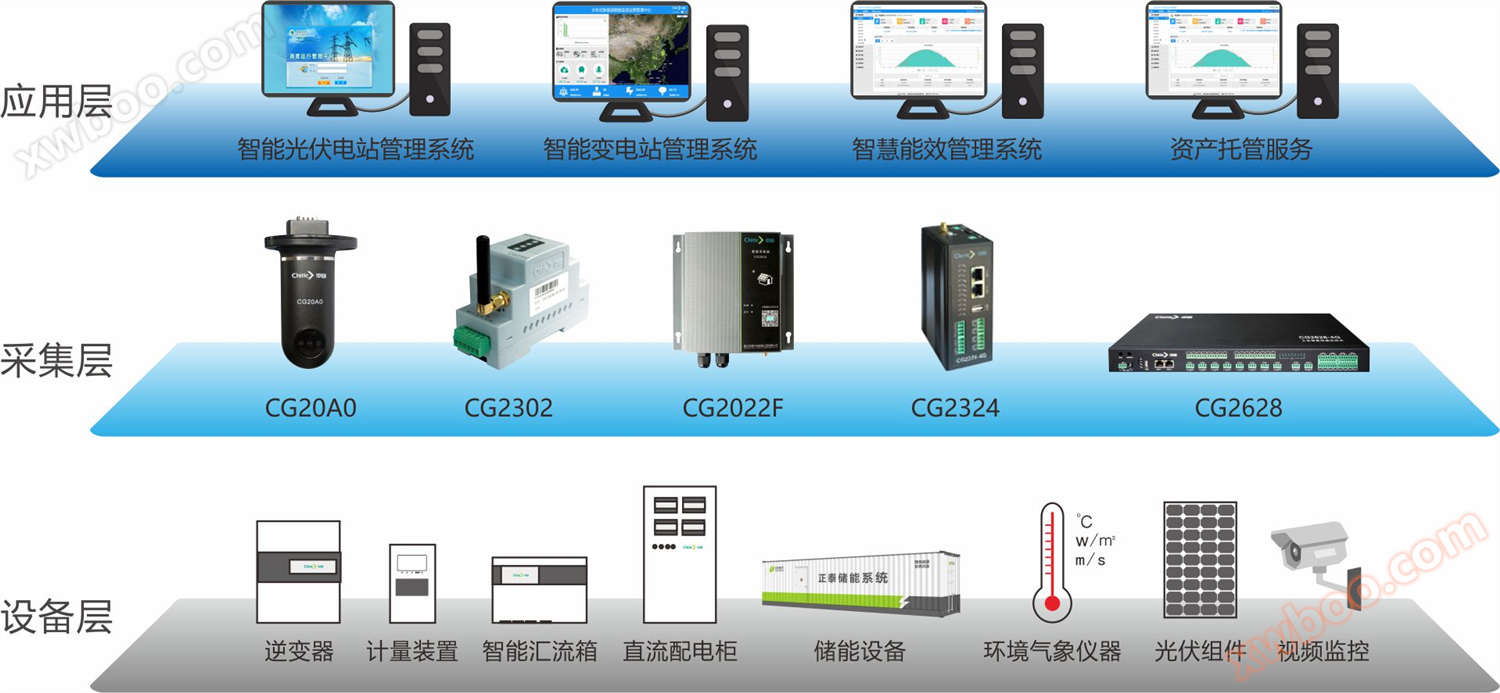
The intelligent monitoring system for photovoltaic power stations is designed and developed to meet the monitoring needs of photovoltaic power stations. Combined with secondary power monitoring, it covers real-time data monitoring, equipment control, parameter adjustment of power generation equipment in photovoltaic power stations, and has data upload function. It can provide customers with remote viewing of power stations.
Solution Architecture
Collection layer:Using a photovoltaic dedicated data collector to achieve data collection of terminal devices such as combiner boxes, inverters, distribution cabinets, energy storage equipment, and environmental meteorological instruments.
Network layer:Support multiple communication and transmission protocols to ensure reliable connection between the upper computer and equipment, and real-time transmission of data to the user's photovoltaic power plant cloud data center.
Application layer:The cloud data center equipped with photovoltaic power plants provides users with professional photovoltaic monitoring, data processing analysis, and configuration display, perfectly solving the management problems of photovoltaic power plants for users; At the same time, the system integrates functions such as video surveillance, relay protection monitoring, and remote power dispatch to achieve power system fault warning and intelligent control; Through the introduction of photovoltaic data power station informatization, the management mode of power stations is standardized, the workload of power station operators is reduced, the efficiency of photovoltaic power station operation and management is comprehensively improved, and data support is provided for power station investment and construction decisions.


Our Advantages
Standardization of hardware products, simple structure, and convenient engineering implementation;
Capable of configuration development, facilitating engineers to carry out secondary development of functions;
Support multiple standard power communication protocols and industrial automation communication protocols, facilitating efficient and flexible data exchange with third-party systems;
The monitoring and analysis software has strong, comprehensive functions and high reliability;
Powerful screen configuration function and user-friendly human-machine interface;
Strong system compatibility, supporting multi device access for large ground power stations;
The data interface is open, flexible in expansion, and has a flexible architecture.