-
Phone
156-5028-2386
-
Address
West of Shangfang Village, Jiulong Street, Fangzi District, Weifang City
Product Categories
Shandong Mengzhijie Water Treatment Equipment Co., Ltd

Iron carbon microelectrolysis tower
NegotiableUpdate on 12/26
- Model
- Nature of the Manufacturer
- Producers
- Product Category
- Place of Origin
Overview
Since its inception, the iron carbon microelectrolysis tower has attracted the attention of environmental researchers both domestically and internationally, and has undergone extensive research! There are already many patents and practical technological achievements
Product Details
Iron carbon microelectrolysis towerSince its inception, it has attracted the attention of environmental researchers both domestically and internationally, and has undergone extensive research!There are already many patents and practical technological achievements. In recent years, micro electrolysis treatment of industrial wastewater has developed rapidly and is now used in the treatment of industrial wastewater such as printing and dyeing, electroplating, petrochemicals, pharmaceuticals, gas washing, printed circuit board production, as well as arsenic and fluoride containing wastewater. It has achieved good economic and environmental benefits. The microelectrolysis process has a good treatment effect on wastewater decolorization, and can be used to treat waste with low operating costs. Therefore, it will have good industrial application prospects in China.
1、 Basic principles
Micro electrolysis technology is increasingly being valued in the treatment of difficult to degrade industrial wastewater and has been implemented in practical engineering. Iron carbon microelectrolysis tower,It's using iron-There is a potential difference between carbon particles, forming countless tiny primary cells. These delicate batteries use iron with low potential as the anode,Carbon with high potential as cathode,Electrochemical reactions occur in aqueous solutions containing acidic electrolytes. The result of the reaction is that iron is corroded and becomes divalent iron ions that enter the solution. Regulation of effluent from internal electrolysis reactorPHValue to9Left and right, due to the interaction between iron ions and hydroxide ions, ferrous hydroxide with coagulation properties is formed,It strongly attracts particles with weak negative charges in pollutants,Form relatively stable flocs(Also known as iron mud)And remove it. To increase the potential difference and promote the release of iron ions,In Iron-Add a certain proportion of copper powder or lead powder to the carbon bed.
After microelectrolysis,BOD/CODElevated, it is because some difficult to degrade macromolecules are adsorbed by carbon particles or reduced by iron ion flocculation. Many people believe that microelectrolysis has the ability to decompose large molecules,The theoretical basis for converting difficult to biodegrade substances into easily biodegradable substances is the "new ecology generated in microelectrolysis reactions"[H]Can cause some organic compounds to break chains and change organic functional groups. However, experiments using methyl and phenol did not confirm the ability of microelectrolysis to decompose and break down large molecular structures.
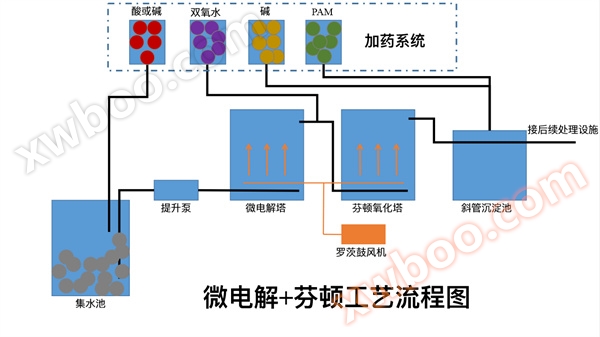
If we want the iron carbon bed to have the ability to decompose organic macromolecules,Usually, hydrogen peroxide needs to be added,Acidic wastewater reacts with iron to generate ferrous ions,Formation of ferrous ions and hydrogen peroxideFentonReagents have oxidative properties that generate hydroxyl radicals, which degrade most difficult to degrade large organic molecules into small organic molecules. Similarly, the reaction can only proceed under acidic conditions.
2、 Process characteristics
1The iron carbon microelectrolysis tower solves the problems of packing plate formation, passivation, activation, and replacement in microelectrolysis wastewater treatment process, and has the advantage of sustained high activity iron bed. Compared to traditional iron carbon fillers, the loss has been reduced60%Above, the amount of sludge generated by simultaneous treatment has been reduced50%above. This technology can be used as a single treatment method or as a pre-treatment process for biological treatment, which is beneficial for sludge settling and biofilm formation.
2、Microelectrolysis reactorThe internal electrolysis anode and cathode, as well as the catalyst, form a structured alloy structure at high temperatures, which does not easily cause anode cathode separation and affect the reaction of the primary battery, unlike the iron carbon mixed combination. Regular micro electrolysis packing has a long service life, easy operation and maintenance, and only consumes a small amount of micro electrolysis packing during the processing. Micro electrolysis can be added regularly based on the volume consumed, without the need for replacement.
3The microelectrolysis reactor adopts microporous activation technology, which has a large specific surface area. At the same time, it is equipped with a catalyst, providing a higher current density and better microelectrolysis reaction effect for wastewater treatment. The reaction rate is fast, and general industrial wastewater only requires30-60Minute, long-term stable and effective operation.
4Due to the dual effects of microelectrolysis and catalyst, microelectrolysis reactors are more effective than traditional iron carbon fillers in treating high organic concentration, high toxicity, high chromaticity, and difficult to biodegrade wastewaterCODImproved resolution rate10-20%In wastewaterCODThe removal rate is generally within35-60%Left and right, chromaticity can be removed60-90%At the same timeB/CValue can be increased0、1-0、3Improved the biodegradability of wastewater.
5The micro electrolysis reactor electrolysis treatment method can achieve the effect of chemical precipitation phosphorus removal, and can also remove heavy metals through reduction. After micro electrolysis treatment, wastewater will form native ferrous or iron ions in the water, which have better coagulation effect than ordinary coagulants and do not require the addition of coagulants such as iron salts,CODHigh removal rate and no secondary pollution to water.

6、Fe2+Catalytic effect, added after microelectrolysisH2O2The Fenton oxidation process is used to treat some difficult to degrade chemical wastewaterCODcrThe resolution rate can reach70-75%It has a good degradation effect on difficult to remove and degrade organic substances containing even fluorine, carbon double bonds, nitro groups, and halogenated structures.
7For high concentration organic wastewater treatment projects that have been built but have not yet met the standards, using this technology as a pre-treatment for the wastewater of the existing projects can ensure stable and compliant discharge after wastewater treatment. It is also possible to separate the high concentration wastewater from the production wastewater for microelectrolysis treatment.
8Iron carbon microelectrolysis tower technology. The microelectrolysis reactor solves the problems and drawbacks of traditional microelectrolysis wastewater treatment processes, such as packing plate formation, passivation, activation, and replacement, and has the advantage of sustained high activity iron bed. The loss of microelectrolysis reactor can be reduced60%above.
9Fast response speed. The microelectrolysis reactor adopts microporous activation technology, which has a large specific surface area. At the same time, the addition of a catalyst provides a higher current density and better microelectrolysis reaction effect for wastewater treatment. The reaction rate is fast, and generally industrial wastewater only requires30-60Minute, long-term stable and effective operation.
10Addressing the challenges of phosphorus removal and heavy metals. The microelectrolysis treatment method can achieve the effect of chemical precipitation for phosphorus removal, and can also remove heavy metals through reduction. It has a good degradation effect on difficult to remove and degrade organic substances containing even fluorine, carbon double bonds, nitro groups, and halogenated structures.
11Easy to operate. Regular microelectrolysis packing has a long service life and is easy to operate and maintain. Therefore, only a small amount of microelectrolysis packing is consumed during the treatment process of the microelectrolysis reactor, which can be added regularly without replacement, greatly reducing maintenance labor intensity.
12There are various ways to apply it. This product can also be applied to high concentration organic wastewater treatment projects that have been built but have not yet met the standards. It is used for wastewater pretreatment to ensure stable and compliant discharge after wastewater treatment. It can also be used to extract high concentration wastewater from production wastewater for micro electrolysis treatment.
3、 Iron carbon microelectrolysis tower structure
The iron carbon microelectrolysis tower consists of a microelectrolysis reactor, a water distribution system, and an aeration system, and can also be configured according to user requirements.
1Micro electrolysis reactor: can be designed as a circular tank, square tank, or belt conveyor reactor according to the site conditions. Its volume can be determined according to the water treatment capacity.
2、Water distribution system:The water distribution system consists of lift pumps, flow meters, and pipelines.
3、Aeration System:The aeration system consists of fans, pipelines, valves, etc. The air pressure can be adjusted according to the micro electrolysis reactor and pipelines, and the air volume can be confirmed according to the design.
Iron carbon microelectrolysis tower, also known as microelectrolysis reaction tower, is an ideal equipment for treating high concentration wastewater. The use of iron carbon fillers filled in the reactor can improve the biodegradability of the wastewater, remove color and heavy metals. It is currently a widely used new type of sewage treatment equipment.

More aboutMicroelectrolysis reactorFor relevant information, please follow the company website (www.sdmzj. com)!


