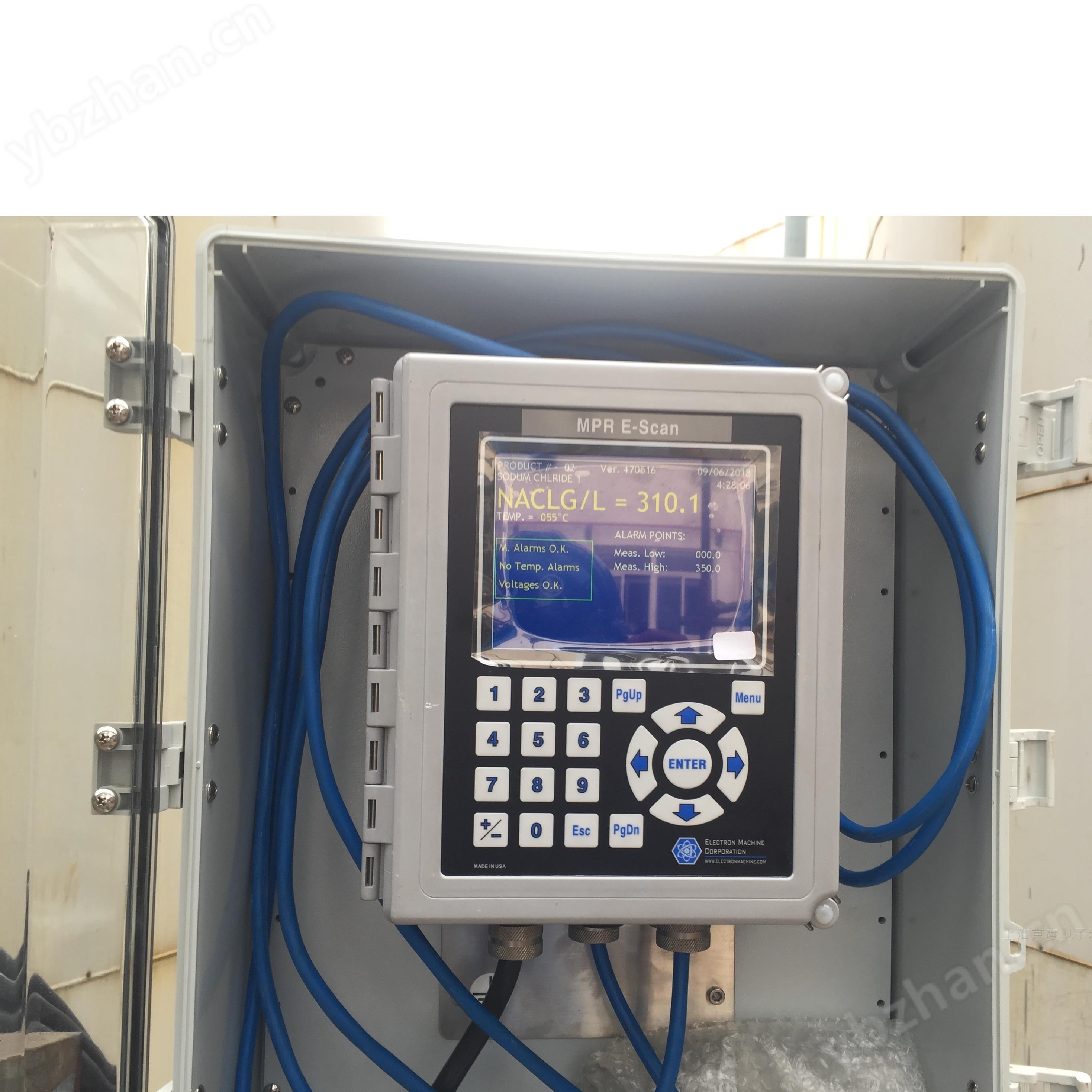
The pipeline dissolution MPR E-Scan online NK concentration analyzer meets the needs of any application that requires online measurement of caustic soda concentration. Currently, it is widely used in the alumina industry for online measurement of caustic soda concentration NK values.
Pipeline dissolution MPR E-Scan online NK concentration analyzer is an instrument used for online monitoring of caustic alkali (NK) concentration in pipeline dissolution solution during alumina production process. Here is a detailed introduction:
working principleOptical principle based on critical angle total reflection. The light source of the instrument emits light towards the prism surface in contact with the measured solution. As the incident angle increases, it reaches the critical angle, and the refracted light propagates along the interface of the medium. By using high-precision optical sensors to detect the critical angle, and based on the relationship between the critical angle and the refractive index of the solution, as well as a pre established database corresponding to refractive index and concentration, the actual concentration of caustic soda (NK) in the solution is calculated.
Technical Features:
high-precision measurementThe measurement accuracy can reach ± 0.1%, providing a guarantee for precise control of caustic alkali concentration in the production process.
Real time online monitoringContinuous real-time monitoring of the concentration of caustic alkali in the leachate, timely reflecting small changes in concentration, and helping operators adjust production parameters in a timely manner.
Strong anti-interference abilityThe detection is not affected by factors such as color, turbidity, bubbles, solid impurities, and external light of the solution, and can work stably in complex alumina production environments.
Automatic temperature compensationEquipped with automatic temperature compensation function, it can eliminate the influence of temperature on the refractive index and concentration measurement of the solution, ensuring the accuracy of measurement results under different temperature conditions.
split-type designAdopting a split design, only the optical sensor is installed on the pipeline, and the transmitter with main electronic components such as CPU and motherboard is far away from high temperature and vibration during the process, resulting in better measurement stability and higher accuracy.
Multiple signal outputsStandard configuration includes one set of 4-20mA and 0-10VDC remote transmission output signals for concentration values, one set of 0-10VDC remote transmission output signals for process temperature values, and optional HART protocol, RS-232, RS-422 communication interfaces for easy integration with control systems.
Large screen displayThe transmitter adopts a 6.7 "true color, 640 * 480 pixel high-resolution TFT large screen, which can simultaneously display the current concentration, temperature, and trend chart. It comes with a 20 key operation keyboard, which is convenient for on-site operation, calibration, and configuration.
Technical Specifications:
measurement rangeThe concentration is 0.00% -100.00%, and the refractive index nD is 1.3200-1.5480.
Repeatability and sensitivityUp to 0.05%.
response speedThe controller is adjustable from 250ms to 3min, and the test probe is less than 500ms.
Process operating temperatureUp to+150 ℃.
work pressure-1 to 20 bar (at 120 ℃).
ambient temperature:-5℃-+50℃。
Prism material9Moh high hardness wear-resistant sapphire, with a liquid surface diameter of 9mm.
light source100000 hour long life LED, spectral D-line 589.3nm.
Application advantagesCan optimize the leaching process, improve the leaching rate of alumina, and reduce the waste of ore resources; Helps to stabilize the concentration of caustic alkali at various stages of the production process, providing the quality of AlOH crystallization and alumina product quality; Can be combined with the automation control system of the production system to improve the automation level and stability of production, and reduce manual operation errors; It can also avoid problems such as reduced production efficiency and waste of raw materials caused by improper control of caustic alkali concentration, and reduce production costs.