-
E-mail
sdgerte@126.com
-
Phone
13589335800
-
Address
Hengda Yulan International, Liuting Street, Chengyang District, Qingdao City
Product Categories
Shandong Geert Environmental Technology Co., Ltd

Smoke and dust monitoring device
NegotiableUpdate on 02/28
- Model
- Nature of the Manufacturer
- Producers
- Product Category
- Place of Origin
Overview
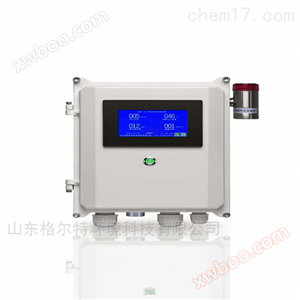
This smoke and dust monitoring device can be used for real-time continuous measurement of particulate pollutant concentrations from various pollution emission sources. It can be paired with a smoke and dust monitoring system and can be connected as a single or several smoke and dust monitoring networks, sharing a front desk. The instrument can be used for monitoring smoke and dust in power plants, steel mills, cement plants, etc. It can also be used for process control of dust removal equipment and other powder engineering.
Product Details
| brand | Other brands | Price range | discuss personally |
|---|---|---|---|
| security level | Explosion proof type | Working principle | Light scattering method |
| Origin category | domestic | application area | environment protection |
1. Overview
This manual describes the installation, operation, inspection, and maintenance of this smoke concentration monitor.
The instrument is based on the principle of backscattering of smoke particles and is used for online continuous measurement of particulate pollutants from fixed pollution sources.
be careful:
This smoke concentration monitor uses a 10mW, 650nm semiconductor laser. Direct injection of the laser beam and reflected light into the eyes can cause serious damage.
Do not look directly at the laser beam and its reflected light
Without proper training, operations beyond the scope of this manual are not allowed.
2. Scope of application
stem or root of plantsSmoke and dust monitoring deviceReal time continuous measurement of particulate pollutant concentration for various pollution emission sources, compatible with smoke monitoring systems, and capable of singleoneConnect one or several devices to form a smoke and dust monitoring network, sharing a front desk. The instrument can be used for monitoring smoke and dust in power plants, steel mills, cement plants, etc. It can also be used for process control of dust removal equipment and other powder engineering.
3. Technical features
lSmoke and dust monitoring deviceAdopting the principle of laser backscattering. Not afraid of mechanical vibration of the flue and beam oscillation caused by uneven refractive index due to uneven flue gas temperature;
Single end installation, no need for optical alignment. The instrument design process greatly reduces the complexity of on-site installation. The installation of instruments and rainproof systems only requires a screwdriver for electrical connections, which can be completed within 20 minutes. Installation and maintenance are extremely simple, greatly reducing the many problems caused by on-site installation and debugging;
Adopting standard 4-20mA industrial standard current output, easy to connect;
The overall power consumption of the instrument is very low, about 5W;
Place the calibrator on site to avoid confusion and loss;
High resolution, suitable for monitoring low concentration emissions as well as high concentration emissions;
Non point measurement, with a large sampling area, can be used for chimneys of various diameters.
4. Technical indicators
measuring range |
MIN 0-200mg/m3 MAX 0-10g/m3 |
Environmental requirements |
Temperature: -40 ℃~65 ℃ Relative humidity: 0-100% R.H |
measurement error |
± 2% F.S. per week |
Size/Weight |
160×160×250mm/ 4kg |
zero drift |
± 2% F.S. per week |
Medium conditions |
High temperature of 300 ℃ (customized for high temperature) |
Span Drift |
± 2% F.S. per week |
signal output |
(4~20)mA |
linearity error |
± 2% F.S. per week |
Maximum output load |
500Ω |
resolution |
1mg/m3 |
power consumption |
MAX5 W |
Applicable flue diameter |
1~20m |
power supply |
DC24V |
5. System principle and composition
The schematic diagram of the host structure is shown in Figure 1

The host includes a laser light source and power control unit, a photoelectric sensing and small signal preprocessing unit, a scattered light receiving unit, a display and input unit, an output driving unit, and a main control unit. The 650nm beam emitted by the laser enters the emission source at a small angle, and the laser beam interacts with smoke particles to produce scattered light. The backscattered light enters the sensor through the receiving system and is converted into an electrical signal for processing The circuit part realizes the functions of photoelectric conversion, modulation of laser beam, signal amplification, demodulation, power control of light source, and V/I conversion.