-
E-mail
394821307@qq.com
-
Phone
19719569656
-
Address
No. 8, Talent Science and Technology Innovation City, Jingjiu Road, Tianchang City, Anhui Province
Anhui Chuchen Technology Co., Ltd
Improvement of anti-interference ability and on-site stability optimization of magnetic sensitive dual color electronic liquid level gauge
Date: 2025-11-05Read: 8
The magnetic sensitive dual color electronic liquid level gauge is based on the non-contact magnetic coupling principle between the float embedded permanent magnet and external magnetic sensing components (such as reed switches or Hall sensors), achieving local dual color (red/green) visualization of liquid level and remote transmission of electrical signal output. Its passive nature and reliable display characteristics make it widely used in key equipment such as high-temperature and high-pressure boiler drums, LPG storage tanks, and chemical reaction vessels.
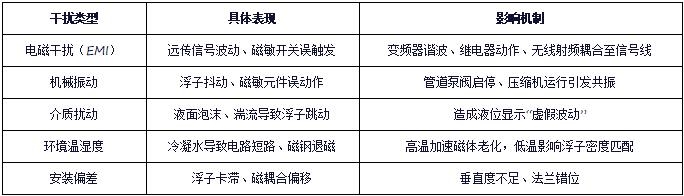
However, with the improvement of industrial automation, the number of electromagnetic interference sources such as on-site frequency converters, high-power motors, wireless communication equipment and other physical interference, such as vibration, condensation, media foam, often lead to the misdisplay, jump, signal distortion and even failure of the level gauge. Therefore, improving its anti-interference ability and long-term stability on site has become an important issue in ensuring production safety and continuous operation.
1、 Main interference source analysis
2、 Key technologies for enhancing anti-interference capability
1. Optimization of magnetic circuit structure
-Adopting high coercivity neodymium iron boron magnetic steel to enhance demagnetization resistance;
-Optimize the distance between the float and the magnetic sensor tube to ensure that the magnetic coupling strength remains above the action threshold even under interference;
-Introduce a magnetic shielding cover (such as Permalloy) to wrap the magnetic sensitive array and suppress external stray magnetic field interference.
2. Anti interference design of sensors and circuits
-Alternative solution for reed switches: using digital Hall sensors (such as Allegro A1324) with temperature compensation and adjustable hysteresis, and stronger anti shake ability;
-Signal line shielding: The remote transmission cable adopts double-layer shielding (aluminum foil+braided mesh), and the shielding layer is grounded at a single point;
-Power filtering: Add a π - type LC filter at the input of the transmitter to suppress conducted interference;
-PCB layout optimization: analog/digital ground separation, keep key signal lines away from interference sources.
3. Software filtering and intelligent discrimination
-Multi point sliding average filtering: smoothing liquid level jumps;
-Rate Limiting: Set the maximum liquid level change rate to filter out sudden interference;
-State self checking mechanism: detects open/short circuits in magnetic sensitive components and outputs fault alarm signals (such as HART diagnosis).
4. Installation and maintenance specifications
-Ensure that the verticality of the liquid level gauge installation is ≤ 2 °;
-Vertical laying should be used when away from high-power cables (spacing>30 cm) or when crossing;
-Install vibration reduction brackets in areas with strong vibrations;
-Regularly discharge pollutants and check the flexibility of the float.
The on-site stability of the magnetic sensitive dual color electronic liquid level gauge depends not only on its basic structure, but also on the system level anti-interference design. Through multi-dimensional collaborative optimization of "hardware shielding+sensor upgrade+software intelligence+standardized installation", its reliability and lifespan in complex industrial environments can be significantly improved.
