-
E-mail
76942054 @qq.com
-
Phone
18028937131
-
Address
No.15 Shihuan Road, Sangyuan Community, Dongcheng Street, Dongguan City
Guangdong Kebao Experimental Equipment Co., Ltd
Study on the Effect of Temperature Conversion Time of High and Low Temperature Impact Testing Machine on Product Failure Modes
Date: 2025-12-12Read: 8
High and low temperature impact testing is an important means of evaluating the reliability of products in environments with rapid abnormal temperature changes, and is widely used in fields such as electronics, automotive, aerospace, etc. Among them, the temperature transition time (i.e. the switching speed from high temperature to low temperature or vice versa) is a key parameter that affects the severity of the test and the failure mechanism. Research has shown that the speed of transition time not only determines the magnitude of thermal stress, but also significantly changes the failure mode of the product.
Under ideal conditions, the faster the temperature conversion, the greater the transient thermal stress that the material or component is subjected to. This is because the coefficient of thermal expansion (CTE) of different materials varies, and they cannot expand or contract synchronously under rapid temperature changes, resulting in shear stress at the interface. For example, on a PCB board, due to CTE mismatch between the copper foil, solder, and substrate connected by solder joints, microcracks or even open circuits may occur under rapid impact; In slow conversion, stress release is more sufficient, and failure is often manifested as performance drift rather than structural damage.
Experimental data shows that whenHigh and low temperature impact testing machineWhen the conversion time is shortened from 30 seconds to less than 10 seconds, the fatigue life of solder joints in electronic components (such as BGA packaged chips) can be reduced by more than 40%. Meanwhile, rapid temperature changes can easily trigger "sudden" failures such as brittle fracture, coating peeling, and sealing failure; However, slower conversion tends to expose "progressive" issues such as material aging, creep, or long-term thermal cycling cumulative damage.
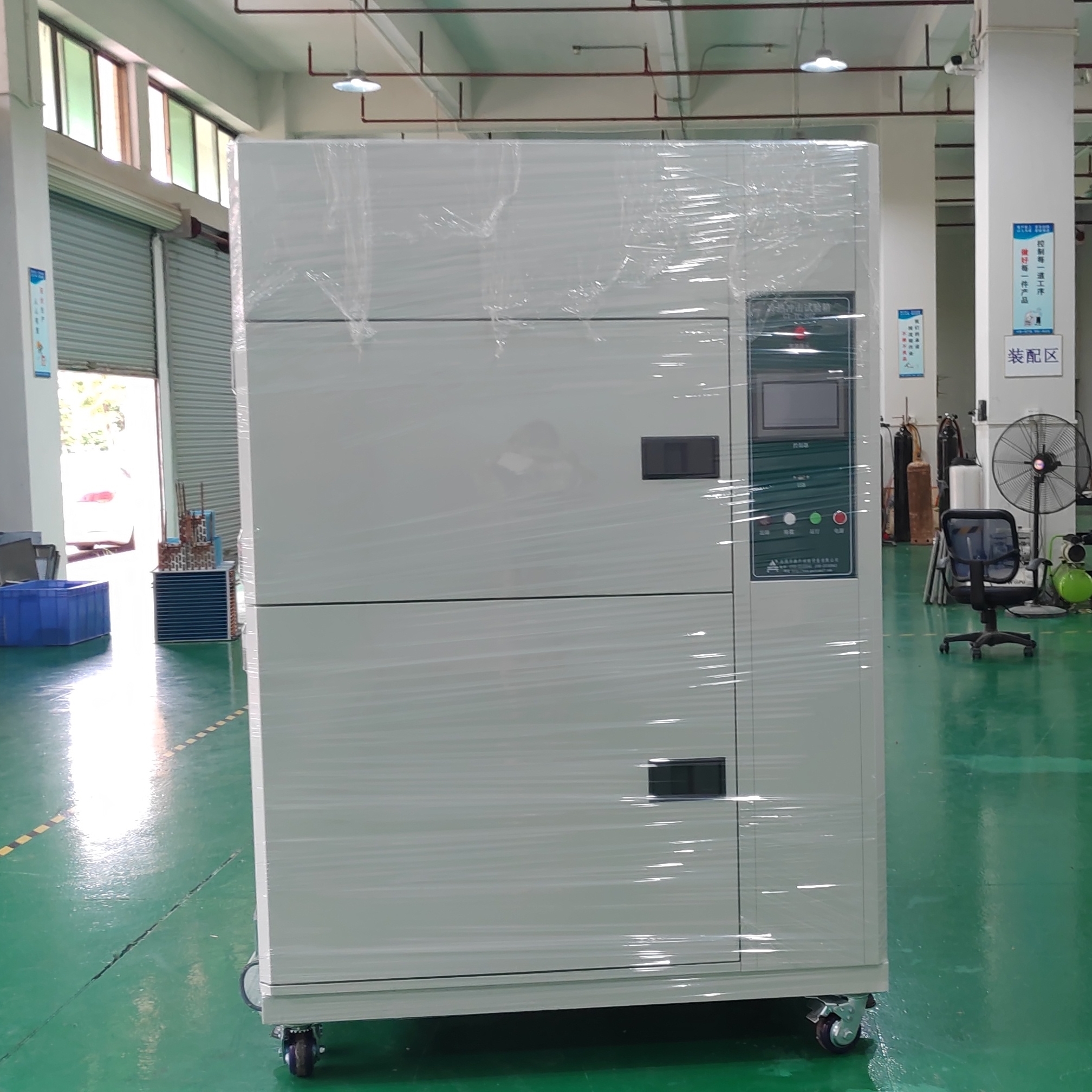
In addition, the temperature conversion time also affects the detectability of failure. Microcracks generated by rapid impact are difficult to detect in the early stages through conventional electrical measurements and require identification using X-rays or acoustic scanning microscopes (SAMs), which increases the difficulty of quality control. Therefore, when formulating test specifications, the conversion time should be reasonably set according to the actual usage environment of the product (such as engine start stop vs spacecraft orbit shadow crossing), to avoid irrelevant failures caused by excessive acceleration or potential defects missed due to excessive looseness.
In summary, the temperature transition time in high and low temperature impact tests is not only a performance indicator of the equipment, but also a core variable for controlling the physical mechanism of failure. Scientifically setting this parameter helps to accurately reproduce failure modes under real service conditions, enhancing the effectiveness of reliability verification and engineering guidance value.