-
E-mail
info@gti-test.com
-
Phone
17640053769
-
Address
Room 7 # 2212, COFCO Plaza, No. 56-39 Huanghe North Street, Huanggu District, Shenyang City
Jitai Precision Instrument (Shenyang) Co., Ltd
Practical Manual for Air Duct Leakage Tester: Equipment Calibration, Testing Process, and Leakage Point Localization Techniques
Date: 2025-09-26Read: 11
The air duct leakage tester is a detection tool in ventilation and air conditioning systems, which can help engineers and maintenance personnel accurately evaluate the sealing performance of air ducts, timely detect and repair air leakage points. This article will provide a detailed introduction to its equipment calibration, detection process, and leak location techniques to help operators better use and maintain this important equipment.
1、 Equipment calibration: ensuring measurement accuracy
(1) Preparation before calibration
Check equipment status: Before calibration, it is essential to inspect the appearance and internal components of the air duct leakage tester to ensure that the equipment is in good condition. Check if the sensor is clean, if the air circuit connection is secure, and if the power supply is stable.
Prepare calibration equipment: High precision pressure standards and flow standards should be selected for calibration equipment to ensure the accuracy of calibration. Calibration equipment should have known accuracy and calibration certificates.
Preheating equipment: Turn on the air duct leakage tester and preheat the equipment for at least 30 minutes to ensure that all components of the equipment reach a stable state.
(2) Calibration steps
Pressure sensor calibration: Connect the pressure standard to the pressure sensor interface of the tester, apply a known pressure value, and record the reading of the tester. Calculate the error of the pressure sensor through multiple measurements and perform calibration adjustments.
Flow sensor calibration: Connect the flow standard to the flow sensor interface of the tester, apply a known flow value, and record the reading of the tester. Calculate the error of the flow sensor through multiple measurements and perform calibration adjustments.
Calibration verification: After completing the calibration, use known pressure and flow values for verification to ensure the accuracy of the calibration results. If the verification result deviates significantly from the standard value, recalibration is required.
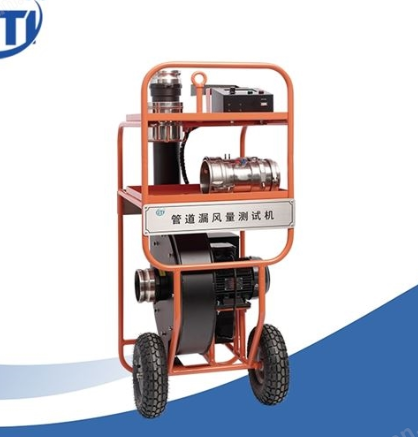
2、 Testing process: Ensure the comprehensiveness and accuracy of the testing
(1) Preparation before testing
Check the duct system: Before conducting the inspection, ensure that the duct system has been installed and all connection points are secured. Close all ventilation openings and valves of the duct system to ensure that there is no interference from external air during the testing process.
Installation tester: Connect the air duct leakage tester to the designated position of the air duct. Usually, the tester is connected to the test port of the air duct through a hose to ensure a secure connection and avoid air leakage.
Set detection parameters: According to the design requirements and testing standards of the air duct, set the detection parameters of the tester, such as testing pressure, testing time, etc.
(2) Testing steps
Apply pressure: Start the tester and apply the set pressure to the air duct through the fan. Usually, the pressure range is between 50Pa and 1000Pa, and the specific pressure value is determined according to the design requirements and testing standards of the air duct.
Measuring pressure difference: When the pressure inside the air duct reaches the set value, the tester will automatically measure the pressure difference inside and outside the air duct. Through high-precision pressure sensors, the tester can display real-time changes in pressure difference.
Calculate air leakage rate: Based on the measured pressure difference and geometric parameters of the air duct, the tester calculates the air leakage rate through the built-in calculation formula. The air leakage rate is usually expressed in cubic meters per hour (m?/h).
Record the test results: Detailed records of the parameters and results of each test, including test time, test pressure, air leakage rate, environmental conditions, etc. These records will help with subsequent analysis and repair work.
3、 Leak location technique: Quickly identify and repair air leaks
(1) Leakage location method
Pressure variation method: After applying a certain pressure inside the air duct, observe the changes in the pressure gauge. If the pressure drops rapidly, it indicates that there are significant air leakage points in the air duct. By gradually moving the position of the pressure gauge, the approximate location of the air leakage point can be determined.
Smoke testing method: After applying a certain pressure inside the air duct, use a smoke generator to inject smoke into the duct. By observing the direction of smoke flow and the location of leaks, one can intuitively locate the point of air leakage.
Acoustic detection method: By using an acoustic detector to capture the sound signal generated by the air leakage point, the air leakage point can be accurately located. This method is particularly suitable for air leakage points that are difficult to directly observe.
(2) Leakage repair
Sealing glue repair: For smaller air leakage points, sealing glue can be used for repair. Apply sealant evenly on the air leakage point, ensuring that the sealant covers the air leakage point.
Patch repair: For larger air leakage points, patches can be used for repair. Cut the patch into an appropriate size and fix it on the air leakage point with sealant to ensure a tight fit between the patch and the surface of the air duct.
Component replacement: If the leakage point is located at the connection of the air duct or in a severely damaged area, it may be necessary to replace the corresponding component. Ensure that the replaced components are compatible with the original air duct system and securely connected.
4、 Summary
The correct use and maintenance of the air duct leakage tester are crucial for ensuring the sealing performance of the air duct system. By mastering equipment calibration, detection processes, and leak location techniques, operators can effectively improve the measurement accuracy and reliability of equipment. Regular equipment maintenance and calibration, timely handling of air leakage points, can ensure that the duct system is always in good working condition, improve the energy efficiency and operational reliability of ventilation and air conditioning systems.