-
E-mail
185945738@qq.com
-
Phone
15306360531
-
Address
3rd Floor, Building 1, Weifang High tech Zone Optoelectronic Industry Accelerator (Phase I), No. 155 Guangdian Road, Yuqing Community, Xincheng Street, Weifang High tech Zone, Shandong Province
Shandong Leiente Intelligent Technology Co., Ltd
The main types and working principles of food safety rapid detection equipment
Date: 2025-12-04Read: 8
Food is of paramount importance to the people, and safety comes first when it comes to food. In the entire chain of food production, circulation, and consumption, safety hazards such as pesticide residues, veterinary drug residues, excessive heavy metals, and microbial contamination are like "invisible killers" that threaten public health. Traditional food safety testing methods rely on professional laboratories, which have drawbacks such as long testing cycles, cumbersome processes, and high costs, making it difficult to meet the needs of rapid screening and immediate supervision on site. The rapid detection instrument for food safety has emerged, relying on its core advantages of "fast, convenient, accurate, and low-cost", becoming a breakthrough in food safety supervision“oneThe key equipment of "kilometer" is to build a solid foundation for safety on the tongueoneLine of defense.
1、 The main types of food safety rapid detection equipment
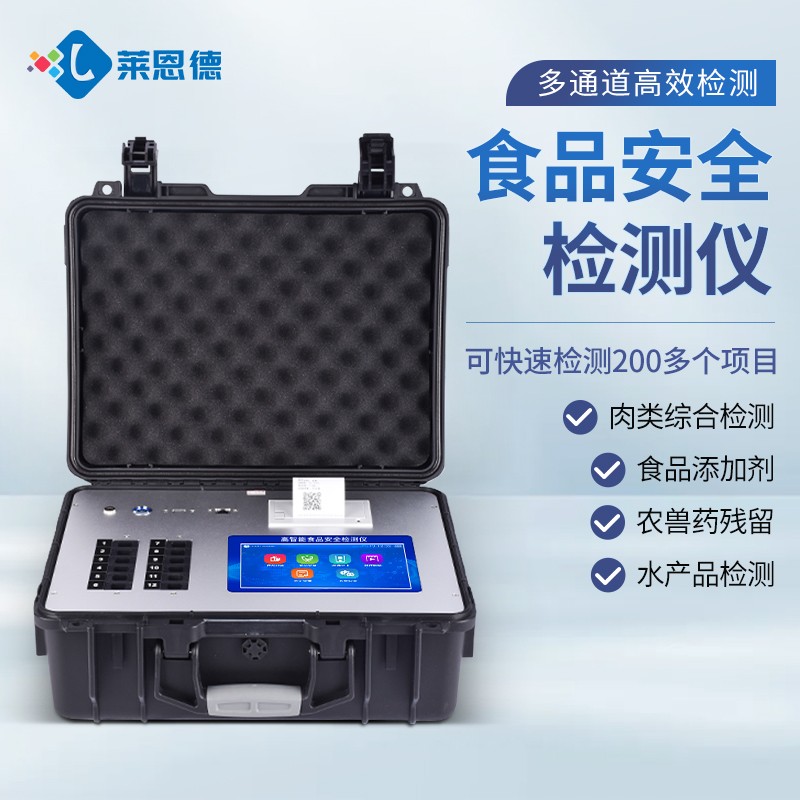
With the diversification of food safety testing needs, rapid analyzers have formed a product system with rich categories and strong targeting. They can be divided according to dimensions such as testing objects, technical principles, and portability to adapt to the testing needs of different scenarios
(1) Divided by detection objects
1. Comprehensive rapid analyzer: With comprehensive functions, it can simultaneously detect multiple pollutants, including pesticide residues, veterinary drug residues, heavy metals, microorganisms, additives (such as nitrite and saccharin), etc. It is the mainstream choice for market supervision, large supermarkets, and food processing plants, and can achieve "one machine multiple inspections" to improve detection efficiency.
2. Specialized rapid analyzer: designed for specific pollutants or food categories, such as pesticide residue rapid analyzer, veterinary drug residue rapid detector, heavy metal rapid analyzer, microbial rapid detector, edible oleic acid peroxide value detector, etc., with higher detection accuracy and suitable for special supervision or segmented industry needs.
(2) Divided by technical principles
Including immunochromatographic analyzer, Raman spectroscopy analyzer, enzyme inhibition detection instrument, biosensor analyzer, colloidal gold detection instrument, etc. Instruments based on different principles are suitable for different detection scenarios. For example, enzyme inhibition detectors are commonly used for rapid screening of pesticide residues, while Raman spectrometers are suitable for non-destructive detection of additives, pollutants, etc. in food.
(3) Divided by portability
1. Portable rapid analyzer: compact in size, light in weight (most models<3kg), equipped with built-in batteries, supports on-site sampling and real-time detection, simplified operation process (some support one click detection), real-time display and printing of detection results, suitable for mobile scenarios such as agricultural markets, catering kitchens, field plots, food transport vehicles, etc.
2. Desktop rapid analyzer: commonly deployed in laboratories, testing centers, or quality inspection departments of large enterprises, with higher detection accuracy, capable of processing batch samples, supporting data storage and online uploading, and commonly used for precision screening in food factory inspection and third-party testing institutions.
2、 The working principle of the food safety rapid detection device: to quickly reveal "hidden dangers"
The core logic of the food safety rapid detection instrument is to capture the characteristic signals of pollutants in food through specific technical means, and after signal conversion and analysis, quickly determine whether the pollutants exceed the standard. The mainstream working principle is based on technologies such as biology, chemistry, physics, etc., with strong targeting and each having its own advantages:
(1) Enzyme inhibition method: the "mainstream solution" for pesticide residue detection
This method is a classic technique for detecting residues of organophosphorus and carbamate pesticides, with the core principle of utilizing the inhibitory effect of pesticides on bile esterase. Under normal circumstances, bile alkaline esterase can catalyze the decomposition of substrates to produce colored substances, and the instrument determines enzyme activity by detecting the absorbance of colored substances; If food contains such pesticides, it will inhibit enzyme activity, leading to reduced substrate decomposition and abnormal changes in absorbance. The instrument calculates the inhibition rate based on the difference in absorbance. When the inhibition rate exceeds the set threshold, it is determined that the pesticide residue exceeds the standard. This method is easy to operate, low-cost, and only takes 10-20 minutes for detection. It is widely used for on-site screening of vegetables and fruits.
(2) Immunoassay: an "immune probe" that accurately identifies specific pollutants
Based on the principle of specific binding between antigens and antibodies, specific antibodies are fixed on test strips. When the sample contains the target pollutant (antigen), it will bind with the antibody to form an antigen antibody complex. The complex migrates along with the sample solution on the test strip and binds again with the antibody at the detection line, forming a visible band (or fluorescent signal detected by the instrument). Based on the absence of stripes or fluorescence intensity, it is possible to quickly determine the presence and approximate content of pollutants. This method has strong specificity and fast detection speed (5-15 minutes), and is suitable for rapid detection of veterinary drug residues (such as clenbuterol and ractopamine), microorganisms (such as Salmonella and Escherichia coli), fungal toxins, etc.
(3) Raman spectroscopy: the 'black technology' of non-destructive testing
By utilizing the Raman scattering effect of light, different substances have different molecular structures and scatter lasers at different frequencies, forming a unique "Raman spectral fingerprint". The instrument emits laser to irradiate the sample, collects scattered light signals, and analyzes the spectrum. By comparing with the built-in standard substance spectrum library, it can quickly identify pollutants (such as additives, pesticides, heavy metals) in food and determine whether the food ingredients are qualified. This method does not require sample pre-treatment (or simple processing), non-destructive testing, and detection time only takes a few seconds to minutes. It is suitable for scenarios such as food packaging integrity testing and liquid food (such as alcohol and beverages) ingredient screening.
(4) Other mainstream technological principles
The biosensor method combines biometric elements (enzymes, antibodies, microorganisms) with signal conversion elements. When the target pollutant binds to the biometric elements, electrochemical, optical, and other signals are generated, which are amplified by the instrument and output detection results. It has high sensitivity and fast response, and is suitable for precise and rapid detection of heavy metals and microorganisms; The colorimetric method involves the color reaction between pollutants and specific reagents, and determines the pollutant content based on the depth of color. It is easy to operate and does not require complex instruments. It is commonly used for rapid screening of additives such as nitrite and sulfur dioxide.
3、 Application scenario of food safety rapid detection device: guarding food safety throughout the entire chain
The application of food safety rapid detection equipment covers the entire chain of food production, processing, circulation, consumption, and supervision, becoming a necessary backup tool for different entities to ensure food safety:
(1) Regulatory enforcement in the field of law enforcement: the "law enforcement tool" for on-site inspections
The market supervision department uses portable rapid analyzers to conduct random inspections in agricultural markets, supermarkets, catering kitchens, and food wholesale markets to quickly identify unqualified food, promptly remove problematic products from shelves, and avoid them from entering the hands of consumers; In the process of ensuring food safety during major events and handling sudden food safety incidents, it is possible to achieve "immediate detection and results", thereby improving regulatory efficiency and emergency response capabilities. For example, during the hot summer season, regulatory personnel can use microbial rapid detection devices to determine whether the total bacterial count of cold dishes and cooked meat products exceeds the standard within 15 minutes, and promptly curb food safety risks.
(2) Food production and processing field: the "quality checkpoint" of source control
In the process of agricultural product cultivation and breeding, farmers or cooperatives can use rapid analyzers for pesticide residues and veterinary drug residues to detect pollutant residues in fruits, vegetables, and livestock products, ensuring that the products meet the standards for harvesting and slaughter; In food processing plants, desktop rapid analyzers are used for raw material inspection, production process quality control, and finished product factory inspection, such as detecting the acid value and peroxide value of edible oil to ensure stable product quality; In the kitchen of catering enterprises, portable analyzers can perform real-time screening of purchased ingredients, avoiding food safety hazards from the source.
(3) In the field of circulation and consumption: the "trust guarantee" for reassuring consumption
Large supermarkets and farmers' markets can set up rapid testing points in prominent locations, providing free food ingredient testing services for consumers (such as vegetable pesticide residue testing), allowing consumers to intuitively understand food safety and enhance consumer confidence; School canteens, elderly care institution canteens, and other collective dining units can use rapid analyzers to regularly detect ingredients, ensuring the safety of collective dining and avoiding the occurrence of collective food safety incidents.
(4) Special scenario application: precise adaptation to segmented requirements
In import and export food inspection and quarantine, rapid analyzers can achieve rapid screening of bulk samples, shorten customs clearance time, and improve port supervision efficiency; In rural and remote areas, portable analyzers can solve the problem of insufficient grassroots testing equipment, allowing food safety supervision to cover "one kilometer"; In the cold chain transportation of food, some specialized rapid analyzers can be adapted to low-temperature environments to detect microbial contamination in frozen food.
4、 The use and maintenance of food safety rapid detection equipment: enabling the "rapid detection guard" to continuously and accurately perform its duties
(1) Core usage precautions
Sample preparation should be standardized, and suitable sampling sites should be selected based on the testing object (if rotten parts need to be removed from vegetables, livestock and poultry products should be homogenized) to avoid sample contamination or insufficient representativeness; Strictly follow the operating instructions to add reagents, control the amount of reagents, reaction temperature and time, these factors directly affect the accuracy of the test results; Before testing, the instrument needs to be preheated and calibrated, and the performance of the instrument should be verified using standard substances; Operators need to receive simple training and be familiar with the instrument operation process to avoid result deviations caused by operational errors.
(2) Key points of daily maintenance
Clean the sample residue and reagent stains on the surface of the instrument in a timely manner after use, especially the core components such as the detection channel, light source, and sensor, to avoid residual substances affecting subsequent testing; Properly store reagents and store them under the required conditions (such as refrigeration and avoiding light) to prevent reagent failure; Regularly check the power and battery performance of the instrument, and charge the portable instrument in a timely manner to ensure the endurance of on-site testing; Regular calibration and maintenance of instruments can be carried out by professionals or manufacturers to ensure that the detection accuracy meets the standard requirements; Store the instrument in a dry, ventilated, and non corrosive gas environment, avoiding direct sunlight and high temperature and humidity environments that can damage the electronic components of the instrument.
From traditional chemical colorimetry to Raman spectroscopy technology, from a single detection function to the comprehensive ability of "one machine for multiple detections", the technological iteration of food safety rapid detection instruments has always revolved around the core requirements of "faster, more accurate, and more convenient". It not only makes up for the shortcomings of traditional laboratory testing, but also promotes the transformation of food safety supervision from "post traceability" to "pre prevention and in-process control". In the increasingly complex food safety situation, this "fast inspection guard" that safeguards tongue safety will continue to provide technical support for the entire food safety chain, allowing the public to eat with more peace of mind and peace of mind.