-
E-mail
185945738@qq.com
-
Phone
15306360531
-
Address
3rd Floor, Building 1, Weifang High tech Zone Optoelectronic Industry Accelerator (Phase I), No. 155 Guangdian Road, Yuqing Community, Xincheng Street, Weifang High tech Zone, Shandong Province
Shandong Leiente Intelligent Technology Co., Ltd
Usage and maintenance methods of power cable fault tester
Date: 2025-12-04Read: 13
In the context of power transmission, communication interconnection, and industrial production, cables are like "blood vessels" that maintain the operation of the system, undertaking the core mission of energy transmission and signal transmission. However, cables are inevitably affected by aging, external damage, environmental erosion, and other factors during long-term use, resulting in faults such as short circuits, open circuits, and high resistance leaks. These faults are often hidden in underground, bridge and other concealed environments, and traditional troubleshooting methods are inefficient and prone to secondary damage. The power cable fault tester has emerged, relying on its precise detection capability, diverse adaptation scenarios, and intelligent analysis functions, becoming a "healthy diagnosis and treatment specialist" to safeguard the safe operation of cable networks.
1、 The main types of power cable fault testers
With the diversification of cable application scenarios, power cable fault testers have formed a multi category and highly targeted product system, which can be divided into different types based on functionality, portability, and technical principles:
(1) Divided by Function
1. Comprehensive power cable fault tester: With comprehensive functions, it is compatible with low-voltage and high-voltage cables, and can detect various types of faults such as short circuits, open circuits, and high resistance flashover. It integrates full process functions such as rough fault distance measurement, path detection, and precise positioning, and is the mainstream choice in industries such as power and communication.
2. Specialized power cable fault tester: designed for specific scenarios or fault types, such as buried cable fault tester, street lamp cable fault tester, mine cable fault tester, high-voltage cable dedicated tester, etc., to meet the precise detection needs of different environments.
(2) Divided by portability
1. Portable tester: compact in size and light in weight (some models<5kg), equipped with ultra long battery life and hard protective box, easy for operation and maintenance personnel to carry to the field, underground and other sites for emergency repairs, supports fast testing mode, and can complete fault pre positioning within 10 minutes.
2. Fixed tester: often installed in laboratories or testing centers, it has higher testing accuracy and can conduct comprehensive and detailed performance analysis and fault diagnosis of cables. It is commonly used for cable factory inspection or in-depth fault diagnosis.
(3) Divided by technical principles
Including Time Domain Reflectometer (TDR), Pulse Reflectometer, Bridge type Detector, High Voltage Pulse Method Locator, etc., instruments with different principles are suitable for different fault scenarios. For example, Time Domain Reflectometer is suitable for long-distance cable fault detection, while Bridge type Detector is more suitable for short distance low-voltage cable diagnosis.
2、 The working principle of power cable fault tester: making hidden faults "visible"
The core logic of the power cable fault tester revolves around "signal transmission reflection analysis", which captures the characteristic signals of the fault point through different technical means and accurately locates the fault location. The mainstream working principles mainly include the following:
(1) Pulse reflection method: a widely used fundamental technology
This method is also known as the "radar method", and its core is to emit specific pulse signals to the cable. When the signal is transmitted along the cable, it will be reflected when encountering fault points (or points with uneven impedance). The instrument can calculate the distance of the fault point by recording the time difference △ t between the emitted pulse and the reflected pulse, combined with the propagation speed v of the pulse in the cable, using the formula L=v ·△ t/2. According to the different levels of pulse voltage, it can be divided into low-voltage pulse method and high-voltage pulse method: low-voltage pulse method is easy to operate, has intuitive waveforms, and is suitable for low resistance short circuit and open circuit faults; The high-voltage pulse law forms an instantaneous short circuit by the high-voltage pulse passing through the high resistance fault point, and then captures the reflected signal to adapt to high resistance fault detection.
(2) Secondary Pulse Method: Precise Cracking Solution for High Resistance Faults
As an advanced technology of pulse reflection method, its core advantage is to simplify complex high impedance fault waveforms into easily readable low-voltage pulse short-circuit waveforms. At the moment of high impedance fault caused by high voltage pulse impact, the instrument synchronously emits low voltage pulse signals to accurately locate the fault point using the low voltage pulse waveform. The key is to equip a high-frequency high voltage data processor, which greatly improves the positioning accuracy despite the higher complexity of the instrument.
(3) Electromagnetic induction method: a "tracking tool" for cable paths
To address the issue of unclear buried cable paths, this method injects electromagnetic waves of a specific frequency into the cable and uses a receiving coil to induce magnetic field signals around the cable. Based on the characteristic of "minimum ground electromagnetic signal directly above the cable", the cable burial path can be accurately located, and the cable burial depth can be calculated based on the signal strength, which is suitable for detecting power outage cables with a burial depth of ≤ 2m and a length of>10km.
(4) Other specialized positioning technologies
The acoustic measurement method is a classic precise positioning method that captures the seismic waves generated by the discharge at the fault point, and is suitable for various high-voltage and low-voltage cables; The combination of acoustic magnetic synchronization law and acoustic measurement and electromagnetic induction technology can improve the accuracy of fault point identification by synchronously capturing sound and electromagnetic wave signals in noisy environments. The step voltage method is mainly used for grounding faults in the outer sheath of cables. The fault location is determined by measuring the large value of the ground potential difference, which is easy to operate and highly targeted.
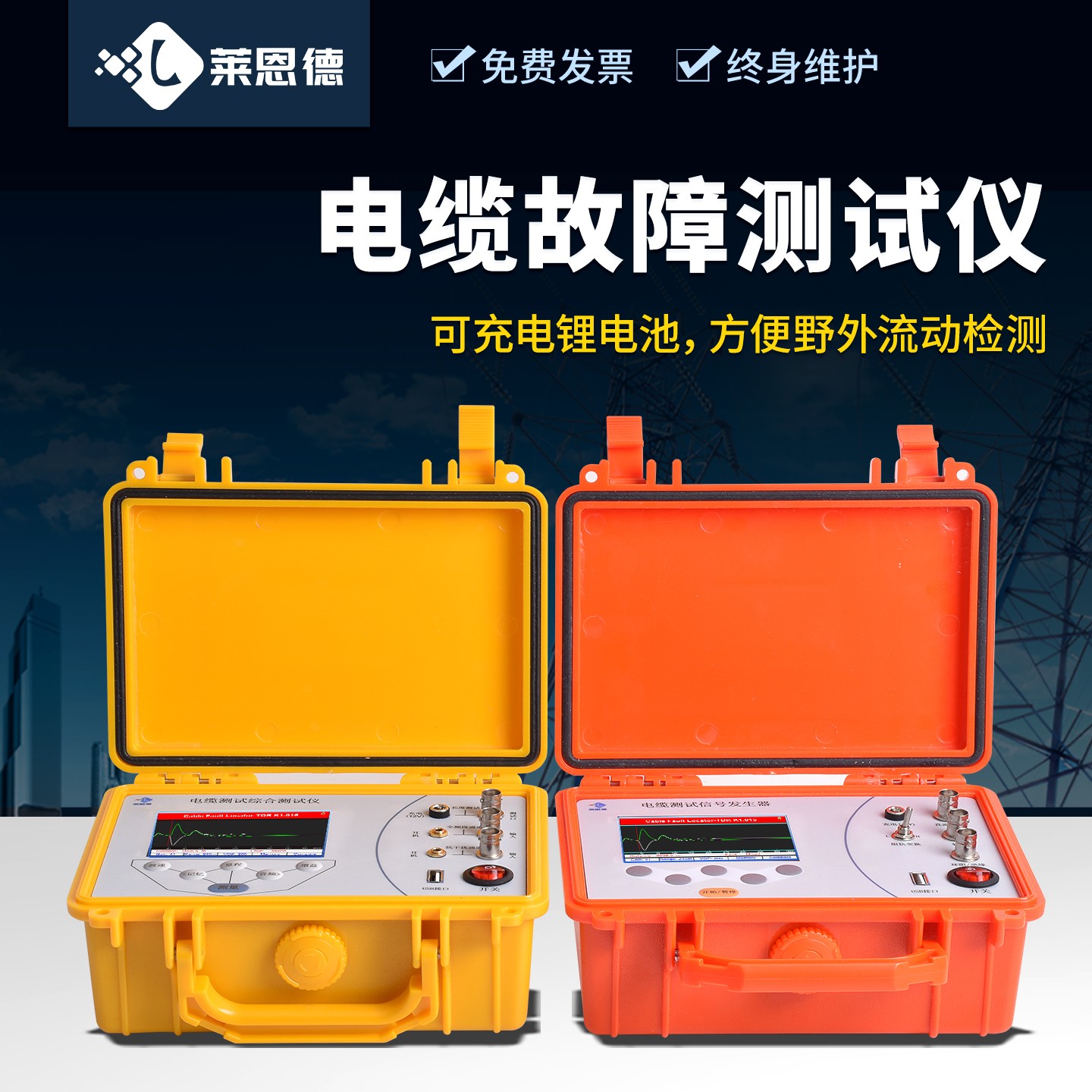
3、 Application scenario of power cable fault tester: safeguarding the safety of cables in all fields
The application of power cable fault tester covers multiple fields such as power, communication, industry, transportation, and construction, and has become a key equipment to ensure the stable operation of various cable networks
(1) Power system: the core support for ensuring power supply continuity
Used in power plants and substations to detect faults in generator outgoing cables and internal connection cables; In transmission and distribution lines, overhead or underground cable faults caused by lightning strikes, aging, and overload can be quickly located, reducing the average troubleshooting time from the traditional 4 hours to 30 minutes and significantly reducing power outage losses. As early as 1993, the Beijing power supply system was equipped with more than 50 sets of pulse reflection method testers in the past 10 years, and their operational skills were included in the content of the advanced engineering examination, which shows their importance.
(2) Communication system: the 'invisible guardian' that maintains smooth signal flow
For long-distance communication trunk lines and local communication networks, faults such as fiber optic cable breakage and communication cable insulation damage can be detected to ensure stable transmission of voice and data signals and avoid large-scale communication interruptions caused by cable failures.
(3) Industrial and Special Scenarios: Safety Assurance for Adapting to Complex Working Conditions
Internally in the factory, used to detect power and control cable faults in production workshops and distribution rooms, reducing production losses caused by equipment downtime; In underground mines, adapt to harsh high temperature and humid environments, detect faults in underground power and communication cables, and ensure operational safety; In the railway system, it is possible to accurately locate faults in signal transmission cables and traction power supply cables, avoiding train safety accidents caused by signal errors or power outages.
(4) Architecture and Livelihood: Protecting Daily Electricity and Life Services
Detecting socket and lighting circuit faults in electrical wiring in office buildings, residential buildings, and other buildings; In the comprehensive cabling system of the community, troubleshooting faults in power supply, communication, and cable TV cables provides stable support for residents' daily lives.
4、 The use and maintenance of power cable fault testing equipment: enabling "diagnosis and treatment professionals" to continuously and accurately perform their duties
(1) Core usage precautions
Before testing, it is necessary to ensure that the cable is powered off and fully discharged, and to provide grounding protection to prevent electric shock accidents; Suitable testing methods and parameters should be selected based on cable type, specifications, and fault nature. For example, high-voltage cables should prioritize the high-voltage pulse method, while low impedance faults can directly use the low-voltage pulse method; Ensure firm and correct wiring to avoid poor contact that may affect test results, while keeping away from high-voltage equipment and strong electromagnetic fields to reduce signal interference; Operators need to receive professional training, be familiar with operating procedures and safety regulations.
(2) Key points of daily maintenance
Clean the surface dust and stains of the instrument in a timely manner after use, especially paying attention to cleaning the testing interface to avoid dust affecting the contact performance; Properly store accessories such as test lines to avoid folding, squeezing, and damage; Regular calibration and verification are carried out to ensure that the testing accuracy meets the requirements. Calibration work can be completed by professionals or manufacturers; Store the instrument in a dry, ventilated, and non corrosive gas environment, avoiding direct sunlight and high temperature and humidity. When not in use for a long time, it should be powered on regularly to prevent electronic components from being damaged by moisture.
From traditional electronic tube instruments to intelligent devices integrated with artificial intelligence algorithms, the technological iteration of power cable fault testers has always revolved around "precision, efficiency, and convenience". It not only makes hidden cable faults "visible", but also promotes cable maintenance from "passive repair" to "active maintenance" - by uploading data to the cloud and analyzing fault patterns with big data, it provides decision-making basis for cable preventive maintenance. In the wave of new power system construction and digital communication upgrade, this cable network's "health diagnosis and treatment specialist" will continue to safeguard the safe and stable operation of various infrastructure.