-
E-mail
Sales@senther.com.cn
-
Phone
13430557816
-
Address
Shiyan Street, Bao'an District, Shenzhen
Shenzhen Sense Technology Development Co., Ltd
Vibration Monitoring Scheme for Cable Car Power System
Date: 2025-10-21Read: 10
1、 Monitoring background and objectives
The power system of the cable car (including motor, gearbox, bearings, drive shaft, etc.) is prone to mechanical fatigue, component wear, and even shutdown due to abnormal vibration during long-term operation. Through real-time vibration monitoring, it is possible to:
Preventive maintenance: Early identification of abnormal vibrations to avoid sudden malfunctions.
Optimize operation: Analyze vibration data, adjust load or lubrication strategies.
Security guarantee: Ensure the safety of passengers and equipment, in compliance with industry standards (such as ISO 10816 vibration standard).
2、 System configuration plan
1. Sensor selection
Recommended models: 310A-20 (± 20g range) or 310A-80 (± 80g range)
Basis: The vibration amplitude of the cable car power system is usually low to medium frequency (<1kHz), and the 310A series wide frequency response (0.1-15kHz) covers typical fault characteristic frequencies (such as gear meshing and bearing defects).
Advantages: Metal welding seal (IP68) is suitable for outdoor high humidity and salt spray environments.
EMI shielding against electromagnetic interference from motors.
Resistance to impact (5000g) and instantaneous vibration.
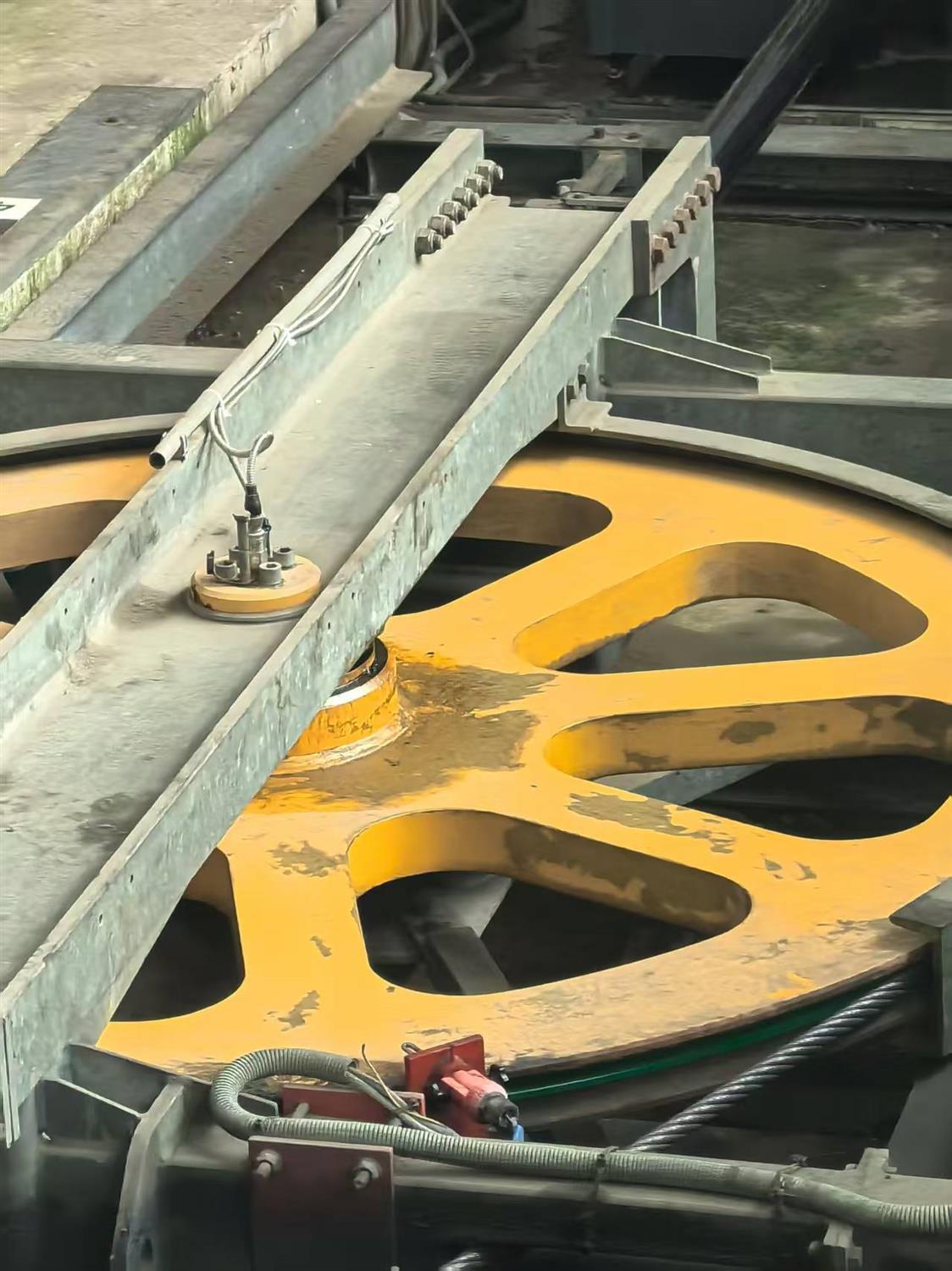
2. Installation location and method
Key measuring point: Non drive end bearing seat of motor (axial/radial)
Gearbox input/output shaft bearings
Drive shaft support seat
Installation method: Threaded fixation (standard 1/4-28 bolt PM0011) ensures high stiffness coupling.
Magnetic seat (MB0001) assists in temporary diagnosis.
3. Supporting equipment
Component model function
Cable 16A-10-B (BNC connector) transmits signals to the acquisition device
Regulator IN-03 (3-channel) IEPE power supply+signal amplification
IN-SDG (8-channel) multi-channel synchronous sampling acquisition system
IN-91 portable analyzer for rapid on-site diagnosis
3、 Data Collection and Analysis
1. Parameter settings
Sampling frequency: ≥ 10kHz (covering a resonant frequency of 15kHz).
Monitoring indicators: Time domain: RMS value, peak value (monitoring sudden impact).
Frequency domain: FFT analysis (identifying characteristic frequencies of gears/bearings).
2. Alarm threshold
Reference ISO 10816-3 standard grading: Normal:<2.8mm/s (RMS)
Warning: 2.8-7.1mm/s
Danger:>7.1mm/s
3. Diagnostic Cases
Bearing failure: Harmonics appear in the frequency domain (such as BPFO/BPFI).
Gear wear: sideband modulation phenomenon.
4、 Advantages of the plan
High reliability: The 310A sensor is corrosion-resistant and impact resistant, suitable for harsh working conditions of cable cars.
Full frequency coverage: from low-speed shaft (<10Hz) to gear high-frequency (kHz level) without omission.
Flexible Expansion: Supports multi-channel synchronous monitoring, and can integrate multiple parameters such as temperature and noise in the future.
5、 Implementation suggestions
Initial stage: Install 4-6 measuring points (key parts of the motor and gearbox).
Long term: Establish a historical database and combine AI algorithms to predict remaining lifespan.