-
E-mail
sales@chotest.com
-
Phone
18928463988
-
Address
No. 1001, Xili Xueyuan Avenue, Nanshan District, Shenzhen, China
Shenzhen Zhongtu Instrument Co., Ltd
Can three coordinates measure automotive pipeline components?
Date: 2025-11-20Read: 82
In the field of automobile manufacturing, pipeline components (such as fuel pipes, brake pipes, air conditioning pipes, etc.) serve as key carriers for power transmission and fluid control, and their quality accuracy directly affects the performance and safety of the entire vehicle. These types of parts have the characteristics of multiple diameters, complex bending, and variable spatial orientation, which bring many thorny challenges to quality inspection work. With the acceleration of automobile lightweighting and electrification trends, pipeline design is becoming more complex, and the requirements for detection accuracy and flexibility are also increasing.
Traditional detection methods such as vernier calipers, simple gauges, or manual scanning often struggle to fully capture three-dimensional geometric deviations when faced with measurement requirements for automotive pipeline components, resulting in incomplete data, low efficiency, and complex data processing in the later stages, making it difficult to adapt to the fast-paced detection rhythm of production lines. More importantly, traditional detection methods are mostly unable to output standardized and visualized accurate data reports. The detection results are mainly based on qualitative judgments of "qualified/unqualified", making it difficult to trace the root cause of quality problems and provide strong data support for product design optimization.
1、 Pain points in the inspection of pipeline components
1. Curvature and direction are complex: Parts often contain composite bending angles and variable diameter structures, and traditional tools cannot accurately measure three-dimensional spatial coordinates, resulting in accumulated errors in key parameters such as bending radius and pipe mouth angle.
2. Single data dimension: contact tools such as vernier calipers can only obtain local dimensions and lack overall morphology analysis; Although early scanning equipment could cover curved surfaces, it had high data noise and poor repeatability, making it difficult to use for process optimization.
3. Imbalance between efficiency and cost: Customized gauges rely on physical benchmarking, have long development cycles, low flexibility, and cannot adapt to the production rhythm of small batches and multiple varieties. In addition, test results rely on manual interpretation, which is highly subjective.
2、 Three coordinate measurement solution
The three coordinate measuring machine adopts high-precision grating ruler and advanced motion control system, with measurement accuracy up to micrometer level. It can accurately capture key dimensional parameters such as outer diameter, inner diameter, wall thickness, center distance, and surface profile of the pipeline. Even for roughness and small defects on the inner wall of the pipeline, it can be accurately detected by matching with dedicated probes.
A professional measurement solution with a three coordinate measuring machine as the core integrates a dedicated pipeline detection module and intelligent software, forming an integrated solution of "hardware+algorithm+scene", which can accurately meet the measurement needs of various automotive pipelines. Whether it is engine fuel pipes, transmission cooling pipes, or complex body brake pipelines, high-precision measurement can be achieved.

3、 Advantages of Coordinate Measuring Technology
1. Multi sensor fusion technology: using a combination of trigger type probes and optical scanning probes, balancing the absolute accuracy of key dimensions with the point cloud density of free-form surfaces.
2. Intelligent path planning: Based on CAD models, automatically generate measurement paths to avoid collision risks while reducing detection time to 30% of traditional methods. For blind spots such as deep holes and concealed pipe openings, it supports automatic probe angle changing and multi view data stitching.
3. Deep data mining: Measurement software directly outputs reports on form and position tolerances (such as straightness, roundness, pipe perpendicularity), centerline trajectory deviation chromatograms, etc., and monitors process fluctuations in real-time through SPC statistical analysis, providing quantitative basis for design iterations.
In practical application scenarios, the staff fix the pipeline components to be tested on the measuring workbench. Through automatic measurement mode, the equipment can automatically complete the measurement of all key dimensions according to the preset program without manual intervention. This not only avoids human operation errors but also greatly improves measurement efficiency.
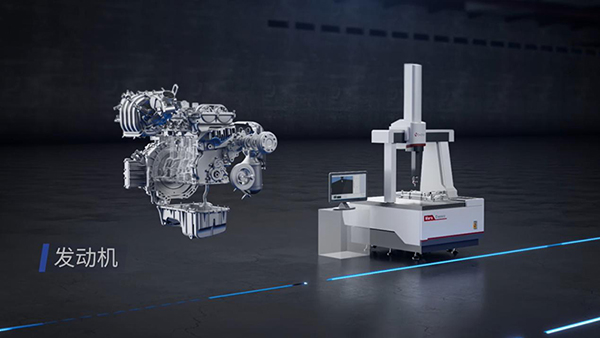
As shown in the diagram, the traditional detection method for measuring the fuel pipe of an engine using a coordinate measuring instrument takes more than 30 minutes to complete a comprehensive inspection of one fuel pipe. However, using a coordinate measuring machine solution only takes 5 minutes to complete, improving measurement efficiency by more than 80% and achieving an accuracy rate of over 99.9% for measurement data. In addition, standardized and visualized data reports can be generated, which not only include detailed dimensional data and tolerance ranges, but also visually display the deviation position between the actual shape of the pipeline and the design model through 3D models, allowing quality management personnel to clearly trace the root cause of problems and provide accurate data basis for production process optimization.
With the development of the automotive manufacturing industry towards intelligence, lightweighting, and electrification, coordinate measuring machines will continue to integrate advanced technologies such as artificial intelligence and big data analysis to further enhance the intelligence level of measurement. If you are facing problems such as low measurement efficiency, insufficient accuracy, and lack of intuitive data reporting for automotive pipeline components, you may want to delve into the three-dimensional measuring machine pipeline inspection solution.