-
E-mail
sales@chotest.com
-
Phone
18928463988
-
Address
No. 1001, Xili Xueyuan Avenue, Nanshan District, Shenzhen, China
Shenzhen Zhongtu Instrument Co., Ltd
What does Rz represent in an optical 3D surface profilometer? How to accurately measure Rz?
Date: 2025-11-20Read: 109
In precision fields such as semiconductor chip packaging, 3C electronic glass screen processing, and optical component manufacturing, the maximum height Rz of the contour is a key parameter for measuring surface micro undulations and is a necessary test in many enterprise production inspections.
When the Rz at the chip wire bonding exceeds 0.5 μ m, it may lead to bonding failure;
When the Rz of the mobile phone glass screen is below 0.02 μ m, it will also affect the touch sensitivity and anti fingerprint coating adhesion.
1、 Invisible roughness is becoming an invisible killer of performance and yield
The traditional contact measurement method is prone to scratching precision surfaces, and single point measurement is difficult to fully reflect the true state of complex surfaces. Although two-dimensional roughness parameters (such as Ra) are popular, they cannot characterize the actual contact area and functional characteristics. These pain points have repeatedly hit the wall for enterprises to precisely control the demand for Rz.
In bearing manufacturing, controlling only the average Ra value may result in local micro peaks not being detected, leading to premature wear of the bearing during high-speed operation; Before coating optical lenses, if the depth of valleys in the substrate material is not effectively evaluated, it will directly lead to insufficient adhesion of the coating. At this point, Rz (average peak valley height), as the core evaluation indicator in the three-dimensional surface contour, can precisely capture these key local features.
2、 How to use an optical 3D profilometer to accurately control Rz and solve the problem of surface quality in precision manufacturing?
The SuperView W1 series optical 3D surface profilometer uses white light interferometry technology as its core, providing an integrated solution of "Rz precise measurement+full field adaptation". The core evaluation parameter Rz (corresponding to parameter Sz in ISO 25178) is defined as the average vertical distance between the five highest peaks and five low valleys within the evaluation area. Unlike Ra, which only reflects arithmetic mean deviation, Rz captures peak valley fluctuations more sensitively, directly related to key performance such as seal leakage risk, coating uniformity, and adhesion after spraying.
Unlike traditional devices that have a single functional limitation, this device breaks through the contradiction between "accuracy and efficiency" and "protection and detection" from the perspective of measurement principles:
1. By non-contact white light interference scanning, nanoscale micro contours can be captured without touching the surface of the sample, avoiding damage to fragile workpieces such as semiconductor wafers and optical lenses caused by contact measurement;
2. At the same time, the precision Z-direction scanning module and 3D modeling algorithm equipped on the equipment can convert the scanning data into intuitive 3D surface images, and then automatically calculate the Rz value through the system software - its roughness RMS repeatability can reach 0.005nm, and the step measurement accuracy is only 0.3%. Even for the ultra smooth silicon chip surface of 0.2nm, the deviation of Rz data measured continuously for 10 times can be stably controlled within a small range, solving the core pain points of inaccurate and easily damaged traditional equipment.

Technical Advantage Focus:
1. Full field measurement with no missing data: millions of data points can be obtained in one scan, comprehensively evaluating the entire area and avoiding accidental errors in single point sampling;
2. Realistic 3D morphology restoration: visually present surface texture, defect distribution, and functional characteristics through 3D contour maps and pseudo color maps;

3、 Scenario based verification
1. In practical application scenarios, the "scene adaptation capability" of optical 3D surface profilometers further amplifies the value of Rz measurement.
(1) In response to the problem of low efficiency in batch wafer Rz detection in semiconductor manufacturing, SuperViewW equipment supports multi area automatic measurement function - workers only need to preset the measurement points of square or circular arrays, and can automatically scan and record the Rz of dozens of wafers with one click, which is more than 8 times more efficient than manual single measurement;
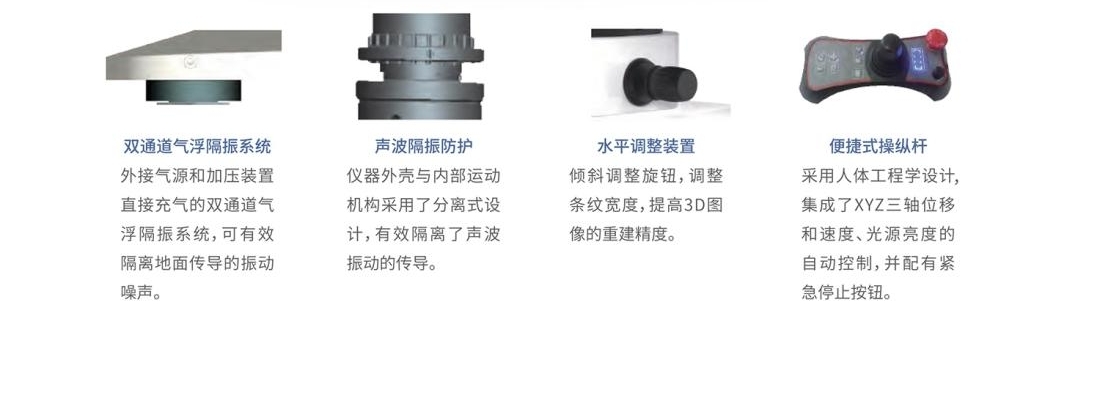
(2) In the Rz detection of 3C electronic glass screens, due to the transparent glass surface and susceptibility to environmental vibrations, the air floating isolation base equipped with the equipment can effectively isolate the vibration noise conducted by the ground. Combined with the 0.1nm resolution environmental noise evaluation function, it can monitor the impact of external interference on Rz measurement in real time, ensuring the stability of Rz data on the glass screen surface;
(3) For workpieces such as optical lenses that require high-precision Rz analysis, the roughness analysis module provided by the equipment can combine the four major standards of ISO/ASME/EUR/GBT to generate analysis reports containing more than 300 parameters including Rz, Ra, Rq, etc., helping engineers accurately judge whether the surface processing quality of the lens meets the design requirements.

2. To verify the reliability of Rz measurement, the SuperView W1 series has undergone rigorous laboratory calibration and industry application testing. (1) In the measurement of silicon chips according to the ISO 25178 international standard, the Rz repeatability StdDev of the equipment for 10 consecutive measurements is controlled within 0.005nm;
(2) When measuring the 5 μ m step height standard block (according to ISO 10610-1:2009 standard), the accuracy of Rz related step height is 0.3%, and the repeatability is only 0.08% (1 σ). These data not only far exceed the industry average, but also provide traceable quantitative basis for quality control of enterprises.
(3) The dual lens collision protection design of the equipment - software ZSTOP lower limit protection and lens spring structure elastic retraction - also provides a guarantee for the safety of Rz measurement. Even in the event of manual operation errors causing the lens to approach the workpiece, the equipment can instantly enter an emergency stop state, avoiding damage to the lens and workpiece, and reducing the maintenance cost and production loss of the enterprise's equipment.
4、 Conclusion: Start your deep diagnosis of surface quality
With the deepening of Industry 4.0, surface quality assessment is undergoing a triple transformation of parameter functionalization, data intelligence, and full process quality control. The optical 3D surface profiler not only solves the pain points of accuracy, efficiency, and safety in Rz measurement for current enterprises, but also achieves seamless integration between Rz measurement data and production MES systems through functions such as programmable measurement, batch data analysis, and multi format report export. The value extension from single point detection to full process control is the core advantage that sets equipment apart from traditional measuring instruments.
If your precision workpiece Rz measurement efficiency is low, data is unstable, and the workpiece is easily damaged, the root cause may lie in the surface microcosm that has not been fully recognized.