-
E-mail
2537020894@qq.com
-
Phone
18962116539
-
Address
6th Floor, Building B, Tengfei Xinsu Industrial Park, No. 5 Xinghan Street, Suzhou Industrial Park
Suzhou Xunpeng Instrument Co., Ltd
Principle and advantages of thermistor temperature transmitter
Date: 2025-12-11Read: 91
The principle of a thermistor temperature transmitter is to isolate, amplify, and linearize the resistance signal of the on-site thermistor, and convert it into a standard signal that is linearly related to the temperature value (such as4-20mA)Output, convenient for long-distance transmission and system integration.
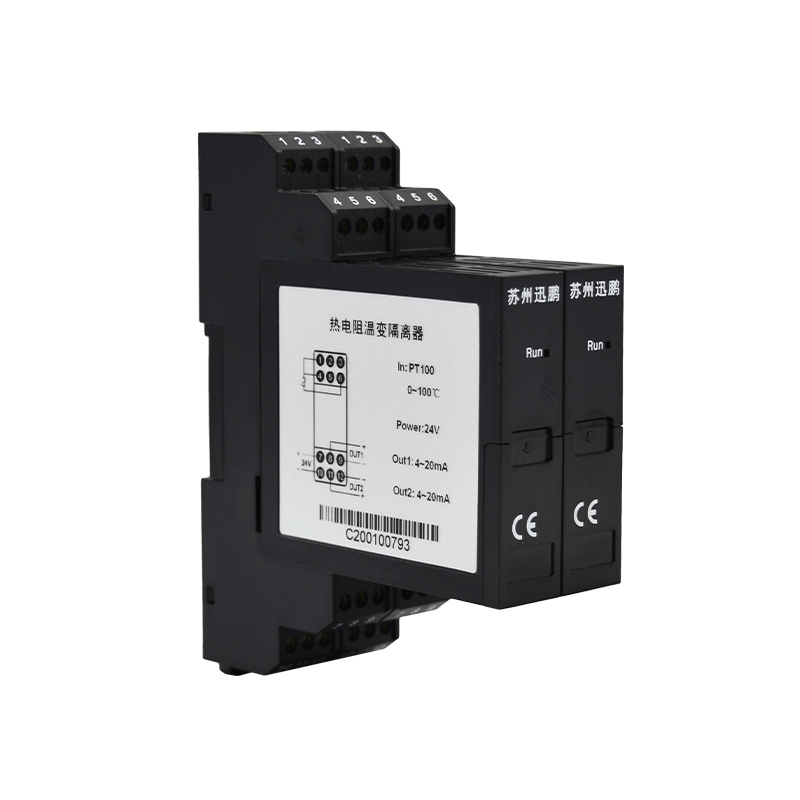
Thermistor temperature transmitters play an important role in the field of industrial temperature measurement, mainly due to theirhigh precisionandGood stability.
high-precision measurementThis is a prominent feature of the thermistor temperature transmitter. Thermal resistance sensors usually use platinum(Pt)Copper(Cu)Or nickel(Ni)Made of metal materials, among whichPt100(In0℃The resistance value is100ΩPlatinum thermistor)More common. This type of sensor works based on the physical characteristics of the resistance value of metal conductors changing with temperature, and has high measurement accuracy(reachable±0.1℃)Characteristics such as good linearity.
Excellent long-term stabilityAnother major advantage is that the resistance value of platinum thermistors changes very little over time, and the annual drift can be controlled within0.05℃Internally, this makes the thermistor temperature transmitter perform well in situations that require long-term continuous monitoring. Due to its stability, the thermistor temperature transmitter reduces the calibration frequency and maintenance workload of the instrument.
In terms of wiring, three main wiring methods are used according to different accuracy requirements and application scenarios: two-wire system, three wire system, and four wire system. Each method has its unique working principle and applicable scenarios, and engineers need to make reasonable choices based on measurement distance, environmental conditions, and accuracy requirements.
Last Article: Structural composition of thermistor temperature transmitter
Next Article: Introduction and Function of Ampere Hour Meter