-
E-mail
376786168@qq.com
-
Phone
18971653633
-
Address
13th Floor, Zhongjian Guanggu Star Mansion, No. 799 Gaoxin Avenue, Donghu High tech Zone, Wuhan City, Hubei Province
Wuhan Shuntong Intelligent Technology Co., Ltd
Application case of optical storage coupling simulation system
Date: 2025-10-17Read: 9
1Project Overview
This project is located in Beijing and aims to solve the problemA certain scientific research instituteresearch projectAnd subsequent risk prediction and assessment for the use of production linesWuhan Shuntong provides customers with a complete set ofOptical storage coupling simulationSystem.
The functions include:
1.It has powerful programming functions and can simulate different waveform outputs through three programming methods: Step, List, and Dyna; Support custom curve simulation and one click import function; Can simulate various solar cell characteristics such as single crystal, polycrystalline, amorphous, etc; Supports multiple output modes such as CC, CV, CP, CR, etc; Adopting four quadrant control technology, the energy flows in both directions at full power, ensuring stable and reliable operation, and energy efficiency.
2.Equipped with charge and discharge management functions, including direct charge protection, uniform charge control, float charge control, and over discharge protection, etc; Real time collection of the working status of photovoltaic systems, accumulation of historical data, providing a basis for system evaluation; Equipped with serial communication data transmission function, supporting centralized management and remote control of multiple photovoltaic system substations.
3.Capable of high efficiency, good dynamic response, and stable output voltage; Flexible switching between Buck mode and Boost mode according to actual needs; Equipped with overcurrent protection, overheating protection, voltage clamp and other protection mechanisms to ensure the safe operation of equipment and systems.
Solving difficulties:
Photovoltaic simulators can provide stable and controllable light sources for the testing and research of photovoltaic systems by simulating different lighting conditions, thereby solving the problem of unstable lighting and ensuringhand overStable DC load output.
IISystem Architecture
1.Photovoltaic simulator,A photovoltaic simulator is a high-precision and highly dynamic DC power supply that has comprehensive I-V curve simulation capabilities and can simulate the output characteristics of various photovoltaic panels.
2.PV controller,Photovoltaic controller is an automatic control device applied in solar power generation systems, mainly responsible for controlling the charging of multiple solar cell arrays to batteries and the charging of batteriesSolar inverterPower supply for the load.
3.DC-DC bidirectional converter is a power electronic device that can convert electrical energy bidirectionally between the two poles of a DC power source, and can achieve buck and boost functions.
4.Pulse potentiometer,Pulse potentiometer is an electronic component that generates pulse signals through rotation or pressing, used in digital devices to adjust parameters and switch functions. Its core is to convert mechanical operations into digital signals that can be recognized by circuits.
5.BMS is the link between the battery and the user, mainly targeting secondary batteries. Its functions include improving battery utilization, preventing overcharging and overdischarging, etc.
6.PCS,PCS, also known as bidirectional energy storage inverter, is the core component that enables bidirectional flow of electrical energy between the energy storage system and the power grid. It is used to control the charging and discharging process of batteries and perform AC/DC conversion.
7.EMS,EMS is the wholeOptical storage coupling simulationThe extremely important core component in the system, which is directly responsible for the control strategy of the system, monitors the faults and abnormalities during system operation, and plays an important role in protecting equipment and ensuring safety.
IIIOn site application screen
1.DC power interface
Display DC output voltage, current, and alarm status information, and manually adjust the output voltage and current to meet the maximum power supply requirements of 500V 10A DC load.

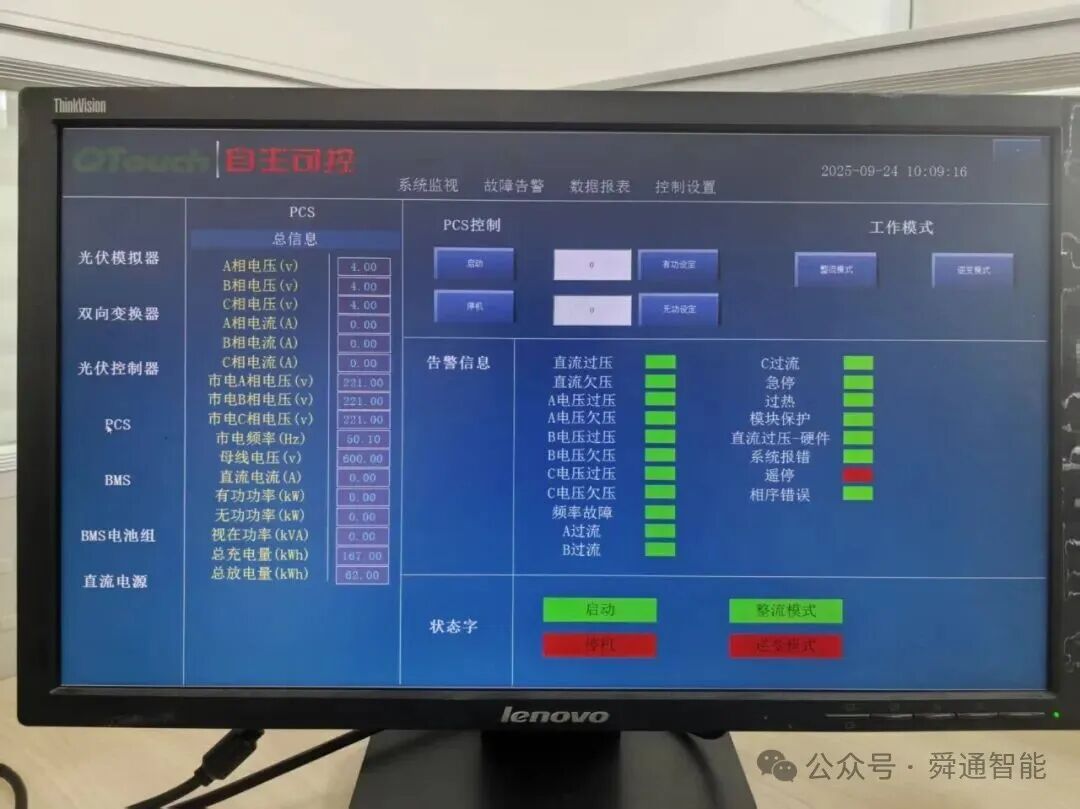
2.PCS interface
Display variable parameters, alarm status and other information, manually adjust active and reactive power output, and switch between grid connected and off grid modes.
3.Photovoltaic controller interface
Display variable parameters, alarm status, and other information, which can be manually adjustedMaximum output voltage and current.
4.Photovoltaic simulator interface
Display variable parameters, alarm status, and other information, which can be manually adjustedSimulate the photovoltaic power generation situation based on the current output voltage and current.

5.Bidirectional converterinterface
displayhigh and low voltageVariable parameters, alarm status and other information,Adjustable charging and discharging.

6. On site equipment assembly screen

4summary
lightStorage coupling simulationThe core advantage of the system is that,No need to rely on actual operational data of photovoltaic power plants,Realize light through digital simulationstoreEfficient management, risk prediction, and value maximization throughout the entire lifecycle of the system are key to enhancing efficiencystoreThe key tool for project operation and maintenance level and economic benefits.
Last Article: Shuntong Cloud Helps Zero Carbon Park Case Study Share
Next Article: Shuntong Energy Custody Product Catalog