09,22,2026 22 views
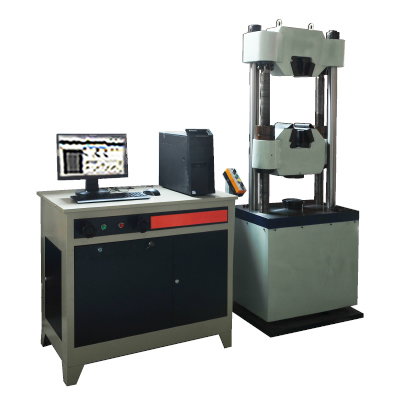
A Hydraulic Universal Testing Machine is a high-performance material testing system used to evaluate the mechanical properties of metals,non-metals,composites,and structural components.By combining hydraulic power with electronic servo control,it can perform tensile,compression,bending,shear,and other static or quasi-static tests with high stability and repeatability.This makes it especially suitable for laboratories,quality inspection centers,manufacturing plants,and research institutions that require reliable large-force testing.
How It Works
The core principle of a hydraulic universal testing machine is electro-hydraulic servo closed-loop control.An electric motor drives a hydraulic pump to generate high-pressure oil,which then flows through a servo valve into a hydraulic cylinder.The cylinder converts hydraulic energy into linear mechanical motion,driving the crosshead to apply controlled force to the test specimen.
During testing,sensors continuously measure force,displacement,and deformation.These signals are fed back to the controller,which compares them with the preset test parameters and adjusts the servo valve in real time.This closed-loop process ensures accurate control of loading speed,force level,and specimen deformation.
Main Components
A typical hydraulic universal testing machine consists of several integrated systems:
Load frame:Usually a four-column or double-screw structure that provides high rigidity and stable loading.
Hydraulic power unit:Supplies clean,stable high-pressure oil to the actuator.
Servo actuator cylinder:Generates tensile or compressive force through piston movement.
Electro-hydraulic servo valve:Precisely regulates oil flow and pressure according to control signals.
Measurement system:Includes load cells,displacement sensors,and extensometers.
Control software:Manages test setup,data acquisition,curve display,result analysis,and report generation.
Key Testing Capabilities
Hydraulic universal testing machines are called“universal”because they can handle multiple test types with appropriate fixtures and software settings.Common applications include:
Tensile testing:Measuring yield strength,tensile strength,elongation,and elastic modulus.
Compression testing:Evaluating compressive strength and deformation behavior.
Bending/flexural testing:Determining flexural strength and bending modulus.
Shear testing:Assessing shear resistance of metals,fasteners,and joints.
Special tests:Some systems can also support peel,tear,creep,and low-cycle fatigue tests when properly configured.
Typical Applications
These machines are widely used across many industries:
Metals and alloys:Steel bars,aluminum alloys,copper wires,bolts,pipes,plates,and castings.
Construction materials:Rebar,concrete specimens,cement mortar,and structural components.
Automotive and aerospace:High-strength metals,fasteners,composites,and structural parts.
Plastics,rubber,and composites:Engineering plastics,rubber seals,fiber-reinforced materials,and laminates.
Research and education:Material development,failure analysis,and mechanical property studies.
Why Choose a Hydraulic Universal Testing Machine?
Compared with purely electronic testing machines,hydraulic universal testing machines offer several advantages for medium-to high-capacity applications:
High load capacity:Suitable for tests ranging from dozens of kilonewtons to several thousand kilonewtons.
Stable loading:Hydraulic drive provides smooth force application,which is beneficial for brittle materials such as concrete and ceramics.
Multiple control modes:Force control,displacement control,and strain control can usually be switched smoothly.
Strong adaptability:With different grips,fixtures,and extensometers,one machine can test various specimen shapes and materials.
Automated data processing:Modern systems can automatically calculate key parameters and generate standardized test reports.

Conclusion
The hydraulic universal testing machine remains one of the most important tools for mechanical property evaluation.Its combination of powerful hydraulic loading,precise servo control,and flexible testing modes allows manufacturers and laboratories to ensure material quality,verify product safety,and support advanced material research.For industries that depend on accurate tensile,compression,and bending data,it provides a reliable foundation for quality control and engineering innovation.