09,22,2026 22 views
The article is provided by Shanghai Litao Automation Technology Co., Ltd
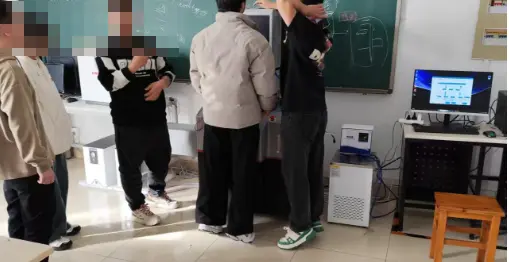
In order to assist in the construction of scientific research capabilities in universities and improve the efficiency of instrument and equipment use, a professional engineering team from Shanghai Litao Technology Co., Ltd. was recently invited by a university in Inner Mongolia to conduct a deep on-site training service on the "Thermal Conductivity and Thermal Diffusion Coefficient Measuring Instrument (Laser Flash Method)" at its campus. This training aims to address the pain points of users in practical operation and scientific research applications, ensuring that the instrument can maximize its value.
List of Core Training Content
This on-site training focused on the four modules of "theory, operation, application, and maintenance", providing systematic and precise explanations and practical operations.
Module 1: Deepening Theoretical Foundations - Understanding Testing Principles
The principle of laser flash method is explained in detail, including the basic physical model, mathematical formulas, and assumptions for measuring thermal diffusion coefficient using laser flash method.
Calculation principle of thermal conductivity: Detailed explanation of how to accurately calculate the thermal conductivity of materials by measuring the thermal diffusion coefficient, combining specific heat capacity and sample density.
Key parameter impact analysis: Analyzed the potential impact of factors such as pulse width, sample thickness, surface state, and heat loss on test results, helping teachers and students establish a scientific concept of error analysis.
Module 2: Practical Skills Enhancement - Mastering Standard Processes
Standard sample preparation specifications: On site demonstrations and guidance were provided on the standard preparation process, size requirements, and coating treatment techniques for different forms (block, sheet, powder, etc.) of samples.
Instrument power on/off and software operation: The system explains the safe start-up and shutdown process of the instrument, as well as the various functions, parameter settings, and establishment of testing sequences of the supporting testing software.
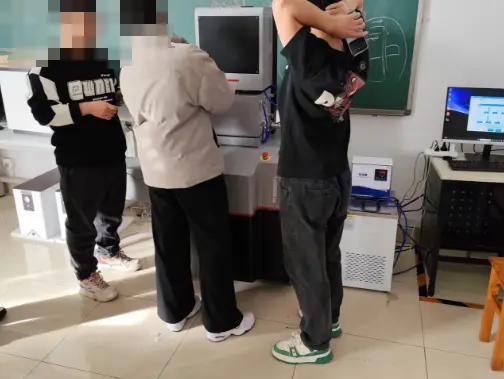
Full testing exercise: From sample loading, parameter setting, data collection to result analysis, led teachers and students to complete a complete testing process, ensuring that each participant could independently get started.
Data processing and report generation: Trained on how to use software for curve fitting, data correction, and generate professional test reports that meet academic publication requirements.
Module 3: Expansion of Scientific Research Applications - Solving Practical Problems
Exploration of Multiple Material Testing Plans: Targeted testing plans and parameter optimization suggestions have been provided for the research fields that the university may be involved in, such as new materials, inorganic non-metallic materials, composite materials, etc.
Common problems and troubleshooting: Summarized possible abnormal curves, data deviations, and other issues that may be encountered in daily use, and taught the system's diagnostic ideas and solutions.
Advanced functions and applications: Introduces the application of the instrument in advanced scientific research scenarios such as temperature testing and anisotropic material testing.
Module 4: Daily Maintenance and Care - Ensuring Long Term Operation of Equipment
Daily maintenance procedures: Clarify daily, weekly, and monthly routine inspection and maintenance items.
Common Fault Warning and Handling: Explained how to identify instrument abnormal states and perform simple fault troubleshooting and handling.
Safety operation specifications: Emphasis is placed on safety precautions such as laser safety and high-temperature operation.
Training value and customer benefits
Through this on-site training, teachers and students from a university in Inner Mongolia not only comprehensively mastered the operating skills of the instrument, but also deeply understood the scientific principles behind it, achieving a leap from "knowing how to use" to "proficient". The specific benefits include:
Improve efficiency: Reduce data bias and experimental failures caused by improper operation, significantly improving research efficiency.
Ensuring data: Ensuring the accuracy, reliability, and repeatability of test results, providing solid data support for high-level paper publication and project completion.
Stimulating Innovation: Expanded the application ideas of instruments in various material research, and stimulated the research and innovation potential of teachers and students.
Reduce risk: By standardizing maintenance knowledge, the service life of the instrument has been extended, and the failure rate and maintenance costs have been reduced.
About Shanghai Litao
Shanghai Litao Technology Co., Ltd. has always been committed to providing customers with high-performance testing instruments and professional and comprehensive after-sales services. We firmly believe that professional training is a crucial component of the value of instruments. The customized on-site training provided to a university in Inner Mongolia once again reflects our concept of "customer first, service first".