-
E-mail
qinsi@139.com
- Phone
-
Address
21st Floor, Building B, Huaqiangbei Metropolis 100, Futian District, Shenzhen, Guangdong Province, China
Product Categories
Shenzhen Futian District Metropolitan Electronic Market Qinsi Electronic Business Department

Authentic QSI lead solder paste
NegotiableUpdate on 02/25
- Model
- Nature of the Manufacturer
- Producers
- Product Category
- Place of Origin
Overview
QS-2881 Non Cleaning Solder Paste Introduction QS-2881 is a non cleaning solder paste designed for today's SMT production
Product Details
detailed information
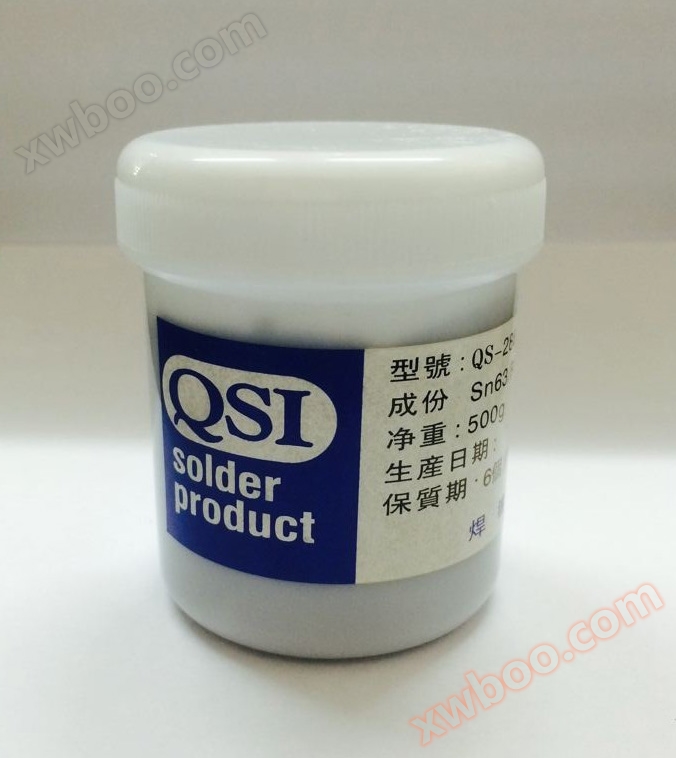
QS-2881 No Cleaning Solder Paste
brief introduction
QS-2881 is a non cleaning solder paste designed for today's SMT production. It uses an artificial rosin, which results in minimal solid residue of the solder paste after reflow. QS-2881 solder paste uses a low ionic halogen activator system. This solder paste is a uniform mixture of non washable flux and solder particles. The flux also contains some additives, such as high boiling point solvents, anti-corrosion agents, and shaking additives, which make QS-2881 meet the ideal characteristics for SMT production.
use
QS-2881 solder paste can be injected using syringe, screen printing, or copper plate printing methods. The following are the commonly used solder paste metal content and viscosity ranges for various methods.
Solder paste coating method, flux content (Wt%), viscosity range (Kcps)
Injection method 13-14 300-500
Screen printing method 11-13 500-780
Copper plate printing method 9-11 780-1400
In the SMT production process, we can choose different proportion alloys based on the electrical characteristics and metal properties of zinc tin dots, and the melting point diagrams of various alloys are available.
Alloy content melting point (℃)
Sn63-Pb37 183
Ag2-Sn62-Pb36 177-189
Bi14-Sn43-Pb43 143-163
For different SMT production, the most suitable solder alloy and particle size can be selected. The melting points of different alloys are shown in the table below. Currently, we use the universal -325/+500 mesh alloy.
QS-2881 solder paste can be welded using almost any reflow equipment, such as oxygen phase method, hot plate method, infrared method, hot air method, and infrared/hot air method, but it is best to use the latter three methods for welding. The following is the recommended reflow heating curve for infrared/hot air soldering of Sn63-Pb37 or Ag2-Sn62-Pb36 tin
Process factors
QS-2881 solder paste is non hydrophilic, insensitive to humidity, and can work at high humidity (relative humidity 80% RH) and room temperature. Here are some process factors we recommend adopting:
A、 Solder paste reheating - Solder paste is usually stored in a refrigerated manner, and the temperature of the solder paste must be brought back to room temperature (approximately 3-6 hours) before use
B、 Printing speed -15-60mm/second
C、 Scraper hardness -80-90 Durometer
D、 Printing Method - Mesh Contact Printing
E、 Parts removal - within 6-10 hours
F、 Working environment - The ideal environment is a temperature between 20 ℃ -25 ℃ and a relative humidity below 75% RH
G、 Reflow temperature curve
Regional temperature range, temperature rise rate, and time
Preheat to room temperature -100 ℃ 0.9-2.5 ℃/s for 30-80 seconds
Soak at 101-180 ℃ 0.4-0.7 ℃/s 2-3 minutes
Reflow 180-230 ℃ 0.75-1.2 ℃/s 50-80 seconds
Storage
Solder paste should be stored in a refrigerated state to extend its storage life. Fresh (unused) solder paste stored at 4-10 ℃ should have a storage period of at least 6 months.
Similar Product Recommend


